
Entertainment
Bitcoin biopic Killing Satoshi leans into generative AI

An upcoming biopic about the mysterious creator of Bitcoin, Satoshi Nakamoto, starring both Casey Affleck and Pete Davidson, is causing controversy for its willingness to use artificial intelligence, not only to generate backgrounds and scene locations but also to adjust actor performances.
The film, Killing Satoshi, will be directed by Doug Liman (The Bourne Identity and 2024’s Road House) but it was producer Ryan Kavanaugh who has been making headlines when he disclosed in a U.K. casting notice that the filmmakers reserve the right to “adjust” actor performances, including the right to “change, add to, take from, translate, reformat or reprocess” those performances, and that the actors themselves will be performing on a “markerless performative capture stage and not in any locations,” according to reporting by Variety.
These revelations come at a time of heightened anxiety and uncertainty in the film and TV industry, particularly around the use of artificial intelligence to augment, or even fully replace, the work of creative professionals. Labor unions, copyright lawyers, and federal courts are scrambling to come to terms with the implications of generative AI’s incredible ability to repurpose existing creative material.
Mashable Light Speed
Consider, for example, this AI-generated encounter between Keanu Reeves’ characters Neo and John Wick and Arnold Schwarzenegger’s iconic Terminator, created using Seedance 2.0, or this AI-generated clip of Jack Black doing a comedic turn as Darth Vader from Star Wars, created using Google’s Veo 4, and you’ll quickly grasp the transformative and disruptive power of these technologies.
In response to the public anxiety around the choice to lean into AI use in the making of Killing Satoshi, producer Ryan Kavanaugh had this to say to Variety:
We were very cautious, sensitive and overly protective of our actors to make sure we only use performance capture AI which means that we will not have any AI-generated actors that do not exist. AI is a tool we’re using to make the filmmaking process more efficient while maintaining all department heads’ jobs, all actor jobs and hopefully helping to grow the industry in a positive way.
Though currently still just in production, Killing Satoshi will be one of the first movies to test these boundaries, so anyone interested in the intersection of AI and creative work should pay close attention to its reception.
Topics
Artificial Intelligence
Film
Entertainment
Starfleet Academy Stops Playing Around With Standout Episode Perfect For Actual Trekkies
By Chris Snellgrove
| Published

Starfleet Academy has proven divisive to fans in large part because it is a strange brew: great actors and top-notch special effects mixed with weird characterization and writing straight out of an early aughts boner comedy. Defenders of the show have maintained that everyone just needs to give the series more time to find its space legs, and the latest episode may have effectively proved them right. “Come, Let’s Away” drops the awkward, forced humor of earlier episodes to deliver a tale full of action, romance, and higher stakes than Starfleet Academy has ever had before.
Part of what makes this particular Starfleet Academy episode so effective is the misdirection baked directly into its plot. “Come, Let’s Away” starts out with scenes of our characters hooking up, and it wisely leverages the solid chemistry between Caleb and Tarima before jumping into the main plot: a joint training exercise where Academy and War College cadets must restart a derelict starship. But when those cadets are kidnapped by killer cannibals, Chancellor Ake must turn to her old nemesis, Nus Braka, for help in saving her students’ lives.
Somehow, Star Trek Returned

For Star Trek fans wanting Starfleet Academy to be more like the Golden Age of Star Trek, this is the episode you’ve been waiting for. First of all, it employs tropes and story beats very familiar to The Next Generation: for example, the cadets having to restart an old starship feels a lot like Riker having to get the USS Hathaway working for war games in “Peak Performance.” Speaking of Number One, “Come, Let’s Away” leans into Caleb and Tarima being the new Riker/Troi by giving them an Imzadi-esque mind link and having their shared romantic connection be a major key to resolving this plot.
While some Star Trek fans have enjoyed the show’s often lowbrow humor, I felt that this Starfleet Academy episode was much stronger for ditching the jokes and giving us an episode that plays out like a tense action thriller. From the moment they are captured, it is clear that our heroes are in mortal danger from bad guys (the Furies) who simply don’t play around. This is made abundantly clear when they partially eat a charismatic War College instructor (!) and then shoot his body out of the airlock to send a message to Starfleet.
The New Big Bad Is Finally Scary

The Furies are so dangerous that Chancellor Ake, at the urging of Admiral Vance, requests the help of Nus Braka, a notorious space pirate who has dealt with these foes before. This is definitely a stronger performance from Paul Giamatti than we saw in the first Starfleet Academy episode, and it helps that he is written much better. While his dialogue still has a few rough edges (like when he describes himself as “wanked” and “spanked”), he mostly comes off as genuinely dangerous, and his weirdly intimate interactions with Ake make him seem less like a Scooby-Doo villain and more like a flamboyant Hannibal Lecter.
Nus Braka is actually the personification of this episode’s greatest strengths: that it’s not afraid to raise the stakes by putting likable characters in mortal danger. In addition to offing the fun new War College instructor (and beware some major spoilers from here on out), they also kill B’avi, arguably the most likable of the War College cadets. Thanks to Nus Braka completely outwitting the Federation, his buddies were able to destroy a Starfleet vessel and ransack a starbase, giving this episode a shockingly high body count.
By Their Powers Combined

“Come, Let’s Away” is a far cry from the more carefree adventures of Starfleet Academy, but the grim subject matter also lends the show something it has desperately needed: some narrative weight. Previously, the show’s constant need to undercut tension robbed various episodes of their power, like filling the big, emotional Sisko episode with jokes about flatulence and genitalia. Also, it was tough to take SAM (a fairly solid character in her own right) very seriously in that Sisko episode because she spent most of her time onscreen talking and acting like a deranged TikTok skit come to life.
But SAM really shines in “Come, Let’s Away,” utilizing her powers in a logical way to restore power to a derelict vessel. Tarima uses her powers in a similarly logical way, and once she fully unleashes her abilities to pop some dude’s heads (Scanners-style!), we see how dangerous a Betazed warrior can be. Caleb also shines, both as Tarima’s partner in telepathic crime and as someone more resourceful than the average member of either the Academy or the War College.
The Ensemble Cast Finally Shines

While the plot involved sidelining some of the main characters (Darem and the Doctor mostly do little more than twiddle their thumbs), this episode of Starfleet Academy did a great job of highlighting most of the ensemble cast. The youngsters got to finally stop being quippy cadets and put their training to use in a life-and-death situation, and they all brought unique strengths to the table while working as a team. In this way, this is probably the most traditional Star Trek episode we have seen so far, and to my surprise, it really left me wanting more.
From the beginning, I have been one of Starfleet Academy’s harshest critics, but it’s not because I want the show to fail; the cast is talented, the SFX are beautiful, and the writers (especially Tawny Newsome) are passionate about the franchise. However, episodes are frequently hampered by bad comedy and low-stakes, teenage drama. To make matters worse, the show occasionally makes huge changes to the lore (like making most Klingons extinct in an offscreen event) that inevitably upset old-school Star Trek fans.
However, “Come, Let’s Away” ditches both the forced comedy and the teen drama, and we get to see these young characters deal with the most Star Trek situation of them all: an Away Team mission that goes catastrophically wrong. The characters are competent, the stakes are high, and the new villains are generally loathsome, adding to the show’s own lure rather than (ahem) cannibalizing older lore. Speaking of loathsome, Giamatti’s Nus Braka establishes himself as the guy you love to hate, and the combination of his master manipulation and his casual cruelty has made this former joke of a character as chilling as Gul Dukat ever was.
Is The New Star Trek Series Finally Worth Watching?

Only time will tell if Starfleet Academy can keep up the breathtaking momentum of this episode: Vance promises that capturing Braka is now Starfleet’s highest priority, and I can only imagine Chancellor Ake (who was uncharacteristically subdued for most of this episode) is itching for payback. This (plus Tarima being in critical condition) certainly implies that the rest of the season will be relatively serious, which is a relief to fans like me who have hated the hokey humor. Of course, the show has been wildly uneven from the beginning, so we may very well be back to goofy shenanigans in the very next episode.
Optimistically, though, I want to believe that Starfleet Academy writers have successfully pulled the rug on our expectations, pivoting the show from a goofy YA comedy fest to something more in line with the golden age of Star Trek. This would be a great way to thread the needle of appealing to older and younger fans, and it would even match the general arc of most YA stories (which inevitably pit their young protagonists against serious, seemingly unstoppable foes). If (and it’s admittedly a big if) that happens, Starfleet Academy could do what NuTrek has been failing to do for nearly a decade: bring generations of fans together in their love of the greatest sci-fi franchise ever made.

Entertainment
Netflix's Surreal, R-Rated 80s Comedy Is Master Director's Secret Masterpiece
By Robert Scucci
| Published

Whenever I think about movies associated with Martin Scorsese, I immediately think about mobsters and crimelords and nothing else, because that’s what he’s best known for. The first films that come to mind are Goodfellas, The Departed, and Bringing Out the Dead, all excellent movies worth their weight in critical acclaim. At 37 years old, though, I’m just now learning about a subgenre popularized in the 80s known as the Yuppie Nightmare Cycle, which mixes film noir motifs with elements of screwball comedy, as can be seen in 1985’s After Hours.
Written by Joseph Minion and directed by Scorsese, After Hours is my official introduction to the subgenre in my own headcanon, though I’m sure I’ve seen movies that fall into this wheelhouse before becoming familiar with the term. What can I say? I’m only human, I go on too many cinematic side quests, and as a result I have blind spots. You don’t know what you don’t know, but now that I do know, I need more of what films like After Hours have to offer because it contains just about everything I’m looking for in a movie.
A Fugue State Of Terrible Decisions

After Hours earns its keep by continually escalating its premise to increasingly absurd extremes. We’re introduced to Paul Hackett (Griffin Dunne), a white-collar word processor working in New York City. He’s conventionally handsome, professionally respected, has a nice apartment, and dresses well. Despite all of this, he lives alone and leads a seemingly hollow life.
While grabbing a bite at a café one night, Paul bonds over the book he’s reading, Tropic of Cancer by Henry Miller, with Marcy Franklin (Rosanna Arquette). She briefly talks about herself and her roommate, Kiki (Linda Fiorentino), a sculptor whose claim to fame is making papier-mâché paperweights shaped like bagels. Feigning interest in these sculptures so he can go back to her place, presumably to hook up, Paul gets Marcy’s phone number and the address she shares with Kiki.

From this point forward in After Hours, Paul’s life takes a turn for the worse in increasingly ridiculous fashion. He loses the only $20 he has on him when his speed-demon taxi driver causes it to blow out the window. Kiki comes onto him after asking for help with a giant sculpture of a screaming man. Marcy grows more unstable the longer he’s around her. Paul leaves the apartment fully intending to go home, but his standard 9 to 5 existence hasn’t prepared him for the fact that subway fare jumps at midnight, and the pocket change he has on hand isn’t enough to cover it.
Far from home, broke, and stuck in the rain, Paul relies on the kindness of strangers to get back to his apartment. This proves to be a misguided approach because every step forward shoves him two steps back, and the people he runs into only make matters worse. Marcy commits suicide in his absence, and the owner of the bar where he seeks shelter, Tom (John Heard), who is her boyfriend, receives the phone call informing him of her death.

Paul, who previously exchanged his own apartment keys for Tom’s as a sign of good faith so he could grab money from the register to afford subway fare, is mistakenly identified as the burglar who’s been terrorizing the neighborhood. A mob forms with every intention of either turning him over to the authorities or killing him. It goes on like this for 90 relentless minutes, so I’ll spare you the granular details.
Can’t Live With ‘Em …
Throughout Paul’s journey in After Hours, he runs into woman after woman who make aggressive advances toward him, often emasculating him in the process, then spiraling when they realize he’s not interested and just wants to get home. From perfect stranger Marcy, to sculptor Kiki, to bartender Julie (Teri Garr), to Mr. Softee driver Gail (Catherine O’Hara), to June (Verna Bloom), who is also a sculptor, Paul keeps sprinting toward bad luck in the form of unwanted female companionship as if it were his true calling. The humor comes from the irony of it all, as Paul’s only reason for venturing out in the first place was to meet a woman with the hopes of taking her out on a date.

After Hours is equal parts neo-noir and slapstick comedy, and it’s impossible to watch without feeling absolutely exhausted on Paul’s behalf. Griffin Dunne’s facial expressions, spanning deadpan dread, astonishment, and pure bewilderment, make this an entertaining outing from start to finish because of how fully he commits to the premise. If you’re in the mood for the worst night out imaginable and want to experience it by laughing at someone else’s expense, you can stream After Hours on Netflix as of this writing.

Entertainment
Starfleet Academy Is Secretly The Least Diverse Star Trek Show
By Chris Snellgrove
| Published
Starfleet Academy is the latest Star Trek show, and one of its big hallmarks is diversity. This includes showcasing characters from very different backgrounds (a human thief, a childlike hologram, an empathic princess, a pacifist Klingon, etc), complete with a wide range of sexualities (gay, straight, and bi? Oh my!). There is even diversity in age: the show focuses on both young characters and their older instructors, and Chancellor Ake alone has a few centuries on her young students.
However, calling itself diverse is a lie. Starfleet Academy is secretly the least diverse Star Trek series ever made. That’s because it has one flaw that effectively cancels out all of the diversity of its character backgrounds and sexualities. Namely, that every single alien character is written like a boring old human being.
The Oldest Trope In Star Trek

Since the days of The Original Series, Star Trek has had an unofficial rule: each show must include an outsider alien character who helps the audience learn more about their own humanity. Spock’s emotionless Vulcan ways contrasted with McCoy’s fiery passion, for example, and Spock ultimately sacrificed his life after learning the value of Kirk’s relentless drive (there’s no such thing as a no-win scenario). After Spock died foiling the ultimate no-win scenario, Kirk declared, “Of all the souls I’ve encountered, his was the most human.”
This wasn’t literally true, of course: not only did Spock remain fully green-blooded, but his decision to save the ship was rooted in his flawless Vulcan logic (the needs of the many outweigh the needs of the one). But his death helped Kirk to find joy in life and rededicate himself to new beginnings. In this way, Spock began the oldest trope in Star Trek: the outsider alien helping others learn more about their own humanity.
Trek Trope: The Next Generation
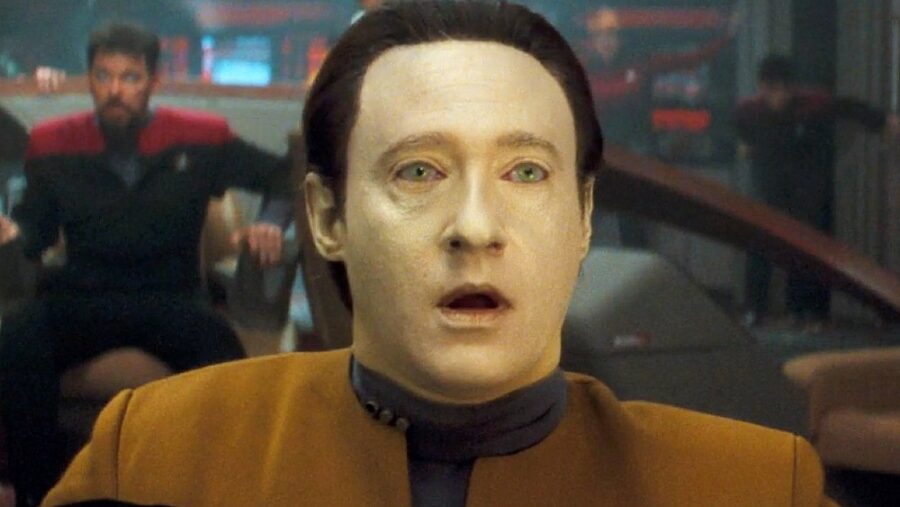
Later Star Trek shows embraced this trope to great effect: on The Next Generation, the android Data dreamed of becoming more human, and his quest helped everyone learn more about the power and promise of their own human journey. On Deep Space Nine, Odo was a Changeling who could never master looking like a solid, but his efforts to understand everyone else helped everyone gain new perspectives on what they took for granted. Neelix helped Voyager’s human crew discover joy in the small things, while T’Pol helped the humans of the Enterprise crew learn from their species’ mistakes as they began exploring strange, new worlds for the first time.
NuTrek has dabbled in this trope: on Discovery, Saru teaches the crew how to adapt to any situation, and Michael Burnham’s Vulcan upbringing helped her discover (for better or for worse) the importance of her emotions. Picard also dabbled in different alien outsiders, ranging from the android Soji to her positronic papa, Data. The return of Data hailed the return of TNG’s beloved alien outsider, and Strange New Worlds brought things full circle by putting Spock front and center.
Starfleet Academy Is Too Human For Its Own Good

Starfleet Academy is often praised for its diversity, and the cast of characters is truly unlike anything we have previously seen in other Star Trek series. Fully eight of the show’s 12 main characters are aliens, and over half of them are women. The show also puts men and women of color front and center: holographic SAM is the show’s biggest link between both Voyager and Deep Space Nine, and Jay-Den Kraag is showing us a strange new world of Klingon culture. Caleb, meanwhile, is the show’s de facto main character, and he often bridges the gap between the more dramatic and comedic elements of the show.
However, once you get past the diverse character archetypes and occasional forehead loaf, a surprising truth emerges: pretty much all the alien characters are written to be human. Darem is meant to be an exotic alien (he’s Khionian, b*tch!), but he is simply written as a cocky human, which is why he and would-be Alpha Caleb are constantly butting heads. SAM is an emissary from a holographic race who knows nothing about humanity, but she is constantly and inexplicably written as a teenage human.
The same goes for Genesis, an alien who is so human that she likes to chew bubblegum and wax philosophic about Daddy issues. Chancellor Ake is a Lanthanite who is nearly half a millennium old, but she is virtually indistinguishable from a quirky wine mom. On paper, the Klingon Jay-Den would be the most alien of them all because he hails from a warrior race, but in making him a softspoken, quippy pacifist making moony eyes at his crush, Starfleet Academy has made him the most human Klingon we’ve ever seen (yes, even more than Alexander).
They’re Only Human

Making all these aliens effectively human is by design, of course: Starfleet Academy is designed to appeal to young audiences, so this is a way of ensuring that these young characters are relatable despite their alien heritage. No matter what exotic planet they hail from, all of these 32nd-century cadets utilize slang and references very familiar to 21st-century youngsters. In this way, Paramount hopes to retain the old guard of Star Trek fans while appealing to Zoomers and even Generation Alpha.
Time will tell if Starfleet Academy manages to secure the (ahem) “next generation” of Star Trek fans, but they are already alienating older fans through (ironically enough) the lack of truly alien characters. There is no alien outsider to help characters and viewers appreciate their own humanity; instead, every alien is written as a human with a chip on their shoulder and a mouth like a sailor. Sure, this makes the latest Star Trek series feel like other popular drama series, but it also dilutes the new show by removing one of the franchise’s most distinctive sci-fi elements.
When Is A Star Trek Show Not Actually A Star Trek Show?
That leads to some downright philosophical questions, like “When is a Star Trek show not actually a Star Trek show?” Paramount is gambling that stripping the franchise of everything familiar in the name of mass appeal is the only way forward, but it’s an approach that has been driving away legacy fans in droves. Now, the studio is about learn the answer to “when is a Star Trek fan no longer a Star Trek fan?”
Simple: when they unsubscribe from Paramount+, the worst streaming platform the galaxy has ever known.

Starfleet Academy Stops Playing Around With Standout Episode Perfect For Actual Trekkies
Hollywood isn’t happy about the new Seedance 2.0 video generator


