
Tech
Avalanche thinks the fusion power industry should think smaller
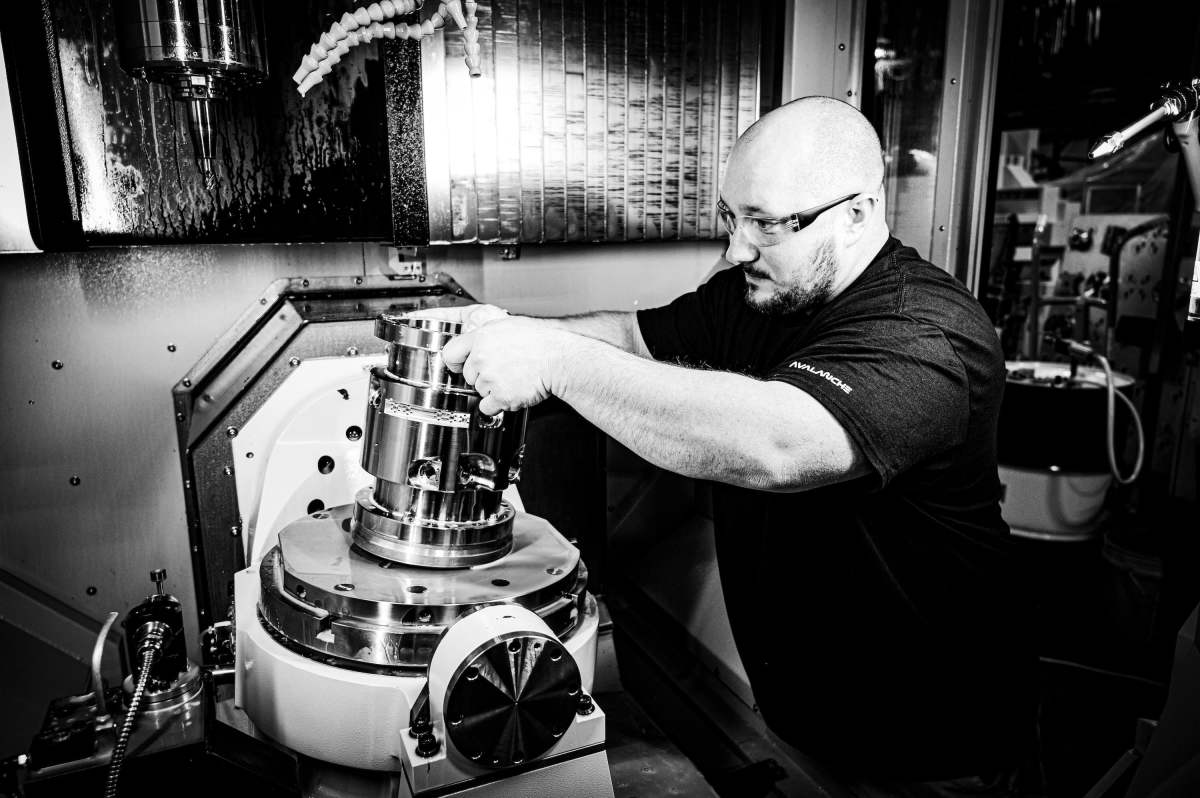
Nuclear fusion conjures images of massive reactors or banks of dozens of large lasers. Avalanche co-founder and CEO Robin Langtry thinks smaller is better.
For the last several years, Langtry and his colleagues at Avalanche have been working on what’s essentially a desktop version of nuclear fusion. “We’re using the small size to learn quickly and iterate quickly,” Langtry told TechCrunch.
Fusion power promises to supply the world with large amounts of clean heat and electricity, if researchers and engineers can solve some vexing challenges. At its core, fusion power seeks to harness the power of the Sun. To do that, fusion startups must figure out how to heat and compress plasma for long enough that atoms inside the mix fuse, releasing energy in the process.
Fusion is a famously unforgiving industry. The physics is challenging, the materials science is cutting edge, and the power requirements can be gargantuan. Parts need to be machined with precision, and the scale is usually so large as to obviate rapid fire experimentation.
Some companies like Commonwealth Fusion Systems (CFS) are using large magnets to contain the plasma in a doughnut-like tokamak, others are compressing fuel pellets by shooting them with powerful lasers. Avalanche, though, uses electric current at extremely high voltages to draw plasma particles into an orbit around an electrode. (It also uses some magnets to keep things orderly, though they’re not nearly as powerful as a tokamak’s.) As the orbit tightens and the plasmas speed up, the particles begin to smash into each other and fuse.
The approach has won over some investors. Avalanche recently added another $29 million in an investment round led by R.A. Capital Management with participation from 8090 Ventures, Congruent Ventures, Founders Fund, Lowercarbon Capital, Overlay Capital, and Toyota Ventures. To date, the company has raised $80 million from investors, a relatively small amount in the fusion world. Other companies have raised several hundred to a few billion dollars.
Space-based inspiration
Langtry’s time at the Jeff Bezos-backed space tech company Blue Origin influenced how Avalanche is tackling the problem.
Techcrunch event
Boston, MA
|
June 23, 2026
“We’ve figured out that using this sort of SpaceX ‘new space’ approach is that you can iterate really quickly, you can learn really quickly, and you can solve some of these challenges.” said Langtry, who worked with co-founder Brian Riordan at Blue Origin.
Going smaller allowed Avalanche to speed up. The company has been testing changes to its devices “sometimes twice a week,” something that would be challenging and costly with a large device.
Currently, Avalanche’s reactor is only nine centimeters in diameter, though Langtry said a new version grow to 25 centimeters and is expected to produce about 1 megawatt. That, he said, “is going to give us a significant bump in confinement time, and that’s how we’re actually going to get plasmas that have a chance of being Q>1.” (In fusion, Q refers to the ratio of power in to power out. When it’s greater than one, the fusion device is said to be past the breakeven point.)
Those experiments will be carried out at Avalanche’s FusionWERX, a commercial testing facility the company also rents out to competitors. By 2027, the site will be licensed to handle tritium, an isotope of hydrogen that’s used as fuel and is crucial to many fusion startup’s plans for producing power for the grid.
Langtry wouldn’t commit to a date when he hopes Avalanche will be able to generate more power than its fusion devices consume, a key milestone in the industry. But he’s thinks the company is on a similar timeline as competitors like CFS and the Sam Altman-backed Helion. “I think there’s going to be a lot of really exciting things happening in fusion in 2027 to 2029,” he said.
Tech
Doss raises $55M for AI inventory management that plugs into ERP

Enterprise resource planning (ERP) systems are often described as a company’s “central brain” because the software connects different departments — including finance, HR, and inventory — into a single database where everyone shares the same information.
In recent years, a new crop of AI-powered ERP startups, such as Rillet and Campfire, has emerged hoping to replace legacy offerings like NetSuite. These companies claim that traditional ERPs are clunky, expensive, and time-consuming to implement.
However, according to Doss co-founder and CEO Wiley Jones, many new AI ERPs lack robust inventory management, the process of ensuring that the data on physical goods remains synced with the accounting ledger.
Doss claims to solve this by providing an AI-native inventory management layer that integrates with existing accounting systems, whether traditional ERPs or ones built by AI-based startups.
On Tuesday, Doss announced that it raised a $55 million Series B co-led by Madrona and Premji Invest, with participation from Intuit Ventures. Other new and existing inventors in the round include Theory Ventures, General Catalyst, Contrary Capital, and Greyhound Capital.
Doss, founded in 2022, originally focused on a core accounting product similar to those offered by AI-native startups like Rillet and Campfire. But last year, the startup decided instead of competing with these companies, “we would rather partner with them, and play a different game,” Jones told TechCrunch.
Jones explained that AI-native ERP companies manage accounts receivable, accounts payable, and other finance functions, but most don’t offer procurement and inventory management that integrates with accounting workflows.
Techcrunch event
San Francisco, CA
|
October 13-15, 2026
“We’re building a lot of the traceability for the supply chain, but through the lens of plugging into a finance and accounting partner,” Jones said.
The company’s main partners include Rillet and Campfire. Many clients also use Doss in conjuction with Intuit’s QuickBooks.
“The reason that they work with us is that [physical goods management] is not something that they’re likely going to build as a core competency without putting in a lot of energy and effort,” Jones said.
Doss’ core customer base consists of mid-market consumer brands, typically generating between $20 million and $250 million in top-line revenue. One such customer is Verve Coffee Roasters, a high-end specialty coffee brand.
The startup sees itself as competing with traditional ERPs. But these players are not sitting ideal in the age of AI, either. NetSuite, for instance, has recently introduced its updated AI ERP. It also competes with other agentic procurement startups such as Didero.
While Jones admits that selling two ERP systems, one for accounting and another for inventory management like Doss, “is a hard sell,” he says that legacy ERPs are so hard to implement that many customers are choosing to have two newer, AI-powered systems.
“I think it’s going to be a very intense fight inside of mid-market that ultimately will be determined by whoever rebuilds their architecture to be most legible and usable for agents,” Jones said.
Editor’s Note: The story corrected the list of Doss’ partners.
Tech
Crunchyroll confirms data breach after hacker claims unauthorized access
Anime streaming service Crunchyroll has confirmed a data breach involving customer service ticket information following an incident with a third-party vendor, after a hacker claimed to have accessed user data and internal systems.
The streaming site, which Sony acquired from AT&T in 2020 for $1.18 billion, operates as a joint venture between U.S.-based Sony Pictures Entertainment and Japan-based Aniplex. Crunchyroll has more than 2,000 titles in over 12 languages and serves 15 million subscribers worldwide, per its website.
Reports of a threat actor claiming access to Crunchyroll user data surfaced online this week, with a hacker alleging that they obtained data about millions of users.
Crunchyroll said it is investigating the claims.
“Our investigation is ongoing, and we continue to work with leading cybersecurity experts,” the company said in a statement to TechCrunch, adding that it has not identified evidence of ongoing unauthorized access.
Separately, materials shared with TechCrunch by a cybersecurity-focused account, International Cyber Digest, indicate the attacker may have gained access to Crunchyroll’s Zendesk support system. Screenshots we have seen appear to show the company’s internal Slack messages and stolen support data, apparently stolen by hacking an employee at Telus Digital, an outsourcing giant that handles customer support for Crunchyroll. The hacker allegedly stole customer support ticket data until early 2025, at which point their access was revoked.
The cybersecurity account said the hack was separate from a recent breach affecting Telus Digital, which the company confirmed last week.
Crunchyroll did not respond to a follow-up question about whether the third-party vendor relates to its support partner, Telus Digital.
Telus Digital did not respond to requests for comments.
The hacker told BleepingComputer they had downloaded about eight million support ticket records from Crunchyroll’s systems, including roughly 6.8 million unique email addresses, though the claims have not been independently verified. The hacker also told the publication they gained access on March 12 after compromising an Okta single sign-on account belonging to a Crunchyroll support agent.
Tech
BKR Capital raises $14.5M (so far) to invest in Black founders
Canada’s BKR Capital announced Monday that its Fund II has closed CA$20 million (around $14.5 million), bringing it closer to its CA$50 million target.
This fund is looking to back “high-growth technology companies led by founders from the Black community, building solutions for the future of work, living, and global connectivity,” managing partner Lise Birikundavyi told TechCrunch. The firm is mainly looking at Canada but is open to backing select companies globally. The average check size will be between $250,000 and $1.5 million, she said.
Birikundavyi said that almost 70% of the Black population in Canada is first- or second-generation immigrants, “resulting in founders who build globally from day one, unlocking early access to international markets and creating a structural advantage in scaling.”
Though many U.S. firms have shied away from openly advertising a mission that could be perceived as diversity, equity, and inclusion (DEI), Birikundavyi said her Toronto-based fund doesn’t share those exact fears. What’s happening in Canada is less of a DEI rollback and more of a reframing, she said, where investors are “prioritizing discussion on performance,” even though “the underlying opportunity remains unchanged.”
She added, “Expanding access to overlooked founders continues to surface high-quality deals, making this less about DEI and more about arbitrage investing.” She believes investors in Canada still see “inclusive investment” as good for the ecosystem and full of potentially lucrative business opportunities.
The firm’s thesis is rooted in the belief that “overlooked markets and diverse lived experiences can unlock outsized venture opportunities,” Birikundavyi said. The firm launched in 2021 and raised $22 million for its Fund I (which Birikundavyi said is performing better than at least 75% of the other funds launched around the same time). She said BKR Capital hopes to make its final close for Fund II in December and invest in 25 companies.
Techcrunch event
San Francisco, CA
|
October 13-15, 2026

French superstar Antoine Griezmann joins Orlando City
Kylian Mbappe: Knee is 100%, 'false things were said'


