
Entertainment
Astronaut Mom Calls Home From Space For The First Time
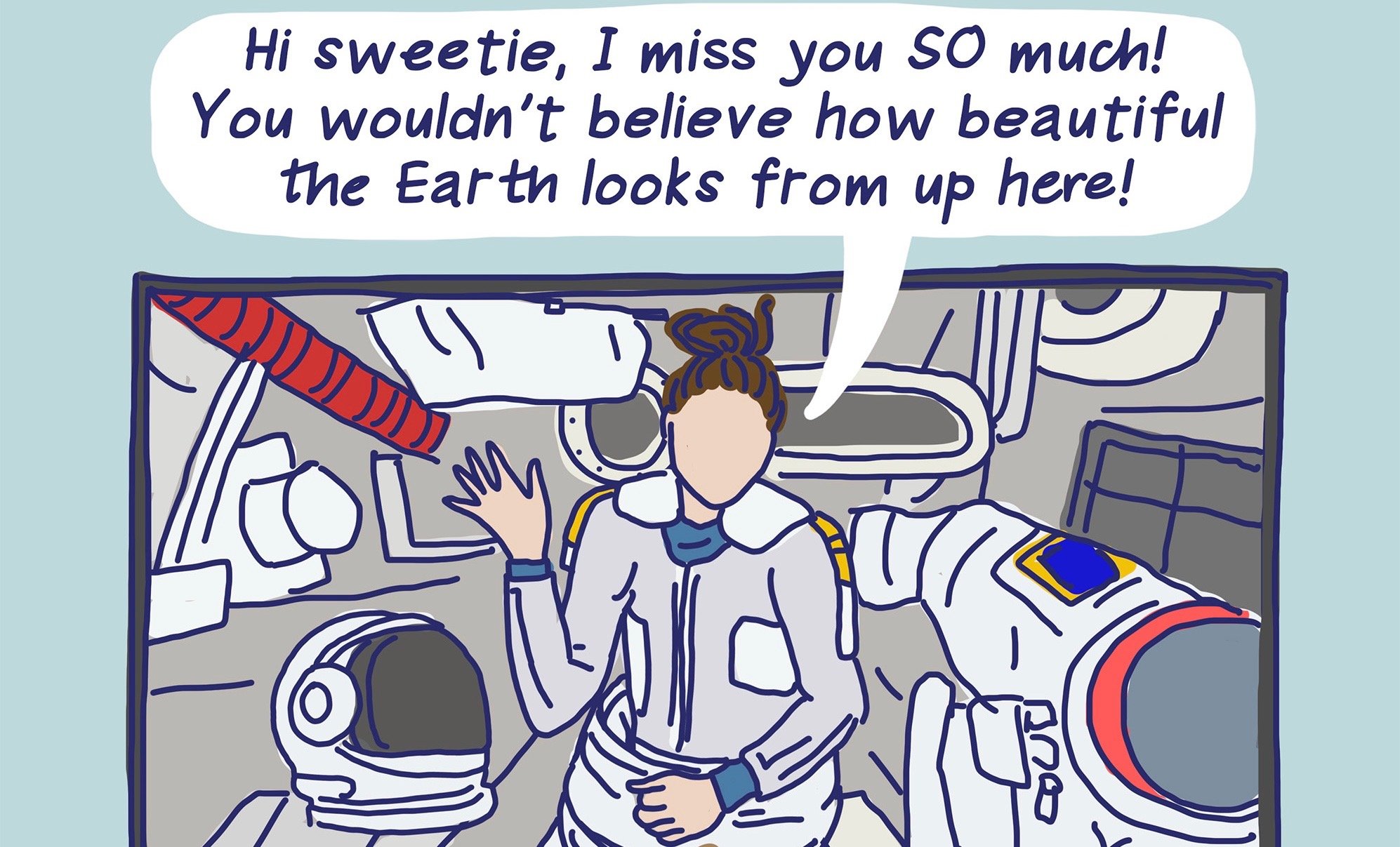
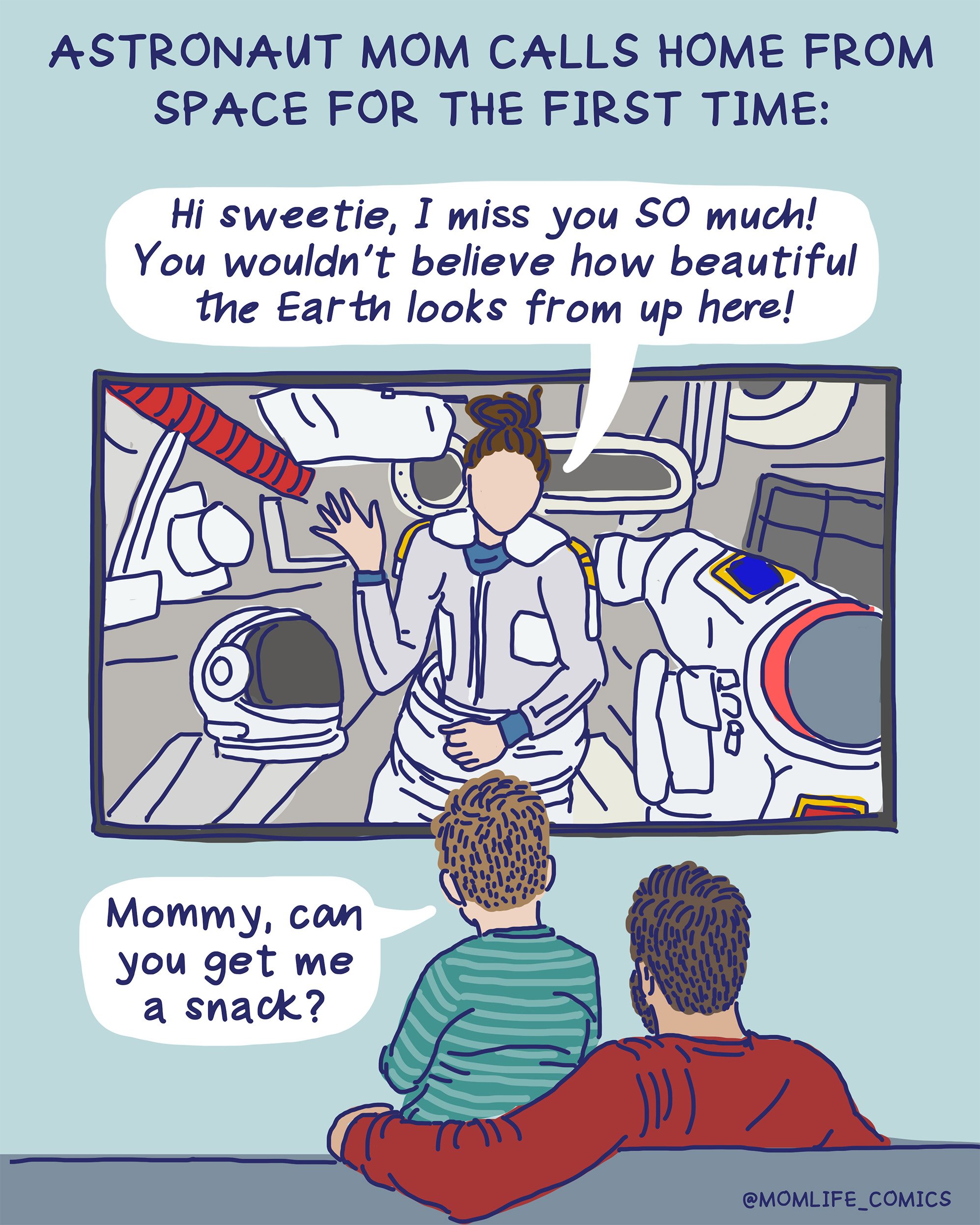
Classic. By the wonderful Mary Catherine Starr.
P.S. A viral comic about parenting double standards and kids in conversation.… Read more
The post Astronaut Mom Calls Home From Space For The First Time appeared first on Cup of Jo.
Entertainment
Free iPhone deal: T-Mobile is giving away the Apple iPhone 17 for free — how to qualify

TL;DR: The iPhone 17 and iPhone 17 Pro are available for free right now with T-Mobile. Here’s how to qualify for this limited-time offer.
Free when you trade in your eligible phone on an Experience More or Experience Beyond plan..
Free when you switch to T-Mobile and bring your number on an Experience Beyond plan.
Samsung has been the center of attention this week, and that’s totally fair. It’s not every week that a major brand drops three new foldables smartphones, two smartwatches, and smart glasses. But can we hold some space for Apple?
Apple prices are bumping in the face of RAMageddon, but you can still secure a special offer on iPhones from T-Mobile. This popular mobile carrier has just dropped a fresh batch of free iPhone deals on the latest handsets:
-
Apple iPhone 17 — free when you trade in your eligible phone on an Experience More or Experience Beyond plan.
-
Apple iPhone 17 Pro — free when you switch to T-Mobile and bring your number on an Experience Beyond plan (no trade-in needed).
Needless to say, T-Mobile isn’t handing over a new iPhone without some strings attached. The retail cost of your new phone is offset by 24 consecutive monthly bill credits. Your monthly statement will show a standard charge for financing the phone, which is immediately balanced out by an equal credit.
What exactly does this mean? You’re signing up for a 24-month commitment with the network, and any unpaid balance on the phone’s retail value will become due immediately if you decide to cancel your service, switch to another carrier, or upgrade to the iPhone 18 before the end of your deal.
You will also need to pay standard upfront taxes and a one-time $35 activation fee, but that’s a small price to pay for the latest iPhone.
Mashable Deals
We get that at this point, it’s tempting to wait for the next batch of iPhones to be announced. According to our rumor tracker, Apple is “widely expected to launch a new lineup of iPhones later this year, including the iPhone 18 Pro, 18 Pro Max, and the rumored iPhone Ultra, the company’s first-ever foldable.” That’s exciting news for iPhone fanatics, but with prices on the rise, this could be the last example of mobile carriers offering new phones for free.
Get the Apple iPhone 17 for free this weekend with T-Mobile.
Entertainment
Star Trek Just Proposed Nuking Migrants To Solve Mass Migration Problems
By Joshua Tyler
| Updated

Star Trek: Strange New Worlds beamed in for a fourth season this week, and avoided the jokey premises that hamstrung the previous season, for at least one episode. Instead, in this first episode titled “Valles Marineris,” it took on the hot topic of mass migration by sending the Enterprise back in time to deal with the consequences of an invasive species sucking up resources.
The Enterprise arrives 65 million years in the past to find an extra planet in our solar system. It’s ruled by a race of intelligent insects who use mass migration to invade planets. That extra planet and its inhabitants aren’t the only surprise. The planet Mars is not a dead world in the past. It’s vibrant, alive, and run by technologically advanced Martians.

Meanwhile, Earth is still a place of volcanoes and dinosaurs. At one point, the Enterprise’s genetically enhanced security chief saves the day by punching a velociraptor.
The insectoids intentionally crashed a ship into Mars and “fed” on their world. Then the Martian commander hammers the situation home by saying, “That’s why your discussions of cultures, of science, although kind and hopeful, are not relevant.”
When Pike says, “There may be other ways to deal with them,” the Martian commander responds by pointing out that many thought the same on her world. “As they talked, we died,” she says. The Martians were only able to stop the insects by ripping a hole in their own planet, killing all the invading settlers and also two million of their own people.

On Earth, Enterprise’s crew discovers a crashed insectoid colony ship. Everyone aboard was killed, but our heroes learn the insects were trying to land and feed on Earth, presumably to do the same thing they did to Mars. The Enterprise away team voices sympathy for the dead creatures, with Lieutenant Ortegas voicing, “They may be different from us, but they wanted to survive too.” Meanwhile, Lieutenant Commander Noonien-Singh acknowledges the reality of the situation, “If they were settlers, I’m not sure if I should feel sad or relieved.”
Captain Pike quickly realizes the truth. If this insectoid race is allowed to send “settlers” to Earth, humanity’s future home planet, they’ll suck up all the resources and wipe out our entire future. To save the human race from dangerous mass migration, Pike allows the Martians to blow up the insectoid planet and genocide the race of resource-consuming migrants.

The parallels to the real world are hard to miss. The episode goes out of its way to portray the insectoids not so much as invading armies but as migrants whose unwanted arrival consumes resources. The Martians deliberately refer to them as feeding on their planet, to hit home the point that the main issue is their resource consumption. The crashed ship on Earth is referred to as a ship of settlers, not soldiers.
Mars has already been devastated by the process, and Earth is next. Stripped of the science-fiction setting, the episode clearly explores questions of mass migration, resource competition, demographic change, and whether a civilization has the right to prevent an influx it believes threatens its long-term survival.
“Valles Marineris” was written by Akiva Goldsman and Henry Alonso Myers. It’s worth noting that Myers wrote some of the best and most thoughtful episodes in the show’s first season and none of the worst episodes of its subsequent seasons. He was also a driving force behind the gone-but-not-forgotten spy series Chuck from the 2010s and the 2016 show The Magicians.

In telling this story, Strange New Worlds did what Star Trek has always done, and what the best science fiction usually does, by engaging with a real-world problem and clearly restating it in a way that lets the audience reason out the best response.
Reasoncraft Is Honest Persuasion
This approach, while persuasive, is not propaganda, which is dishonest persuasion done through manipulation. There’s nothing dishonest in what Strange New Worlds is doing. It’s persuasion through logical thinking. There’s never really been a clear word for this type of up-front screenwashing before, so I’ve come up with one.
This is Reasoncraft. Reasoncraft is persuasion through openly stated reasons and honest exploration, rather than manipulation.

Even at its lowest point, Star Trek has always stuck with reasoncraft as its form of persuasion. It’s fundamental to the franchise, and it’s part of why shows like Starfleet Academy are so bad.
Reasoncraft Results In Bad Writing For Bad Ideas, And Good Writing For Good Ideas
When a piece of entertainment uses reasoncraft to make good arguments, the result is often good writing. When reasoncraft is used to make bad arguments, the result is bad writing that makes no sense.
This turned Starfleet Academy into one of the worst shows in television history. It’s also why the previous Strange New Worlds season was so reviled. The stories they told in season 3 were nonsense because the arguments they were making were also nonsense. This season 4 episode of Strange New Worlds, while not perfect, is at least a step up from those season 3 lows. It’s a step up because it takes on hard questions, considers them honestly, and then follows those honest answers to their logical, unflinching conclusion.

Reasoncraft is also why a show like Star Trek: Deep Space Nine is so good. Because when that series tackled a complex issue and used reasoncraft, they followed it through to its logical conclusion, even if that conclusion didn’t always fit with their personal ideology. That willingness to follow the story where reason takes it, even if that conflicts with the beliefs of the show’s writers, is something modern Star Trek has often been unwilling to do.
It’s why people with bad ideas resort to propaganda. Dishonesty is the only way to screenwash others into believing something stupid without also creating an entertainment product that plays out like something written on the side of a bathtub with a water crayon.
Entertainment
How A 2010s Sci-Fi Stunner Was Kneecapped By Tom Cruise Success
By Joshua Tyler & Chris Snellgrove | Published

There are plenty of post-apocalyptic movies out there, but most of them share the same problem: by the end, you feel just as hopelessly miserable as the characters onscreen. Far too many directors think the key to this genre is simply to give us scene after scene of bleak despair.
What audiences really want is a movie that uses a fictional future apocalypse as a lens to help us understand our present day. In 2013, one sci-fi movie tried to do exactly that, and it enlisted the biggest movie star in Hollywood history to make it happen.
It was directed by a man who is currently the hottest filmmaker in Hollywood, responsible for much of two of the industry’s most recent, big-money hits. The elements were there to make this an all-time great sci-fi movie, and nothing like that happened at all.
This is why Oblivion failed.
A Tom Cruise Movie Starring Tom Cruise

Tom Cruise stars in Oblivion as Jack Harper, a technician repairman of drones on Earth who begins to question his mission when he encounters a spaceship crash that throws his world upside down. It’s 2077, and Earth has been devastated by a war with an alien enemy known as the Scavs. Humanity won the war, but the planet was left mostly uninhabitable. Most survivors have relocated to Saturn’s moon Titan, while Jack Harper and his communications partner Victoria, played by Andrea Riseborough, remain stationed on Earth to maintain the drones protecting massive machines that harvest the planet’s remaining resources.
Jack’s memory has been wiped for security reasons, but he is troubled by recurring dreams of a woman he does not know. While investigating a crashed spacecraft, Jack discovers that the woman from his dreams is Julia, played by Olga Kurylenko, an astronaut who has been in suspended animation since before the war. Her arrival causes Jack to question everything he has been told about the Scavs, the mission, and his own identity.

When he made Oblivion, director Joseph Kosinski was coming off the modest success of Tron: Legacy, a movie that nearly everyone agreed worked only because of his visionary directing. He used the goodwill he’d built up there to get funding for a movie based on a concept he’d written out as a pseudo-graphic novel, called Oblivion.
The work was a preview/pitch booklet with text and concept art. Kosinski had it handed out to attendees at the San Diego Comic-Con. That booklet ended up in the hands of Tom Cruise and got his attention. Cruise called Kosinski, and with Tom Cruise on board, getting funding became easy.

Karl Gajdusek developed that pitch into a screenplay for the big screen, and then Michael Arndt was tasked with revising some of Kosinski’s and Gajdusek’s writing, using the pseudonym of “Michael deBruyn” as his writing credit for the film. William Monahan also got involved at some point, making his own changes to the script. If you’ve followed along with our Why It Failed series before, you should know that this much writing and rewriting is already a bad sign.
Disney stepped up to make the movie, inspired by Kosinski’s Tron: Legacy success, but then bailed when they wanted something closer to a PG version, even though the material worked better as a harder PG-13 post-apocalyptic action film. Universal, which had already been interested, ended up taking it on.
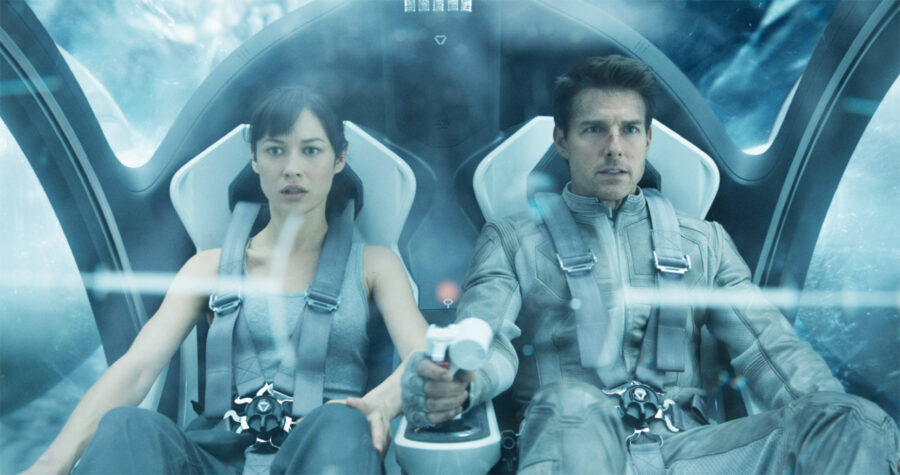
Olga Kurylenko came in alongside Jessica Chastain, Olivia Wilde, and Noomi Rapace to read for the role of Jack’s wife and crew member Julia. Chastain originally won the part and was contracted to start production until she was cast in 2012’s Zero Dark Thirty about the mission to capture and kill Osama bin Laden. Cruise let her out of her contract to do the historically important film, and Kurylenko was cast as Julia in place of Chastain.
The production’s biggest creative decision was that Kosinski did not want the movie to look like a standard green-screen sci-fi film. Coming off Tron: Legacy, he wanted Oblivion to feel more physical, more photographic, and more daylight-driven. He said the visual idea was “beauty in the desolation,” influenced by sci-fi artists Peter Elson and Chris Foss, whose work showed colorful daylight futures rather than only grim wastelands.

Oblivion’s most famous and successful production trick was the Sky Tower. Instead of surrounding the movie’s glass house set with green screen, Kosinski built the set with real glass and surrounded it with a massive 270-degree projected sky. Pixomondo filmed sky footage from Haleakalā in Hawaii, then projected that imagery around the Baton Rouge set. The projection was not just background; it became the main light source for the actors and reflective surfaces.
Because of that, Oblivion looks fantastic. Watching Cruise’s drone repairman blast through the wrecked-up wasteland of a post-alien-invasion New York City on a futuristic dirt bike, past the strewn carcasses of container ships and submarines, is spectacular. When he floats through the ruined world in his bubble ship, the special effects are crisp and clean and blend seamlessly with the frame. They’re so good you don’t notice them.
The entire film reminds you of those IMAX movies you saw as a kid, where a helicopter-mounted camera sweeps around the rim of an active volcano or dives into the Grand Canyon. It’s amazing.
Why Oblivion Failed

Oblivion looks like a huge hit. It wasn’t.
It opened at number one in North America, then faded fast, finishing with about $89 million domestic and $286 million worldwide. That made it respectable, especially overseas, where Cruise still had serious drawing power. But respectable was the ceiling.
Oblivion earned enough to avoid embarrassment, but not enough to be remembered. The movie was forgotten almost the second it left theaters.
Critics were mixed. Reviewers kept circling around the same complaint: Oblivion looked like a major event, but underneath all that polished design it felt assembled from better science fiction movies.

I’m not sure that’s fair. The big twists in the plot may have been done before, but they’re executed in a totally unique way. Oblivion has interesting ideas, interesting ideas worth exploring.
In the end, that was not enough. Oblivion was caught in the worst possible middle ground. It was too expensive and polished to feel like a scrappy original discovery, but too familiar to feel like the next great science fiction event.
The trailers sold mystery, Tom Cruise, and beautiful ruined-Earth imagery, but they never gave audiences a simple emotional hook beyond “Tom Cruise in another futuristic movie.” That mattered because Oblivion arrived only eight years after War of the Worlds and two years after Mission: Impossible – Ghost Protocol, with Cruise still viewed by many casual moviegoers more as a brand than a character actor.
The movie also arrived when people were kind of burnt out on last man on Earth stories. They’d already seen WALL-E, Moon, The Matrix, and others.
Oblivion was good-looking, competent, and easy to admire, but it did not give people enough reason to insist everyone else see it.
Overshadowed By Edge Of Tomorrow
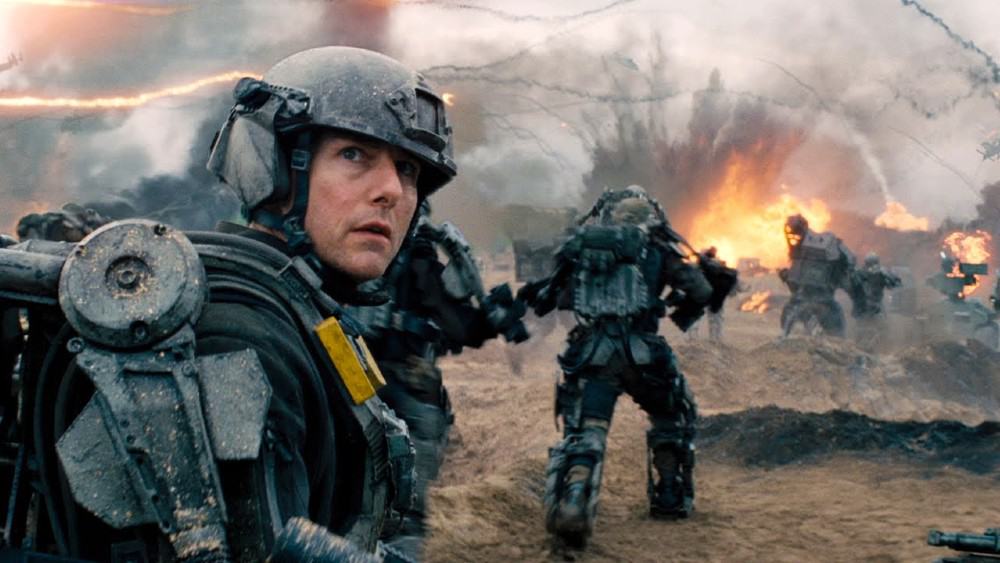
A year later, Tom Cruise would release another mid-level, ambitious sci-fi movie called Edge of Tomorrow. Unlike Oblivion, that film gained massive critical acclaim and immediate cult status.
Edge of Tomorrow love was, and is, so strong that it completely overshadowed people’s memory of Oblivion, and now, while everyone still talks about Edge of Tomorrow, it’s as if Oblivion never existed. That’s a shame, because Oblivion was a good, big-screen experience. The look of the movie is like nothing else you’ve ever seen, and while it’s still worth watching at home on television, there was something special about the way it looked, projected on a screen in a darkened theater.
Oblivion is a worthwhile sci-fi movie. If it were released today, it might get the credit it deserved, but back then, when moviegoers didn’t know how good they had it, Oblivion was easy to relegate to, well, oblivion.

Marlins host Padres, eager to prevent tying franchise losing streak
Sonny Gray, Red Sox strive to stay hot in clash vs. Blue Jays


