
Tech
Apple’s iOS 26.4 arrives in public beta with AI music playlists, video podcasts, and more
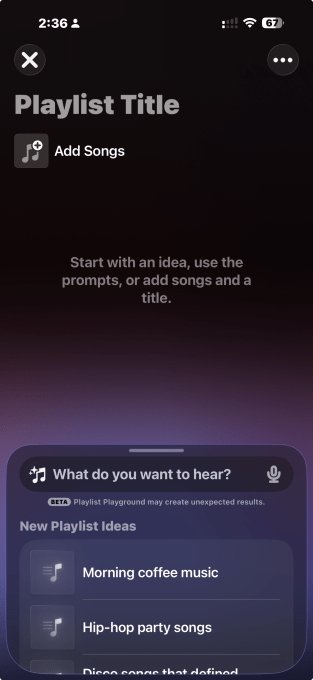
Apple this week released the latest version of its mobile operating system, iOS 26.4, which introduces several new features, including an AI-powered playlist-generation feature in Apple Music, support for video content in the Podcasts app, end-to-end encryption (E2EE) for RCS messages, and more.
The update is currently available in pubic beta, with the public release expected sometime in March or April.
Apple Music’s AI playlist
One of the most noticeable improvements arrives in Apple Music — iOS 26.4 introduces a new AI-powered “Playlist Playground” feature that leverages Apple Intelligence. The feature allows users to generate a custom 25-song playlist from a text prompt, such as “upbeat workout mix” or “calm evening.” Users can then further refine the results and even select matching cover art.

In addition, Apple Music’s user interface has been refreshed to showcase full-screen artwork for albums and playlists.
Concerts Near You
Plus, Apple Music is getting a new “Concerts Near You” section that helps users discover live shows from their favorite artists. You can filter this section by Date and Genre, or switch locations if you’re traveling.

Apple Podcasts video episodes
Following Spotify’s push into video, Apple’s Podcasts app is making it easy to switch back and forth between audio and video episodes with this release. Creators can publish video podcasts using HTTP Live Streaming (HLS), and listeners can seamlessly switch between audio and video playback within the same episode, moving to a full horizontal display if they choose.

At launch, the video episodes will be integrated with other Apple Podcasts features, like personalized recommendations and editorial curation on the New tab and Category pages, just as audio podcasts are.
HLS also brings an automatic quality adjustment feature, which helps videos play better whether listeners are on Wi-Fi or cellular. Plus, users will be able to download video episodes for offline viewing. At launch, HLS is supported by Acast, Amazon’s ART19, Triton’s Omny Studio, and SiriusXM, including SiriusXM Media, AdsWizz, and Simplecast.

Creators will be able to dynamically insert video ads, including host-read spots, into their podcasts, too. Apple doesn’t charge creators to distribute podcasts, but it says that, starting later this year, participating ad networks will have to pay an impression-based fee for the delivery of the dynamic ads in the HLS videos.
Encrypted RCS messaging
Messaging is also receiving an important upgrade with encrypted Rich Communication Services (RCS), which begins testing in iOS 26.4. End-to-end encryption for RCS conversations will one day help ensure messages between iPhone users and Android users are just as secure as iMessage.
Currently, Apple is only testing this between iPhones in beta. These conversations will be labeled as encrypted and cannot be read while sent between devices. The company notes that the feature will be released publicly in a later software update for iOS, iPadOS, macOS, and watchOS, and the beta is not available for all devices and carriers.
Stolen Device Detection is on by default
Security improvements are another highlight of iOS 26.4. Stolen Device Protection is now enabled by default, adding an extra layer of biometric authentication for sensitive actions such as accessing saved passwords or making certain account changes. By requiring Face ID or Touch ID authentication in more scenarios, Apple reduces the risk of unauthorized access if a device is stolen and the passcode is compromised.

CarPlay adds in-car video playback
Drivers using Apple CarPlay will also notice changes. CarPlay now supports in-car video playback for select apps — including the Apple TV app —but only when the vehicle is parked to ensure safety. This enhancement introduces new entertainment options for passengers when they’re stopped or while waiting in the car for a period of time. (Hooray for parents in the pickup line at school!)
Third-party AI services come to CarPlay
CarPlay for the first time will offer access to third-party AI services like OpenAI’s ChatGPT, Google’s Gemini, and Anthropic’s Claude.
Audio Zoom in Camera app

Meanwhile, the Camera app introduces Audio Zoom. When recording video, the microphone focuses on the subject as you zoom in, reducing background noise and enhancing clarity. This feature makes it easier to capture speeches, performances, or interviews without external audio equipment.

Additionally, the Ambient Music feature is now accessible through a widget, letting users instantly play soundscapes designed for focus, sleep, or relaxation directly from the Home Screen, instead of just the Control Center as before. The feature, first introduced in iOS 18.4, added a variety of ambient sounds to stream across categories like Sleep, Chill, Productivity, and Wellbeing.
“Urgent” reminders
There’s also a new “Urgent” section in the Reminders app that groups high-priority tasks and can trigger more prominent alerts when deadlines approach. Setting a reminder as Urgent will add an alarm so you’re sure not to miss the event.

And more …
A few other smaller features include the following:
- A new unified Apple Account Hub in the App Store, Apple Music, and other Apple apps replaces the “profile” feature that was previously used.
- A new animation is in the Messages app when you draft a message.
- An updated Wallpaper Gallery separates the different categories in a new way; a similar design came to the Apple Watch Face Gallery as well. The new version includes sections for Weather, Astronomy, Emjoi, and more, among other changes.
- Apple Music lets you add songs to multiple playlists at once.
- The Health app adds a new metric: Average Bedtime, which shows the average time you went to bed over the past two weeks. The Vitals section was also updated to include a blood oxygen level on the daily graph.
- Freefrom adds a Content Hub for Creator Studio subscribers, providing access to new AI features and high-quality art. Its icon was updated, too.
- The Personal Hotspot feature now includes a Data Usage section that shows how much data has been sent to your device and which Apple and non-Apple devices have been using your data.
- Live Captions adds support for Chinese (Taiwan) under the language options.
- There’s a new “Set Battery Charge Limit” action in Shortcuts.
- The App Store’s Search bar is back at the top of the screen.
- The link to iCloud.com gets a larger, featured section within the iCloud section in the Settings app. Before, there was only a toggle to “Access iCloud Data on the Web.” Now it’s more like a big ad for iCloud.
Notably absent from this release is a next-generation Siri experience. While Apple has signaled deeper AI ambitions for its voice assistant, those larger changes do not appear in iOS 26.4, reportedly delayed once again.
Tech
Replit’s Amjad Masad on the Cursor deal, fighting Apple, and why he’d rather not sell

Amjad Masad has been building Replit for a decade, but the last 18 months have been something else entirely. The AI coding assistant company went from $2.8 million in revenue in all of 2024 to tracking toward what Masad describes as a billion-dollar annual run rate.
At TechCrunch’s sold-out StrictlyVC event in San Francisco on Thursday night, we covered a lot of ground in a short time, beginning with the question everyone in the industry is asking right now: in a world where rival Cursor is reportedly in talks to be acquired by SpaceX for $60 billion, is Replit also bound to sell?
We also talked about Replit’s net revenue retention — a measure of how much existing customers expand their spending — which Masad says is reaching as high as 300%, his willingness to take Apple to court over what he called outright lies in its App Store battle with Replit, and the possibility of the company beginning to invest in its own customers.
On the question of independence, Masad was firm. Unlike Cursor, which he said has been operating at negative 23% gross margins, he argued Replit has the economics to make that path viable — even if he stopped short of ruling out a sale entirely.
The following has been edited for length and clarity:
TC: Cursor’s reported SpaceX deal was the talk of the industry last week. What did you make of it?
AM: It’s kind of hard being an independent, smaller AI company that’s building on foundation models, especially if you’re burning a ton of cash. Part of the reporting suggested Cursor has negative 23% margins, and if you’re also wanting to invest in training models, that makes it incredibly hard to stay independent.
Techcrunch event
San Francisco, CA
|
October 13-15, 2026
For us at Replit, partly because we target a different customer set, we’ve been able to run the business more rationally. We’ve been gross margin positive for over a year. We’re slightly more expensive, but we provide a lot more. Our audience tends to be mostly non-technical users who previously haven’t been able to create any software. We provide an end-to-end platform — from the prompt all the way to a deployed application that can scale. We handle security, databases, database migration. And we’ve been doing this long enough that we’ve built a lot of those primitives into the platform.
Is Replit for sale? I would assume you are talking with potential acquirers all the time; it’s your fiduciary responsibility.
Yeah. We have amazing partners, and they sometimes bring up these topics. But we’re going to try to stay independent. I would love for us to remain an independent company. We’ve been around for 10 years, before it was even accepted that you could make apps just from ideas. We were talking about creating a billion software creators back in 2018 at YC, and people sometimes actually laughed at that dream. Now that dream is possible, and we kicked off this revolution with our agentic coding experience in September 2024. It just feels like we can take it much further.
You work closely with Anthropic, Google, and OpenAI. If you had to rank them — who’s doing it best?
Anthropic is still undefeated on the core agentic loop. They have the best tool calling; the agent can stay coherent much longer. GPT-5 is catching up quickly. Google’s Flash family of models is just amazing on price-performance. If you want something fast and cheap, they’re actually beating open source right now. We use all three, and honestly I wouldn’t discount the newer labs either. Reflection AI is coming out with open-source models we’re hearing great things about. And the Chinese models are impressive — Kimi is as good as an Anthropic-generation model from January, so it’s only about three months behind.
When you’re in a bake-off for an enterprise deal, what wins it for you?
Most of our sales are inbound or organic — very product-led. We’ve acquired customers like Zillow and Meta purely through people adopting the product and then raising their hand to buy an enterprise plan. When it does go top-down and there’s a formal bake-off, we usually win on product. But even in cases where we might be missing a feature, once it hits the C-suite and the IT group, Replit wins on security. A lot of vibe-coding tools will generate a website and connect it to an external database — great products, but it makes security much harder, because the database is open to the public and you need to configure row-level security, which is especially difficult for non-technical builders. Replit being full stack, with the database built into the project and not open to the public — that makes the app inherently more secure.
We also spent 10 years battling crypto scammers and hackers, so our cybersecurity function is as good as a dedicated cybersecurity startup. Every time you deploy an app on Replit, we create an entirely new isolated project on Google Cloud. We inherit Google’s security model.
Can we talk about churn? How long do you hold onto customers if the best prototypes eventually get rebuilt into a company’s existing stack?
Churn is very, very low, and net retention is incredibly high — 300% in some cases. What we actually hear from customers is that when engineers get nervous and try to rebuild an app into their own stack, they often make it worse. Once enterprises get comfortable with the full Replit stack — especially when we set up a single-tenant environment for them — they keep the apps on Replit. Bain & Company, for example, replaced Tableau and Power BI with Replit and Databricks.
There’s a growing concern about AI bloat — non-technical users generate far more code and burn through far more tokens. That’s good for you [given your usage-based fees]. What about your customers?
We don’t have a lot of regrettable spend. Enterprises are very ROI conscious, and they tell us about the returns they’re getting. For the most part they feel the investment is totally worth it — often one, two, three orders of magnitude. If they spend $100,000 a month with Replit, they’re usually generating $2 million, $3 million, $10 million in some kind of return.
Let’s talk about Apple. Another rival, Lovable, just got an app-building app approved by the App Store this week. Replit has been in App Store purgatory, with Apple blocking your updates for months. How much does that hurt you?
It’s not life or death — we could lose the app and it wouldn’t do anything meaningful to our business. But it’s an app people genuinely love. We’ve been on the App Store for four years. Kids in underprivileged communities learn to code on Replit on their Android devices. Executives use it in meetings.
The reason Replit got blocked when others weren’t, we believe, is that Replit makes iOS apps. When we launched that capability in December, there were charts going around showing how many apps were getting into the App Store through us. We think Apple feels threatened by that.
Apple’s stated reason is that you’re downloading new code to the device [after the approval process], which violates their guidelines.
That’s a lie. And we can prove it in court if we have to.
Is that going to happen?
I hope not. I’m a fan of Apple, and I’d love to collaborate and build something great together. We’re happy to send customers to Xcode [Apple’s own development environment]. But you can’t run a marketplace that a billion people have access to and make decisions that are discriminatory or based on whims.
Just wondering if, like Nvidia, OpenAI and others, you’re thinking about investing in your own customers in exchange for equity.
We’ve thought a lot about it, and it is a consideration. I’ve personally invested in a few startups that started on Replit before they made any money. Some of them, like Magic School — a teacher decided to take his time during COVID to learn a little bit of vibe coding and built an AI app for other teachers. He found this problem that in America, we burn out a lot of teachers. He wanted to use AI to reduce the workload. He did that, and he made $20 million in the first year. Other companies that started on Replit, I think, are valued at half a billion dollars. The entrepreneurship happening on Replit right now is genuinely exciting. We integrated with Stripe a few months ago, and the transactions flowing through Replit are growing triple digits month over month. Pretty soon, our customers will be making more revenue than we are.
You can watch our full conversation with Masad below:
When you purchase through links in our articles, we may earn a small commission. This doesn’t affect our editorial independence.
Tech
Uber wants to turn its millions of drivers into a sensor grid for self-driving companies
Uber has a long-term ambition that goes well beyond shuttling passengers: the company eventually wants to outfit its human drivers’ cars with sensors to soak up real-world data for autonomous vehicle (AV) companies — and potentially other companies training AI models on physical-world scenarios.
Praveen Neppalli Naga, Uber’s chief technology officer, revealed the plan in an interview at TechCrunch’s StrictlyVC event in San Francisco on Thursday night, describing it as a natural extension of a nascent program the company announced in late January called AV Labs.
“That is the direction we want to go eventually,” Naga said of equipping human drivers’ vehicles. “But first we need to get the understanding of the sensor kits and how they all work. There are some regulations — we have to make sure every state has [clarity on] what sensors mean, and what sharing it means.”
For now, AV Labs relies on a small, dedicated fleet of sensor-equipped cars that Uber operates itself, separate from its driver network. But the ambition is clearly much larger. Uber has millions of drivers globally, and if even a fraction of those cars could be transformed into rolling data-collection platforms, the scale of what Uber could offer the AV industry would dwarf what any individual AV company could assemble on its own.
The insight driving the program, Naga said, is that the limiting factor for AV development is no longer the underlying technology. “The bottleneck is data,” he said. “[Companies like Waymo] need to go around and collect the data, collect different scenarios. You may be able to say: in San Francisco, ‘At this school intersection, I want some data at this time of day so I can train my models.’ The problem for all these companies is access to that data, because they don’t have the capital to deploy the cars and go collect all this information.”
Becoming the data layer for the entire AV ecosystem is a pretty smart play, particularly considering Uber years ago abandoned its own ambitions to build self-driving cars (a move that co-founder Travis Kalanick has publicly lamented as a big mistake). Indeed, many industry observers have wondered if, without its own self-driving cars, Uber might one day be rendered irrelevant as AVs increasingly spring up around the globe.
The company currently has partnerships with 25 AV companies — including Wayve, which operates in London — and is building what Naga described as an “AV cloud”: a library of labeled sensor data that partner companies can query and use to train their models. Partners, which Uber plans to more aggressively invest in directly, can also use the system to run their trained models in “shadow mode” against real Uber trips, simulating how an AV would have performed without actually putting one on the road.
Techcrunch event
San Francisco, CA
|
October 13-15, 2026
“Our goal is not to make money out of this data,” Naga said. “We want to democratize it.”
Given the obvious commercial value of what Uber is building, that positioning may not last long. The company has already made equity investments in numerous AV players, and its ability to offer proprietary training data at scale could give it significant leverage over a sector that right now depends on Uber’s ride marketplace to reach customers.
When you purchase through links in our articles, we may earn a small commission. This doesn’t affect our editorial independence.
Tech
FDA approval, fundraising, and the reality of building in healthcare according to BioticsAI founder
Founders building in the healthcare space can’t just build fast and break things. Timelines stretch longer, stakes are higher, and success depends on navigating systems that reward rigor over speed.
That’s exactly the reality Robhy Bustami, co-founder and CEO of BioticsAI, has been building in. His company is developing an AI copilot for ultrasound that helps detect fetal abnormalities, an area where misdiagnosis rates remain surprisingly high. Bustami joined Isabelle Johannessen on Build Mode to discuss how the company has navigated a highly regulated space and kept the team motivated while cutting through all the red tape.
BioticsAI started scrappy. The team built an early, functioning version of the product for under $100,000, an almost unheard-of milestone in the medical device world. That prototype helped them win TechCrunch Startup Battlefield in 2023, bringing early visibility and credibility. In January, they gained FDA approval, which means they can begin launching in hospitals and growing the business at a new rate.
From day one, the team approached product development with FDA approval in mind. Instead of building first and figuring out regulation later, they integrated clinical validation, regulatory strategy, and product development into a single process. That meant working closely with clinicians, collecting large-scale datasets, and running structured clinical studies before ever reaching the submission stage.
The FDA process itself is often viewed as a black box, but Bustami emphasizes that founders don’t have to navigate it blindly. Early engagement with regulators, through pre-submission meetings, helped the team align on study design and expectations. Still, risk never fully disappears. For many investors, the biggest question is simple: What if the FDA says no?
Internally, those long timelines create a different kind of challenge: keeping a team motivated when the biggest milestone is years away. At BioticsAI, that meant building a culture of alignment across engineers, clinicians, and researchers, ensuring everyone got to see the wins that were happening.
“Making sure everyone is completely aligned, even if it’s outside of their technical scope,” Bustami said, “constantly seeing wins on the R&D side,” from clinical studies to new healthcare partnerships.
Techcrunch event
San Francisco, CA
|
October 13-15, 2026
Now, with FDA clearance secured, BioticsAI is entering a new phase: deployment. The company is beginning to roll out its technology in hospitals, with plans to expand beyond obstetrics into broader areas of reproductive health.
Building in healthcare is a long game. It requires patience, discipline, and a willingness to operate in uncertainty. For founders willing to take that path, the reward isn’t just a successful company — it’s the chance to build something that genuinely changes how care is delivered.
Subscribe to Build Mode on Apple Podcasts, Spotify, or wherever you like to listen. Watch the full videos on YouTube. Isabelle Johannessen is our host. Build Mode is produced and edited by Maggie Nye. Audience Development is led by Morgan Little. And a special thanks to the Foundry and Cheddar video teams.
Apply to Startup Battlefield: We are looking for early-stage companies that have an MVP. So nominate a founder (or yourself). Be sure to say you heard about Startup Battlefield from the Build Mode podcast. Apply here.
TechCrunch Disrupt 2026: We’re back for TechCrunch Disrupt on October 13 to 15 in San Francisco, where the Startup Battlefield 200 takes the stage. So if you want to cheer them on, or just network with thousands of founders, VCs, and tech enthusiasts, then grab your tickets.
Use code buildmode15 for 15% off any ticket type.
When you purchase through links in our articles, we may earn a small commission. This doesn’t affect our editorial independence.

Ben Rice (3-run HR) backs Will Warren as Yankees beat O's
Galaxy in need of 3 points vs. Whitecaps


