
Tech
Android phones are getting more anti-theft features
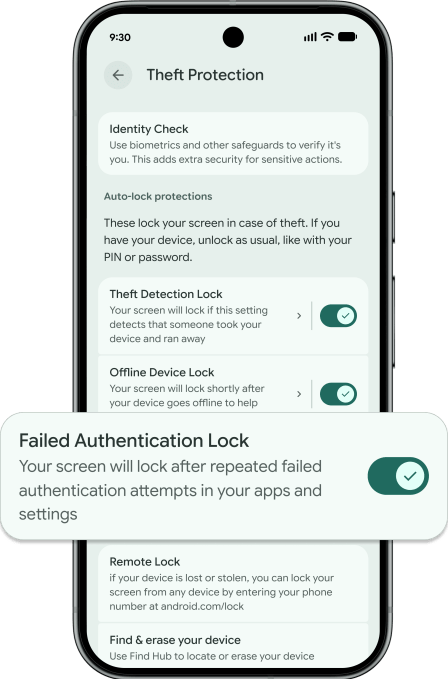
Google on Tuesday announced an expanded set of Android theft-protection features, designed to make its mobile devices less of a target for criminals. Building on existing tools like Theft Detection Lock, Offline Device Lock, and others introduced in 2024, the newly launched updates include stronger authentication safeguards and enhanced recovery tools, the company said.
While iPhones are often the preferred targets for thieves because of their resale value, Android devices are also subject to theft. That’s particularly true for high-end Android smartphones like the Google Pixel Pro devices, premium foldables, and other top devices from well-known makers like Samsung.

With the new features, users of Android devices running Android 16 or higher will have more control over the Failed Authentication Lock feature that automatically locks the device after an excessive number of failed login attempts. Now users will have access to a dedicated on/off toggle switch in the device’s settings.
The devices will also offer stronger protection against a thief trying to guess a device owner’s PIN, pattern, or password by increasing the lockout time after failed attempts. Plus, Identity Check, a feature rolled out for Android 15 and higher last year, now covers all features and apps that use biometrics — like banking apps or the Google Password Manager.
Remote Lock, a tool that lets you lock a lost or stolen device from a web browser, will now include an optional security challenge or question. With this feature, available to Android 10+, only the real device owner can initiate the lock for added security.
In Brazil, two theft protection features will now be enabled by default, including the Theft Detection Lock, which uses on-device AI to sense motion that could indicate a “snatch-and-run” theft. The Remote Lock feature will also be automatically turned on and accessible from the website android.com/lock.
Tech
Recursive Superintelligence signs $410 compute deal with Amazon

On Tuesday, the AI company Recursive Superintelligence announced a $410 million compute deal with Amazon Web Services. The company, which emerged from stealth in May with $650 million in funding, is focused on building open-ended self-improving systems, a potentially compute-intensive approach to AI research. This multi-year deal is meant to provide flexibility as the company looks to scale up those systems.
Recursive’s $410 million outlay represents the bulk of the company’s fundraising to date— but on a call with TechCrunch, Socher emphasized that he expected it to be the first of many such deals. Today’s announcement is “likely going to be one of the smallest compute deals we’re going to sign in the next few years,” Socher said.
Recursive’s emphasis on self-improving AI systems means much of the budget that would traditionally go towards headcount and operations is put straight into compute, as the company seeks to automate its own product development process.
“For us, it’s less about headcount and more about agent count,” Socher said.
There’s no investment component to Amazon’s involvement, in contrast to major labs’ habit of hybrid investment arrangements. But the sheer scale of the commitment allows AWS to commit significant resources to supporting Recursive’s unique needs, which may help to draw in other foundation-level AI companies going forward.
“Part of the agreement is that we’re going to co-develop infrastructure purpose-built for these types of company,” said Jason Bennett, VP for startups and venture capital at AWS.
Recursive self-improvement (RSI) has long been seen as an inflection point for AI, with some expecting an explosion of progress once AI can be improved without human involvement. But as more labs and companies pursue the idea, the specific requirements have become ambiguous, with some predicting an imminent breakthrough while others characterize self-improvement as more of a continuum.
But in Recursive’s case, the goal is to use the powers of RSI to develop actual products — and Socher expects to be releasing the earliest examples before the end of the year.
“We are excited to build like really amazing products that people can use, and you will see those within a few months, not within a few quarters or years,” Socher says. “In October or so, you’ll see some actually tangible, useful things that you’ll be able to play around with.”
When you purchase through links in our articles, we may earn a small commission. This doesn’t affect our editorial independence.
Tech
Apple launches ‘Upgrade’ device leasing program in partnership with Klarna
Apple is introducing a new leasing program in partnership with the “buy now, pay later” service Klarna, giving eligible customers the option to pay for Apple devices through monthly installments, the tech giant announced on Tuesday. The program is available for the iPhone, Apple Watch, Mac, and iPad on the Apple Store online, in the Apple Store app, and at Apple Store locations in the United States.
Leasing prices start at $17.99 per month for iPhone, $11.99 per month for Apple Watch, $24.99 per month for Mac, and $11.99 per month for iPad. Apple Upgrade offers one- and two-year leasing options for iPhone and Apple Watch, and two- and three-year for Mac and iPad.
At the end of the lease term, customers can upgrade to the latest generation of their device, purchase their current device with a one-time payment, or return it and exit the program, Apple says.
The rollout of the program comes as Apple has been struggling with supply chain issues related to “RAMageddon,” which refers to the industry-wide shortage of memory chips that is driving up the price of hardware. As a result, Apple recently announced price hikes for its Mac and iPad lineups, sparing the iPhone for now. The new Upgrade program seems to be Apple’s answer to making those higher prices more manageable for consumers.
Customers can manage their lease directly in the Klarna app, where they can view their billing schedule and track remaining payments.
With the launch of the new Upgrade program, Apple is discontinuing its existing in-house financing and installment programs in the U.S., which include the iPhone Upgrade Program and iPhone Payments.
The official launch follows a report from Bloomberg’s Mark Gurman last week, which revealed that Apple was preparing to introduce a lease-to-own program for its devices.
Apple says that when customers enroll in Apple Upgrade, they can lower their monthly lease payments by trading in their existing device through its Apple Trade In program. They can also earn 3% Daily Cash back when using Apple Card to make their lease payments.
When you purchase through links in our articles, we may earn a small commission. This doesn’t affect our editorial independence.
Tech
Fish Audio raises $52M seed to build AI voice models for creators and enterprises
The market for AI-generated voice models is massive. Creative use cases require AI voice models to be more expressive, while enterprises looking to automate customer support and sales ops need them to be more steerable.
Palo Alto-based Fish Audio wants to cater to all of those use cases with its library of more than 15,000 natural language controls. Since launching last year, the startup now has more than 8 million people using the open-source or hosted versions of its models, and generates annual recurring revenue of $21 million.
To continue building on that traction, the startup on Tuesday said it has raised $52 million in a seed round that was led by Coreline Ventures and Capital Today. The funding also saw participation from 359 Capital, Parable, Play Time, Alphalist Partners, Bayhouse Ventures, Carya Venture Partners, and HF0.
Fish Audio started as a small project by former NVIDIA researcher Shijia Liao, who, frustrated by non-expressive synthetic voices available on the market, trained a voice generation model on a single GPU, which he then open-sourced. The Fish Speech repository on GitHub now has more than 31,000 stars and is used by indie developers, video game designers, and creators.
The company has launched five models in the last year: four speech generation models and one speech-to-text model. It has open-sourced three of its speech generation models, but its latest S2.1 Pro model is available only through its paid API.
Fish Audio offers paid monthly plans suited for creators and teams that unlock a set number of minutes of generation plus voice cloning features. The company also offers an enterprise version of its APIs and platform, and says organizations like HeyGen and Sanas are already using it.
“Every enterprise has different use cases and different preferences. For example, companies like HeyGen, which use our voices to power AI avatars, want realism in voices; a gaming studio would want expressive voices for their characters; and voice agent companies like LiveKit want more natural-sounding and low-latency voices that are expressive enough for calls,” Cao said.
One way the startup has built its library of voices is by asking users to submit their own voices for training its models, and compensating them if their voices are used. That resulted in some trouble a few months ago, however, as some creators alleged that their voices were uploaded to Fish Audio without their consent. The startup had a DMCA takedown process in place to address such concerns, but the takedowns themselves took a long time.
Fish Audio’s CEO and co-founder Rissa Cao told TechCrunch that the company has now automated the takedown process. Creators can submit a short voice sample or a contract to prove that an uploaded voice belongs to them, and their voice will be taken off the startup’s platform in less than three minutes, she said.
Still, that doesn’t prevent anyone from uploading an artist’s voice without their knowledge. And until the artist finds out, their voice will continue to be used on the platform unless they file for its removal.
Osuke Honda, a partner at Coreline Ventures, said a community-driven model only works when creators trust the platform.
“A community-centric approach can only become a durable advantage if creators trust the platform. That means consent, transparency, and attribution must be built into the product rather than treated as afterthoughts. I believe the industry needs to move toward verified voice ownership, clear licensing terms, easy reporting and takedown processes, and eventually revenue-sharing models where creators benefit financially when their voices are licensed or used commercially,” he said.
Cao said when the startup was only offering its product as an open-source project with plans for creators, it was running efficiently and didn’t need outside capital. But it wanted to develop more advanced models, and also wanted to accommodate enterprises as investor interest was ramping up, which led it to seek capital.
Looking ahead, Fish Audio plans to release an audio understanding model this year. It’s also building a speech-to-speech model.
The speech generation market is crowded, with companies like ElevenLabs, WellSaid, Cartesia, Speechify, Async (previously Podcastle), and Krisp competing for creators and enterprises’ budgets.
According to Rico Mallozzi, a partner at 359 Capital, fine-grained controls for developers and cost-efficient model training will help Fish Audio compete better with big AI labs.
“I think what they’ve been able to build, state-of-the-art models, with the team they have, compared to some of these other well-funded AI labs or companies, is incredible. It shows their technical acumen in closing the gap between artificial-sounding and human-like voices,” Mallozzi told TechCrunch over a call.
The story has been updated to reflect that the company raised $52 million in the seed round.
When you purchase through links in our articles, we may earn a small commission. This doesn’t affect our editorial independence.

Recursive Superintelligence signs $410 compute deal with Amazon
Apple launches ‘Upgrade’ device leasing program in partnership with Klarna


