
Entertainment
The Killer Fantasy Epic That Tried To Save Us From Christopher Nolan's Odyssey

By Robert Scucci
| Published

With Christopher Nolan’s adaptation of The Odyssey fast approaching, it’s time to get back into all of the great historical epics that have come out over the years. Gladiator (2000) is always a no-brainer thanks to Russell Crowe’s magnetic performance as Maximus Decimus Meridius, and if you want to channel your inner Spartan while a single tear runs down your cheek because you’re 37 and need to accept the fact that you’re never getting the abs back, you can fire up 300 (2007) to get your fill. Between those two films, though, is a little $185 million historical epic called Troy (2004), which wasn’t exactly a critical darling upon release (53 percent on Rotten Tomatoes), but has remained a fan favorite for decades.
Here’s the thing about historical epics based on Ancient Greek mythology: they almost always lose points for not properly representing the source material. But here’s my counterpoint: this is a movie, everybody speaks American English, and our main hero’s weakness is his heel because his mother dunked him upside down in the River Styx to make him immortal, but the water didn’t touch the spot where she was holding him. In other words, let’s suspend some disbelief, watch some epic battles, and enjoy the show.
I’m No Scholar, But Troy Is Badass

I hate long movies that don’t earn their runtime, but Troy is built differently because it fully commits to spectacle. There are plenty of names being said out loud that made me think, “Oh, that’s how you pronounce that; I’ve only ever read it before,” followed immediately by enough cinematic violence to distract me from the fact that I should probably brush up on both my history and my phonics.
Here’s the short and sweet version of what happens in Troy because, if I’m being real, I’m not watching this one for the plot. I’m watching it to see thousands of extras get leveled while armies wage war against each other and burn everything to the ground.

After Paris (Orlando Bloom), a prince of Troy, sparks a forbidden romance with Helen (Diane Kruger), the wife of Spartan King Menelaus, tensions between the two kingdoms explode into all-out war. The Greek armies unite under the ambitious Agamemnon (Brian Cox), bringing along their greatest warrior, Achilles (Brad Pitt), whose legendary fighting skills are matched only by his pride and ego. As Troy braces for invasion, noble prince Hector (Eric Bana) struggles to defend his family and city from destruction. What follows is a massive clash driven by love, revenge, ambition, and the pursuit of glory during a time when nothing else really mattered.
Beyond Epic In Scope And Scale
Filmed during that sweet spot in movie history where CGI enhanced a film instead of completely replacing practical filmmaking, Troy never feels like a green screen experience. Sure, digital effects were used to fill out backgrounds with massive armies and sprawling naval fleets, but the production still relied on thousands of extras swinging rubber swords during combat sequences so everybody could safely hack away at each other with reckless, military-sanctioned abandon. It’s even been reported that Brad Pitt and Eric Bana spent days rehearsing their final duel without stunt doubles to make sure audiences got the best fight sequence money could buy.

Speaking of Brad Pitt, his portrayal of Achilles is second to none. He brings a certain level of nonchalance to the role, like he’s a party guy who just so happens to be exceptionally gifted at war. He’s untouchable and unflappable, and he commands the screen whenever he shows up while channeling serious dude-bro energy anytime somebody asks anything of him. When we’re first introduced to him, he effortlessly kills Boagrius (Nathan Jones), a giant hulk of a man, while violently hungover and not even having eaten breakfast yet. It’s poetry in sandals, and it’s ridiculously fun to watch play out.
For every bit of charisma in Troy, however, there’s also a healthy amount of corn you need to chew through. The most egregious moment, to me, is when Ajax lets out his battle cry in the middle of combat, bellowing, “I am Ajax, breaker of stones! Look upon me in despair!” Don’t get me wrong, that’s an objectively badass thing to say, but Troy is set in 1184 BC and he delivers the line like he knows there’s a camera crew behind him and he wants to sound as cool as humanly possible. Moments like that can take me out of movies like Troy, but it’s also worth mentioning that this is still an incredible quote to casually work into real life whenever the opportunity presents itself.

In 2026, Troy’s legacy has far exceeded its initial reputation, which is reflected in its much stronger 74 percent Popcornmeter score on Rotten Tomatoes. The critics may have gone hard on this movie at the time, but it’s also worth remembering that critics don’t always know how to have fun. Troy is fun. It’s pure popcorn spectacle wrapped in armor, and if you’re looking for next-level fight choreography and carnage, it really doesn’t get much better than this.

As of this writing, Troy is not available through standard streaming subscriptions, but it can be rented or purchased on demand through Amazon Prime Video, YouTube, Fandango at Home, and Apple TV+.

Entertainment
Carmen Electra's Raunchy, R-Rated 90s Sci-Fi Is A Mating Ritual Mockumentary
By Robert Scucci
| Published

Nature documentaries are incredibly informative if you want to learn how different species interact, feed, and mate in the wild. Taking a page from the National Geographic playbook, The Mating Habits of the Earthbound Human is the ultimate mockumentary about how humans interact with one another while trying to find a romantic suitor. If you’re familiar with Nathan W. Pyle’s Strange Planet comics, you’ll love how the unnamed alien narrator in this movie tries to make sense of human dating rituals through his limited understanding of life on planet Earth.
An Alien’s Explanation Of Human Interaction
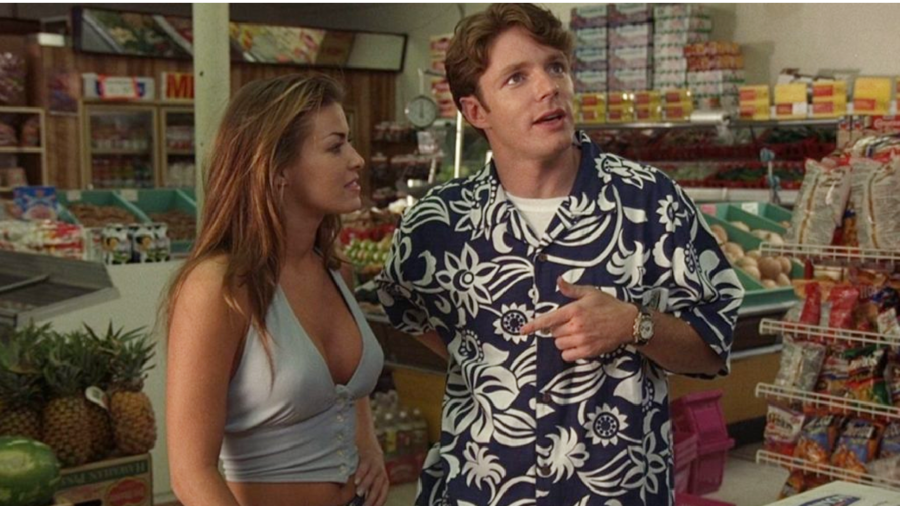
Narrated by none other than David Hyde Pierce (Frasier), The Mating Habits of the Earthbound Human is an absolutely hilarious exploration of misguided anthropology. The film is framed as a nature special using humans as its subject of study, and Pierce’s dry delivery gives it a convincing nature documentary vibe. The Narrator’s long-winded attempts at explaining simple concepts, like shaving and phone call etiquette, are detailed to the point of agony and the primary source of humor in this film.
The Mating Habits of the Earthbound Human starts out in a nightclub, and we’re introduced to “The Male,” Billy Waterson (Mackenzie Astin), and “The Female,” Jenny Smith (Carmen Electra). Billy and Jenny immediately hit it off and start dating shortly after their initial exchange. As their romance develops throughout the film, The Narrator attempts to make sense of, and explain to his equally confused audience, the various human interactions he witnesses, highlighting the complexity of modern dating.
The Narrator’s Enthusiasm Will Win You Over

While I think Mackenzie Astin and Carmen Electra deliver flawless performances in this satire, The Narrator’s enthusiasm and curiosity in The Mating Habits of the Earthbound Human is what really got me laughing out loud. For example, when describing how women prefer romance movies and how men like action movies, The Narrator explains, “Human females enjoy stories about one person dying slowly. The males prefer stories of many people dying quickly.”
An equally hilarious observation made by The Narrator in The Mating Habits of the Earthbound Human involves Billy’s use of a computer mouse at his job, which is described as “a toy named after one of the small rodents of his planet.” Extrapolating his observation to the point of absurdity, The Narrator goes on to say that “He presses his fingers against the rodent’s buttocks and gently taps upon its cheeks. Still, he prefers the female of his own species.”
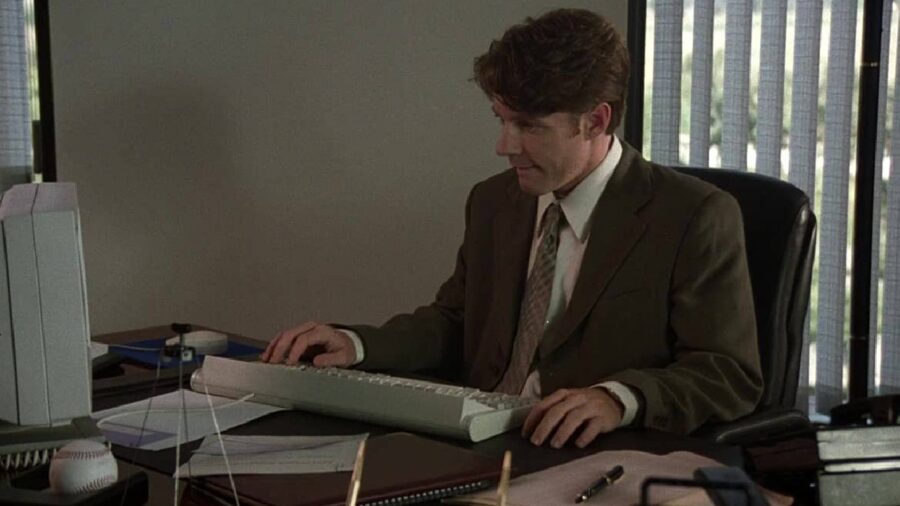
The Narrator’s descriptions range from making sense of human technology to the use of prophylactics, which is acted out by a bunch of actors dressed in white running into a wall to demonstrate how they’re being blocked from the female’s egg after the male and female engage in intercourse.

Fully committing to its bizarre nature documentary premise, The Mating Habits of the Earthbound Human is highly quotable and convincingly points out why and how human dating is such an exhausting ordeal on planet Earth. It’s also worth pointing out that there is some truth behind The Narrator’s assumptions, but his intelligence, coupled with his naivety, adds a layer of ridiculousness to the narrative that makes for a truly unforgettable movie-watching experience.
The Ultimate Anti Rom-Com

The Mating Habits of the Earthbound Human effectively uses satire to poke fun at romantic comedies while being a romantic comedy itself, which is easier said than done. Through its self-awareness, it lampoons every single trope found in the genre without wearing out its welcome. David Hyde Pierce’s ability to play it straight while reading The Narrator’s lines is nothing short of commendable, and I’m going to reasonably assume that he had to work through several takes in the voice-over booth to actually nail his lines without laughing out loud himself.
If you’re looking for a romantic comedy that doesn’t succumb to the usual genre trappings, The Mating Habits of the Earthbound Human comes with strong recommendations. This anthropological analysis of human dating as perceived by an intelligent alien life form can currently be rented or purchased on-demand through Apple TV+, Amazon Prime Video, and Fandango at Home.

THE MATING HABITS OF THE EARTHBOUND HUMAN SCORE
Entertainment
Tragically Overlooked Dark 90s Sci-Fi Was Supposed To Be An American Gundam
By Jonathan Klotz
| Published

Before the rise of dedicated networks for cartoons, the Saturday morning and after-school animation blocks were the day’s highlight for most kids. We got to enjoy such classics as Denver the Last Dinosaur, Cowboys of Moo Mesa, Dinosaucers, Bravestar, and not one but two Sonic the Hedgehog cartoons. As fun as those shows were, story and character development weren’t their selling point, which is what Exosquad was created to change about American animation.
Airing from 1993 through 1994, for 52 episodes, Exosquad was the response of Jeff Segal, the head writer from Challenge of the Go-Bots, to match the quality output of Japanese anime. Typically, American cartoons were structured more like sitcoms than dramas, and the status quo would always be reset by the end of the 22-minute episode. Taking heavy inspiration from Mobile Suit Gundam, the original storyboard designs for the series even refer to it as “American Anime.”
In The Grim Darkness Of The Far Future

Exosquad is set in the future after humanity has colonized and terraformed Venus and Mars, where the Neosapiens, a bio-engineered slave race used by humanity for menial labor, have launched an uprising. Taking control of the planets, the Exosuit pilots that form Able Squad and their allies form the core of humanity’s fight against the Neosapiens.
Unusual for an American cartoon of the time, Exosquad treats the war completely seriously, with characters dying and multiple episodes of fighting followed by more episodes of clean-up and what to do as an occupying force.

While the long-form storytelling was something unique and groundbreaking, what wasn’t new and different was that each member of Able Squad had a different exoframe that they would pilot. From the winged blue frame used by squad leader J.T. Marsh, to the green reconnaissance frame of Alec DeLeon, and the extra-large two-pilot vehicle design of Diana and Thrax’s frame, it’s clear that while Exosqaud broke storytelling ground, it was still designed to sell toys.
When Afternoon Cartoons Go Dark

The colorful designs of the exoframes covered the dark nature of the story, with Episode 22, “Fire Ship,” remaining a standout that has stuck with me for decades. After being betrayed, Able Squad is captured and held on board a captured ship rigged with explosives as a booby trap for the Terran leadership. I was 10, and here was an episode with the heroes contemplating mortality and debating a plan to explode the ship prematurely so that no one else would die.
In 1993, this was unlike anything else on the air, and while yes, the heroes survived this time, that wasn’t always the case. Characters would routinely be injured and unseen for episodes at a time as they recovered, nameless pilots would die in almost every episode, and there was a very palpable sense of dread as the war ramped up and it was clear that not everyone would be making it home alive.
Tragically Ahead Of Its Time

No matter how dark the story became, the animation remained spectacular throughout, but it was the same studio, AKOM, in South Korea, that handled X-Men ’92, Batman: The Animated Series, and Gargoyles, so of course, it’s going to look good. For an American 90s cartoon that is, compared to its contemporary, Gundam Wing, Exosquad doesn’t hold up.

Exosquad came out during an interesting time for American animation, as the industry was quickly evolving and changing, going from Teenage Mutant Ninja Turtles at the start of the decade, to Spongebob Squarepants by the time it came to a close. The saga of Able Squad and the Neosapien War still stands out as a series that was unique and ahead of its time. Thankfully, if you want to experience the war yourself, is available for rent or purchase through Amazon Prime Video and Apple TV+.
Entertainment
R-Rated Dark Netflix Sci-Fi Thriller Is Over-The-Top Action At Its Best
By Jeffrey Rapaport
| Published

One reason we love Netflix is that, like any good streaming service, the platform offers a lot of options. However, the sprawling catalog can sometimes inspire decision paralysis. If you want to lock in on something worth your time, consider Project Power: the thrilling, R-rated film weaving together threads of sci-fi, action, and a dash of real-world commentary into a compelling, singular tapestry.
Visionary directing duo Henry Joost and Ariel Schulman shot the 2020 film, sporting a unique narrative penned by Mattson Tomlin; their collaborative efforts engineered a cinematic venture that hooked audiences with its novel premise: a pill granting temporary superpowers. Moreover, the movie admirably grounds its tale in the gritty, vibrant streets of near-future New Orleans. It provides a multifaceted exploration of Power, whether supernatural or societal.
Superpowers With A Twist

Project Power begins in the not-too-distant future, when a new drug, unsubtly termed “Power,” has hit the streets. The drug offers users a tantalizing yet dangerous proposition: five minutes of pure, unadulterated superhuman abilities. We’re talking super strength, invisibility, bullet-dodging, you name it. The catch? The powers are unpredictable and unruly, varying widely from user to user and, most damningly, often accompanied by dangerous side effects (including death).
Jumping from high-concept sci-fi futurism to the intimate, even sociological fabric of fictionalized New Orleans, Project Power’s principal characters are Art, played wonderfully by Jamie Foxx, a former soldier harboring a vendetta; Frank, the ’90s heartthrob Joseph Gordon-Levitt, a local cop bending the rules to protect the city; and Robin, played commendably by Dominique Fishback, a brainy, resourceful teen dealing drugs to care for her ailing mother.
Different Motivation
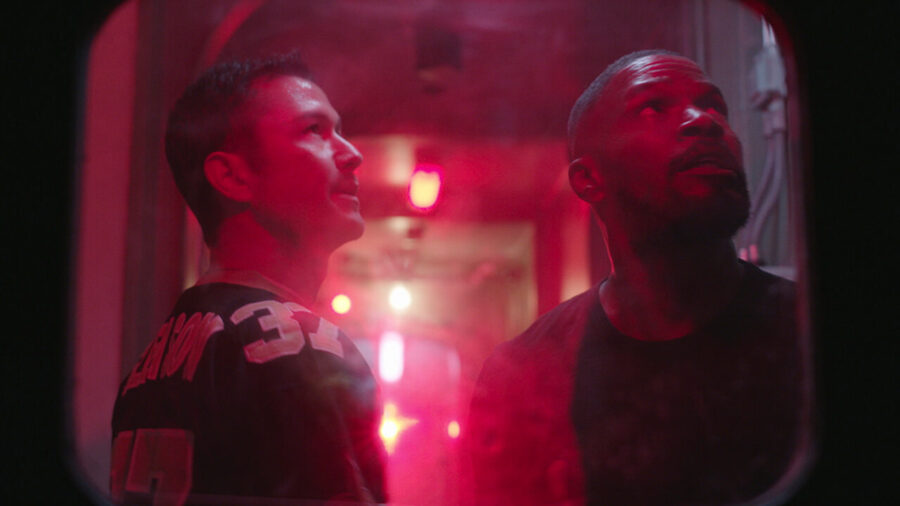
Each character retains their burning desire to locate the source of the Power pills, wreaking havoc in their city in the process.
Art’s quest in Project Power is incredibly personal. Tracy (Kyanna Simone), his daughter, was kidnapped by the shadowy, nefarious group behind the drug. Born with natural superpowers due to Art’s exposure to experimental drugs during his deployment, Tracy’s unique genetics mean she’s a perfect guinea pig for the manufacture of the power pills. His mission constitutes a desperate rescue opp.

Whereas Frank, on the other hand, witnesses the devastation the narcotic inflicts on his city. Though Frank employs Power to compete with the criminal underworld, he’s nonetheless, motivated by a sense of duty to halt the drug’s spread and expose those responsible for it.
Thirdly, Robins’s involvement with Power is initially strictly business. However, her journey grows increasingly intertwined with Art and Franks, evolving her into an integral ally in their crusade. With her quick wit and street smarts, she becomes indispensable. At the same time, her personal growth is a central theme of Project Power.
Pure, Genre-Blending Bliss

Fusing realism and high-concept sci-fi thematics, themselves borrowing heavily from the superhero universe, the film admirably achieves a simultaneity of genres. In this, it reminds viewers of genre-bending hits like District 9 and Bone Tomahawk. Indeed, at its heart, the movie amounts to more than impressively stylistic, action-packed set pieces, and delves into ethical and moral quandaries posed by its central conceit.
The film questions the nature of power beyond the drug’s scope; who has it, who wants it, and at what cost? The film scores ethical points, as well, for shining a spotlight on New Orleans. More than a mere backdrop, the city functions as a living, breathing character in Project Power, enriching the film with its cultural tapestry and post-Katrina resilience. All of which offer a poignant context for the movie’s meditation on power dynamics, whether sci-fi or systemic.
Mixed Thoughts

On the critical side, the movie received mixed reviews, ranging from positive to lukewarm, and currently sitting with a 61 percent approval rating on Rotten Tomatoes. Critics ardently enjoyed its action sequences, impactful visuals, and performances, principally Fishback’s. That said, experts leveled some criticism at its screenplay, with some suggesting the project’s ambitious premise could have been explored more deeply.
That said, Project Power enjoyed success on Netflix; it became one of the platform’s most-streamed films upon release. Indeed, the streaming service reveals that 75 million accounts streamed the movie within a month of its release.
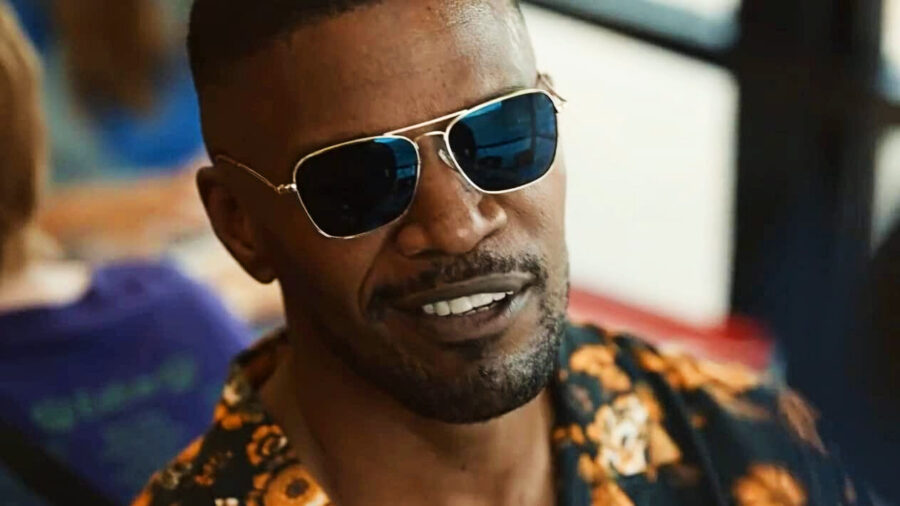
Music fans, especially hip-hop aficionados, should consider the film, too, given it features a prominent supporting role by Colson Baker, otherwise known as Machine Gun Kelly, who plays a drug dealer trafficking in Power.
Ultimately, for a sci-fi thrill ride sure to impress with its unique concept and powerful performances, stream Project Power today.

Ice bucket challenge gaining steam after Chris Johnson ALS diagnosis
Carmen Electra's Raunchy, R-Rated 90s Sci-Fi Is A Mating Ritual Mockumentary


