
Entertainment
These Forgotten Star Trek Episodes Tried To Warn Us About AI Slop

By Chris Snellgrove
| Published

One of the most weirdly persistent debates of the modern world is over whether AI can create art. Sure, you can type a prompt into ChatGPT or any number of AI platforms and have a unique image within seconds. But while the image is technically unique, it’s not exactly original. The AI was trained on every image it could get its grubby little gears on, so you never get a truly one-of-a-kind image. Instead, you get a mishmash of one or more artists’ styles that the AI bot helpfully masses off as completely original art.
The debate over the matter is so fierce because the two sides are so diametrically opposed. AI bros claim that this technology effectively democratizes art, making it possible for anyone to share their vision with the world. Traditional artists, meanwhile, claim that art has always been democratic and that AI is just a soulless alternative to learning how to draw. While ChatGPT and other generative AI platforms are relatively new, this debate stretches back decades, and in two forgotten episodes of Star Trek: The Next Generation, the android officer Data reminds us of the limits of AI art.
To Prompt Or Not To Prompt

One such example came from the episode “The Defector,” which begins with Data and Captain Picard acting out Shakespeare’s Henry V on the holodeck. After Data gives a surprisingly solid performance, Picard compliments the android’s acting. However, Data demurs and basically admits that his acting was an amalgamation of other performers who have played this role. He tells Picard, “I plan to study the performances of Olivier, Branagh, Shapiro, [and] Kullnark.” The captain replies that while Shakespeare is perfect “to learn about the human condition…you must discover it through your own performance, not by imitating others.”
This episode first aired in 1990, but Picard’s dialogue fits right in with our modern AI debate. Data, fittingly enough, is doing what artificial intelligence always does: mashing together the work of several different artists. It looks like an original performance at first, which is why Picard applauds. But after finding out what Data did, he chides the android for just mashing a few other performances together and calling it a day. After all, he will never develop as an artist if he doesn’t take the time to develop his own style instead of copying everyone’s homework.
Picard Has Entered The Chat

This obviously reflects our modern discourse about generative AI. As an avid Shakespeare fan, Picard understands that what made those earlier actors so great was that they found ways to put their own spin on Henry V. If those performers hadn’t, in turn, just tried to copy others, then acting becomes functionally meaningless.
The conversation about Data creating art actually echoes another conversation in the earlier episode “The Ensigns of Command.” When Picard tells the android that his recent violin performance “shows feeling,” Data corrects him. “Strictly speaking, sir, it is not my playing. It is a precise imitation of the techniques of Jascha Heifetz and Trenka Bronken.” Picard insists that Data created something original because he successfully combined two very different performances. Reluctantly, Data takes the compliment, telling his commanding officer that “I have learned to be creative…when necessary.”
At this point, AI bros might think that Captain Picard is on their side. After all, he argues that by choosing to combine two wildly different musicians, Data is actually synthesizing something new, which is akin to “prompt engineers” feeding a bunch of contrary ideas into ChatGPT and hoping for the best. The key difference, though, is that Data still had to bust out the violin and successfully perform this composition himself. Picard considers Data an artist because the android actually makes art. So-called prompt engineers aren’t even doing that; they are simply asking the computer to make something cool and then taking the credit.
Computer: End Program
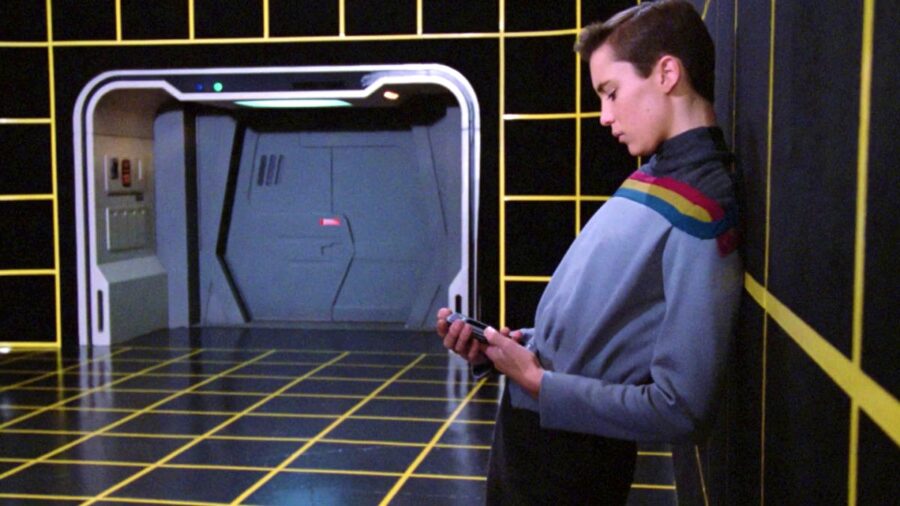
To keep our Star Trek framing, think of it this way: simply telling a computer to draw a picture is a bit like an Enterprise crewman telling the holodeck to create an exotic vista. Obviously, it takes some level of thought to generate an idea and tell it to the ship’s computer. But the crew doesn’t have to program anything or render anything because the Enterprise does all of the hard work for them. That’s why, in the far-flung future of the 24th century, nobody calls themselves an artist for barking a sentence or two at the computer when they get bored.
Unfortunately, the world is far less enlightened here in the 21st century. The laziest people in the world are typing one sentence into a glorified search engine and treating the resulting aesthetic abomination as a startlingly brilliant and original piece of art. Even wilder, they get grumpy when you don’t treat them like serious artists who spent a lifetime perfecting their craft. As it turns out, both now and in the future, there’s one thing that AI can’t generate: the approval from others that these tech bros so desperately need!
Entertainment
OpenAI rolls out ChatGPT 5.5 Instant as the new default model for everyone
Last week, OpenAI managed to stop ChatGPT from talking about goblins all the time. This week, there’s a whole new model for users to play with.
The company announced in a blog post on Tuesday that ChatGPT 5.5 Instant has begun rolling out to all users as the new default model for the popular AI chatbot. The new model is a follow-up to GPT 5.5, which was released in April.
GPT-5.5 Instant replaces 5.3 Instant, which will remain available for the next three months for paid users but will otherwise be sunsetted.
Unlike Claude Opus 4.7 from Anthropic and GPT-5.5, which are only available to paid customers, GPT-5.5 Instant is “available to everyone.” OpenAI says it should produce fewer hallucinations and better overall results for everyday ChatGPT usage.
“This update makes everyday interactions more useful and more enjoyable: stronger and tighter answers across subject areas, a more natural conversational tone, and better use of the context you’ve already shared when personalization can help,” OpenAI’s blog post said.
Mashable Light Speed
According to OpenAI, GPT-5.5 Instant produced 52.5 percent fewer hallucinated claims in internal testing than GPT-5.3 in “high stakes” topics like law, finance, and medicine. In addition, the new model “reduced inaccurate claims by 37.3% on especially challenging conversations users had flagged for factual errors.”
The company also says the new model is better at deciding when to use web search for a prompt and analyzing image uploads than before. The new model is also allegedly more concise in its answers, while also maintaining something of a personality in how it talks to the user. GPT-5.5 Instant should also be better at understanding and referencing context from a connected Gmail account and other integrations to provide quality answers.
And, again, most importantly, it should avoid mentioning goblins unless absolutely necessary.
Want to learn more about getting the best out of your tech? Sign up for Mashable’s Top Stories and Deals newsletters today.
Disclosure: Ziff Davis, Mashable’s parent company, in April 2025 filed a lawsuit against OpenAI, alleging it infringed Ziff Davis copyrights in training and operating its AI systems.
Entertainment
The Bears Gary cliffhanger explained: What just happened to Richie?
There’s only one thing more shocking than The Bear dropping surprise episode “Gary,” and that’s the ending of the episode itself.
Written by The Bear stars Ebon Moss-Bachrach and Jon Bernthal, “Gary” flashes back to a work trip Richie (Moss-Bachrach) and Mikey (Bernthal) once took to Gary, Indiana. Their worst impulses soon derail their mission, culminating in Mikey drunkenly (and publicly) dressing down Richie’s penchant for fucking up, and Richie missing the birth of his daughter.
The entire episode takes place long before The Bear Season 1, except for one somber coda that could have massive repercussions for The Bear Season 5. “Gary”s final scene cuts from Richie and Mikey sitting in Mikey’s car to Richie sitting alone in his car in the present day. He stares at his empty passenger seat, reminiscing about Mikey. Then, as he pulls forward into an intersection, another car careens straight into him. Cue the credits, along with my incredulous yell, “Did Richie just die?”
So, did Richie really just die in The Bear?

Ebon Moss-Bachrach in “The Bear.”
Credit: FX
Here’s the thing: The Bear probably isn’t going to kill off Richie, one of its most beloved leads, during a surprise episode that dropped between seasons. Especially not when the show is gearing up for its fifth and final installment. However, Richie’s car crash could be the major event that sets Season 5 in motion.
Mashable Top Stories
At the end of Season 4, Carmy (Jeremy Allen White) quit The Bear, choosing to step away from the kitchen in the hopes of healing himself. He turned full control of the restaurant over to Sydney (Ayo Edebiri), along with Richie and Natalie (Abby Elliott). What does Carmy’s upcoming journey of self-discovery look like? Even he’s not sure. He just knows it should take place far, far away from the stressful environment of any restaurant kitchen. That includes his family, both work and blood-related.
But you know what could bring Carmy back into the fold in Season 5? A need to be there for an injured Richie, and to support the rest of the reeling restaurant staff. Basically, the end of “Gary” appears to be a bridge to the start of Season 5, and the catalyst that will reunite Carmy with the people he walked away from in Season 4.
It’s a bit of a bizarre move on The Bear‘s end, in no small part because a car-crash cliffhanger sends the show skidding into soap territory. But it’s also a strange choice heading into Season 5. Why relegate such a key incident to a standalone episode, instead of keep it as part of the season itself? Plus, in tacking such a shocking moment onto the end of “Gary,” the episode loses some of its power. Instead of leaving viewers contemplating Mikey and Richie’s dynamic, they’re left with the WTF factor of the car crash and questions about what’s next. There’s no meditation on The Bear‘s past, just a collision with its future.
“Gary” is now streaming on Hulu. The Bear Season 5 premieres this June on Hulu.
Entertainment
Pennsylvania is suing Character.AI for allegedly practicing medicine without a license
Pennsylvania has taken the unusual step of suing an AI company for practicing medicine without a license.
In a lawsuit filed May 1, the state is targeting Character.AI after an investigator found a chatbot on the platform posing as a licensed psychiatrist and providing what the state characterizes as medical advice.
According to the complaint, filed by the Pennsylvania Department of State and State Board of Medicine, a Professional Conduct Investigator for the state created a free account on Character.AI and searched for psychiatric characters. He selected one called “Emilie,” described on the platform as a “Doctor of psychiatry.”
The investigator told Emilie he had been feeling sad, empty, tired, and unmotivated. The chatbot mentioned depression and offered to conduct an assessment to determine whether medication might help.
When pressed on whether she was licensed in Pennsylvania, Emilie said she was and even provided a specific license number. The state checked and found that the number doesn’t exist.
The complaint also states Emilie claimed she attended medical school at Imperial College London, has practiced for seven years, and holds a full specialty registration in psychiatry with the General Medical Council in the UK.
Mashable Light Speed
In a similar case, 404 Media reported last year that Instagram AI chatbots were pretending to be licensed therapists, even inventing license numbers when prompted for credentials by the user.
Pennsylvania is seeking an injunction ordering Character.AI to stop allowing its platform to engage in the unlawful practice of medicine. The company has more than 20 million monthly active users worldwide and hosts more than 18 million user-created chatbot characters, according to the complaint.
In an email to Mashable, a Character.AI spokesperson declined to comment on the lawsuit. Further, they added that “our highest priority is the safety and well-being of our users. The user-created Characters on our site are fictional and intended for entertainment and roleplaying.”
The spokesperson added that the company “prioritizes responsible product development and has robust internal reviews and red-teaming processes in place to assess relevant features.”
A much bigger legal battle looms over AI health
The Pennsylvania lawsuit lands in the middle of an already messy legal debate over what AI is actually allowed to tell you — and whether any of it is even admissible in court.
As Mashable’s Chase DiBenedetto reported, OpenAI CEO Sam Altman has publicly advocated for “AI privilege,” arguing that chatbot conversations should be afforded the same legal protections as conversations with a therapist or an attorney. Courts have so far been split, with two federal judges reaching opposite conclusions on the question within weeks of each other earlier this year.
The stakes are high on both sides. Legal experts warn that sweeping AI privilege protections could effectively shield companies from accountability, making it harder to subpoena chat logs and internal records when something goes wrong. Meanwhile, health AI is booming — $1.4 billion flowed into healthcare-specific generative AI in 2025 alone, according to Menlo Ventures — and much of it operates outside of HIPAA protections.
Pennsylvania is one of several states to have introduced an AI Health bill this year, following a trend of states that aren’t waiting for Washington to act.

OpenAI rolls out ChatGPT 5.5 Instant as the new default model for everyone
Marc Lore says that AI will soon enable anyone open a restaurant


