
Entertainment
Buffy’s Most Heartbreaking Plot Twist Was Inspired By History's Darkest Devil Story

By Chris Snellgrove
| Published
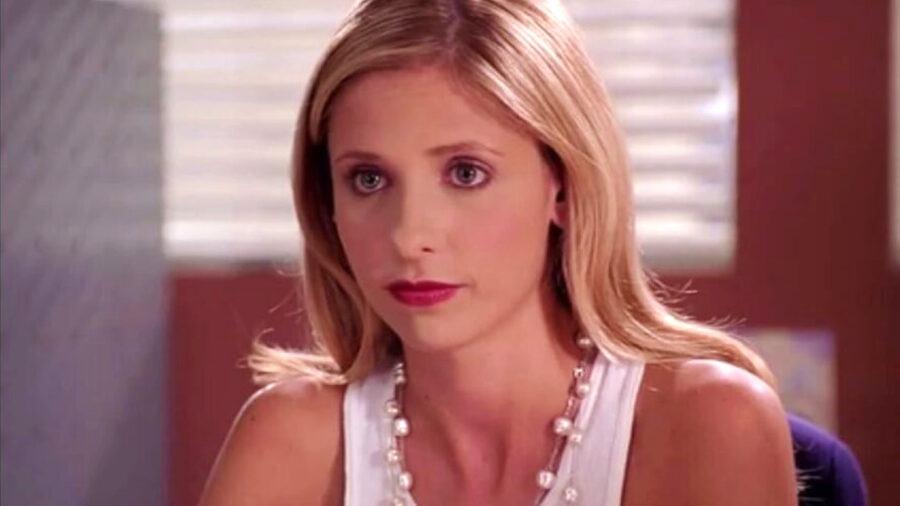
In Buffy the Vampire Slayer, Angel is a character stricken by a very specific curse: as a vampire, one of his victims’ families gives him his soul back, forcing him to constantly experience the crushing guilt of everyone he has ever hurt or killed. To make things worse, there was a catch to this curse that served to twist the knife in Angel’s heart. Specifically, if he ever experiences a moment of true happiness, he would lose his soul and once again become Angelus, one of the scariest vampires the planet had ever known.
All of this makes Angel (played by David Boreanaz) one of the most complex and fascinating characters in television history, and many Buffy fans have wondered where showrunner Joss Whedon got the idea for this gut-wrenching curse. But you don’t have to look far to discover the answer: as it turns out, Whedon drew inspiration from one of the most famous stories in all of literature. You see, Angel’s curse is very similar to what we see in the tale of Faust, better known as the original “deal with the devil” story.
What A Terrible Night For A Curse

If your memories of English class are a little fuzzy, here’s a quick primer: Faust was originally a German legend about a man who, despite his success, simply wanted more out of life. In order to get it, he made a deal with the devil in which he would get all of the worldly knowledge and pleasures that he could ever want. But after a life of experiencing what amounted to Heaven on Earth, his soul would go straight to Hell once he died.
Multiple authors have adapted this German folktale, and the most famous was created by Johann Wolfgang von Goethe. He added his own twists to Faust’s pact with the devil, including Faust making a very special wager: he will become a servant in Hell only if the Devil can provide him with a moment of true happiness that he would want to last forever. This unexpectedly happens when Faust begins dreaming of people working together to make the world a better place; this moment of happiness damns his soul, but he is effectively saved by God, who rewards Faust with salvation because of his righteous dream of human harmony.
The Most Tortured Vampire In History

Needless to say, there is plenty of parallelism between what happens to Goethe’s Faust and what happens to Angel in Buffy the Vampire Slayer. Once his soul is restored, Angel does his best to atone for all the terrible acts that he committed as a vampire. But once he experiences a moment of true happiness (which happened, awkwardly enough, during sex with Buffy), he loses his soul, becoming once more a terrible monster who damns himself with each transgressive act.
Arguably, Angel is also the beneficiary of the same divine grace that saved Faust: after losing his soul and becoming Angelus, he enacts a plan meant to plunge the entire world into Hell. Buffy stops him, but only after Willow successfully restores his soul. This leads to the most heartbreaking moment in the entire series, in which Buffy has to kill the only man she has ever loved, sending him to a hell dimension in order to save every human on the planet.
Saved By The Spell

He is inexplicably resurrected in Season 3, and there is never an official explanation given for who or what brings him back from Hell. But one very prominent fan theory is that he was brought back by The Powers That Be, the same mysterious group of cosmic powerhouses who ensured Angel met Buffy. Later, they gave prophetic visions to Doyle, the demon who helped Angel become a champion of the helpless once he moved to Los Angeles.
Angel was originally condemned to Hell thanks to a very Faustian curse, and he may have been saved in the same way: by divine powers that rewarded his dream of making the world a better place. Either way, it’s clear that the tale of the most iconic vampire in Buffy the Vampire Slayer was influenced by the original deal with the devil story, one that has been influencing storytellers for centuries. Even though most fans never clocked it, this means that the hottest TV show of the ‘90s is forever connected to a German folktale that became popular nearly 500 years ago!
Entertainment
The Extremely R-Rated 90s Sci-Fi That Sent An Alien Caveman On Revenge Quest

By Robert Scucci
| Updated

It really takes a lot for me to sit through an entire movie without knowing what the hell it’s about, and I most recently experienced this with 1996’s Savage. There are so many unrelated storylines that feel like they should connect and lead to a satisfying payoff, but they never really do. My experience with the film made me want it all to make sense, but I had to read detailed plot synopses on both Wikipedia and IMDb just to make heads or tails of the thing, and somehow I ended up even more confused.
Normally when I write reviews, I open those tabs to get the character and talent names straight because I’m great with faces but terrible with names. In this case, I had to SparkNote my way through the plot because Savage is profoundly nonsensical, to the point where I think it should be studied.

Savage is a sci-fi action film, but also a revenge film, but also a film about ancient aliens, super-powered cavemen, and an evil virtual reality game company, all of which are completely at odds with each other. Visually, it’s an absolute feast of low-budget special effects, which is what drew me to it during a late-night Tubi scroll in the first place. I don’t regret watching it, but I can’t speak for how you’ll feel about this one, dear reader.
Hell Hath No Fury Like An Alien Caveman Hellbent On Revenge

Here’s where I try to explain what Savage is all about. A man named Alex Verne (Olivier Gruner) gets committed to a psychiatric hospital after his family is randomly murdered. One day, two years later, he decides it’s time to escape. Wandering through the desert, he hears a voice that leads him to a cave. Inside are paintings of ancient aliens. Alex lives like this for an indeterminate amount of time until he encounters an alien apparition that first takes the form of his dead wife, and then the killer. The alien tells him he has to get revenge because the killer will do it again to “millions of others.”
Alex gets electrocuted and suddenly has superhuman strength, which pairs nicely with the caveman skills he developed while living out in the desert. He wanders the streets naked and gets taken into police custody, where he meets Officer Nicky Carter (Jennifer Grant), who’s put off by his strange behavior but still somehow finds him irresistible enough to become a valuable ally by the third act.

Meanwhile, and completely out of nowhere, we’re introduced to Reese Burroughs (Kario Salem), the corrupt chairman of the Titan Corporation. He specializes in virtual reality video games and has hilariously named henchmen Marie Beloc (Kristin Minter), Edgar Wallace (Sam McMurray), and Allan Poe (Herschel Sparber) following him around wherever he goes. As luck would have it, Reese has been waiting a long time for a police report about a weird naked caveman type getting arrested, and now he has to track down Alex and eliminate him for … reasons, I guess.
Alex, now referred to as a savage by Reese and his goons due to his alien caveman abilities, escapes the holding cell, hellbent on breaching the Titan Corporation for … other reasons, I guess, as the home viewer (because this is obviously a direct-to-VHS effort) tries to piece these plot points together. You’re left wondering how the final showdown between these characters will play out in both the real world and the virtual one they occupy.
Thematically Bankrupt With Plenty Of Visual Bangers

Most reasonable people will read the above synopsis of Savage and decide not to watch it. I don’t blame them. However, for a direct-to-video sci-fi B-movie, it has tremendous visuals. The virtual reality sequences are immersive. The aliens are corny but cool, and they perfectly capture that “waking up at 3 am and this is what’s playing on TV after I passed out watching something else” vibe that I remember so fondly from my university days.
If you can get past the fact that the plot makes no sense, Savage is tremendously fun to watch. Personally, I treated it as a series of vaguely related vignettes occupying the same universe, which allowed me to appreciate the visuals without scrutinizing the storytelling too much. That said, it feels like there has to be a director’s cut floating around somewhere because the connection between Alex and Reese is vague at best until far too late in the runtime.


Savage, in all of its insane glory, is currently streaming for free on Tubi. Throw it on when you’re looking for something different because there’s nothing quite like it. Just don’t say I didn’t warn you when you get halfway through and realize that so much has happened without telling anything close to a coherent story.

Entertainment
How A Case Of Mistaken Identity Led To Bill Murray’s Most Bizarre Role
By TeeJay Small
| Published

You probably know Bill Murray as one of the greatest comedic minds of the 1980s through the mid 2000s. If you’ve followed his career closely, you’ve seen him put audiences in stitches with performances in Saturday Night Live, Ghostbusters, Zombieland, and everything in between. Still, every actor makes a few questionable choices in their time, and not every Bill Murray performance is a slam dunk. Fans of the comedic A-lister were shocked, for instance, when Murray agreed to voice the titular orange cat in 2004’s Garfield: The Movie, a role he later revealed he took by mistake after mistaking writer Joel Cohen for Joel Coen.
When this casting news was first announced, fans pontificated on the reason why Bill Murray would agree to lead a highly sanitized PG movie. After all, his other projects around that time include such mature, introspective hits as The Royal Tenenbaums, Lost in Translation, and The Life Aquatic with Steve Zissou. Surprisingly, it turns out that Murray signed on to voice Garfield not for a quick paycheck, not out of love for the original comic strip, but purely by accident, due to this case of mistaken identity.
Not The Coen He Was Looking For

2004’s Garfield: The Movie was written by a screenwriter named Joel Cohen. Cohen is credited as a writer on such hit films as Toy Story, Cheaper By The Dozen, and Evan Almighty. When Bill Murray saw the name on the screenplay for Garfield: The Movie, he mistook the scribe for the very similarly-named Joel Coen, of the Coen Brothers. The Coens, as you likely already know, have a penchant for writing off-beat comedic films that would be a much better fit for Bill Murray’s off-the-walls personality than Garfield: The Movie.
Bill Murray spoke on this subject over a decade ago during a Reddit AMA session. Responding to a fan who asked if there would ever be a third Garfield film, Murray stated “I wasn’t thinking clearly, but it was spelled Cohen, not Coen. I love the Coen brothers movies. I think that Joel Coen is a wonderful comedic mind. So I didn’t really bother to finish the script, I thought ‘he’s great, I’ll do it.’” The comedian claims that he didn’t realize Cohen and Coen were different people until months later, after he started laying down his lines.
A Simple Misunderstanding Extrapolated To Absurdity

In that very same comment, Bill Murray outlined his process while working on Garfield: The Movie, and spoke as though the experience was complete torture. He adds “It was sort of like Fantastic Mr. Fox without the joy or the fun.” Furthermore, Murray claims that all the live action parts of the film were shot before he laid down any lines, and the Garfield model was composited in as a gray blob. It’s well known that Murray improvised heavily throughout the recording process, but he revealed during his Reddit Q&A that he made numerous attempts to reframe entire scenes by swapping his dialogue with jokes that more closely aligned with his vision, much to the chagrin of Joel Cohen.
In an era of social media, it seems like celebrities are more accessible to the public than ever before. Even still, I’m not sure there’s anything more relatable than a guy taking on a massive months-long job based on a simple miscommunication because he couldn’t be bothered to proofread for a single letter H. To this day, Bill Murray has still never worked with the Coen brothers, but he did complete two Garfield films, which are currently available to stream on Hulu.
Entertainment
Every Major Change One Piece Season 2 Made To The Source Material
By Jonathan Klotz
| Published

Now that Netflix’s live-action One Piece Season 2 has been out for awhile, you’ve probably become curious about how it matches up to the original One Piece anime. As with the first season, manga creator Eiichrio Oda was actively involved in all stages of production, even helping with adjustments from the source material and giving them his blessing. His level of involvement is why the series is the new gold standard for live-action adaptations.
The Garp And Gol D. Roger Flashback

Ripped from the Marineford arc and dropped at the start of Season 2’s Loguetown episode, Garp and Gol D. Roger’s conversation is a bit of misdirection. Fans watching only the live-action series would think that Roger is asking Garp, who we know is Luffy’s grandfather, to take care of his son. That would mean Luffy is the son of the greatest Pirate in history.
Except he’s not. Long-time fans know that Roger’s son is Ace, part of Whitebeard’s pirate crew, and user of the Flame Flame Devil Fruit. DC’s Blue Beetle, Xolo Marideuna will play Ace when he makes his first appearance in Season 3.
For now, the flashback to Roger’s execution hints at the existence of his son, misdirects the audience, and lays the stage for something Oda did a lot during One Piece Season 2: placing events from future arcs much, much earlier than before, but where they make perfect sense.
Bartolomeo Appears Much Much Earlier

An example of an early appearance comes right in Episode 1, when the memorable green hair and canines of Bartolomeo appears as a very confused bystander in Loguetown. He doesn’t appear in the anime until episode 633, over 500 episodes from the events of the first episode. But what he does do in the anime, is mention that he saw Luffy during the events in Loguetown. That makes this one of the best changes any live-action adaptation has ever made.

Bartolomeo may not be an East Blue mob boss, but his inclusion in Roger’s execution is technically, not a change from the anime. It’s a bit of a tease for fans as we may not see him again during the Netflix show’s run, unless they start compressing even more arcs each season, and they did a great job bringing the character’s strange appearance to life. He’d eventually become Luffy’s biggest fan, and his ship, the Going Luffy-senpai, is as ridiculous as his fashion sense.
Brook’s Human Form

Yet another pull from the future came in Episode 2, “Good Whale Hunting.” Anime viewers didn’t get to see Brook as a human until long after they got used to his undead skeleton form. His backstory isn’t shown until episode 379, over 40 episodes after his first appearance, and by then, it’s been hundreds of episodes since Reverse Mountain. Including the flashback right away, to explain Laboon’s obsession with ramming the mountain, teases fans with what’s to come, and gives the heartbreaking story maximum emotional impact.

If Brook ever does return to the live-action One Piece, at least Martial T. Bachamen has nailed the look for one of the most unique Straw Hat Pirates. Fans will have to keep waiting to see how they’ll get across his skeletal appearance and wild fighting style in live-action.
Luffy Befriending Laboon

The live-action series changed a lot about the Reverse Mountain arc, from Crocus living inside Laboon, to the weird sky painted on the inside of the whale’s stomach. Among all the changes, Luffy’s plea for friendship is one of the best. It’s perfectly fitting that Luffy, the most joyous, upbeat, enthusiastic character in One Piece, would use the power of friendship to win over the massive whale.

In the anime and manga, Luffy stabs Laboon with the mast of the Going Merry. Instead of declaring their friendship, he announces that he and Laboon are now rivals. On the one hand, that’s how boys make friends, on the other, the live-action did it so well while being true to Luffy’s nature, that both versions work.
Luffy And Zoro Don’t Fight

Zoro gets his shining moment in Whiskey Peak by taking on 100 members of Baroque Works, in what’s not only the highpoint of Season 2, but in the running for Netflix’s best action scene ever. What’s left out, is what comes next in the other adaptations: Luffy attacks Zoro for killing a lot of people he has no idea are Baroque agents. It’s the first real showdown between the two friends and it only comes to an end when Nami acts as the voice of reason. Sort of.

It was a stand out moment in the anime as anime fans love nothing more than debating who can beat who (saying Saitama form One-Punch Man would win is always an immediate flag on the play). Zoro, the greatest swordsman, against Luffy, the indestructible rubber man? It’s a great match up, which Luffy would win 10 out of 10 times, but it’s also easy to see why the live-action series cut it out.
Zoro And Sanji’s Dino Hunt

Little Garden is an interesting early island. Giants weren’t enough, it had to include actual dinosaurs. In the Netflix series, Zoro and Sanji argue over who can take down the biggest beast, and they end up arguing over who landed the killing blow on a massive T-Rex. In the source material, they each take down one of their own. They still argue, but it’s more evidence that Sanji isn’t the joke his only-kicks fighting style can make him look like.
Another small change that ties into the fauna of Little Garden is the missing shot of the insect that bites Nami and gets her sick. Removing any foreshadowing of the illness worked, and Nami going down during the party is an effective teaser for the next part of the journey.
The Marines vs. Baroque Works

Season 1 add a whole new subplot with Kolby and Helmpopo, so it makes sense that Season 2 keeps the Marines involved by including a sequence with Smoker and Tashigi investigating a Marine listening post under a Baroque Works assault. This is the type of addition that helps expand the world of One Piece. Even when the focus is on the Straw Hat Pirates, other characters are going on adventures in the background.
The other reason for the addition is to remind viewers that Smoker is an absolute unit. Without breaking a sweat, he goes through a unit of Agents and Miss Thursday. There’s nothing wrong with letting cool characters show why they’re cool. It’s the basis of Shonen anime.
The Flag

It’s one of the moments in the anime that establishes Luffy as a badass. When he dives and saves Chopper’s flag from destruction at the hands of King Wapol, he’s covered in smoke. Then it clears, and there’s Luffy, holding onto the tattered flag, standing on top of the castle. The kids call this aura farming.
During the Season 2 live action climax, Luffy still saves the flag and gives his speech about what the flag represents to an astonished King Wapol. The scene is still there, but the scale is smaller, the only ones present are Wapol and the crew of the Going Merry. It’s a great moment, and Luffy shows a small fraction of his potential power in absorbing the direct hit, but as with most of the changes from the anime to the live-action, it cuts everything down. Which is understandable, but if more adaptations did it like this, the track record would be a lot better.
One Piece is a Netflix Original, and can be streamed with an active subscription.

Packers extend WR Jayden Reed's contract for reported 3 years, $50.25M
Resurgent offenses of D.C. United, Orlando City set for battle


