
Tech
Blue Origin pauses space tourism flights to focus on the moon
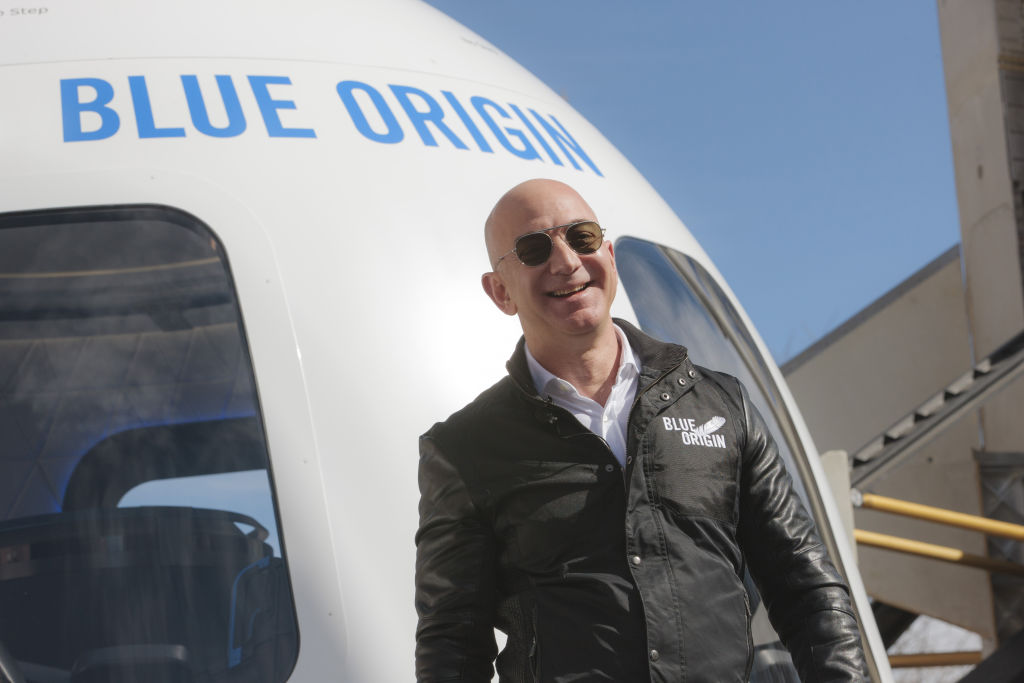
Jeff Bezos’ space company Blue Origin is pausing its space tourism flights for “no less than two years” in order to focus all of its resources on upcoming missions to the moon, the company announced Friday.
The decision puts a temporary halt on a program that Blue Origin has been using to fly humans past the Kármán line, the recognized boundary of space, for the last five years.
Blue Origin made the announcement just a few weeks ahead of the expected third launch of its New Glenn mega-rocket, which is slated for late February. The company had previously suggested it was going to use the third New Glenn launch to send its robotic lunar lander to the moon, but that spacecraft is still undergoing testing at NASA’s Johnson Space Center in Texas.
Since retaking office, President Donald Trump has put pressure on NASA to send astronauts back to the moon before the end of his second term. That has cleared the way for companies other than SpaceX to compete for these missions.
“The decision reflects Blue Origin’s commitment to the nation’s goal of returning to the Moon and establishing a permanent, sustained lunar presence,” the company wrote Friday.
Blue Origin first flew the New Shepard rocket more than a decade ago, and it became the first rocket to go to space and safely land back on Earth. Unlike SpaceX’s Falcon 9, though, the New Shepard rocket was never intended to reach Earth orbit. Its utility has therefore been limited to space tourism flights, which allow passengers around four minutes of weightlessness in Blue Origin’s space capsule, and science missions.
The company said Friday that New Shepard has flown 38 times and carried 98 humans to space, along with more than 200 scientific and research payloads.
Techcrunch event
Boston, MA
|
June 23, 2026
The New Shepard program was previously paused in 2022 after one of the company’s boosters exploded mid-flight. There were no humans on that flight, and the capsule safely ejected away from the booster. But New Shepard remained grounded until late 2023 while Blue Origin worked on identifying and fixing the cause.
Tech
Exclusive: Google deepens Thinking Machines Lab ties with new multi-billion-dollar deal

Former OpenAI executive Mira Murati’s startup, Thinking Machines Lab, has signed a new multi-billion-dollar agreement to expand its use of Google Cloud’s AI infrastructure, including systems powered by Nvidia’s latest GPUs, TechCrunch has exclusively learned.
The deal is valued in the single-digit billions, according to a source familiar with the matter, and includes access to Google’s latest AI systems built atop Nvidia’s new GB300 chips, alongside infrastructure services to support model training and deployment.
Google has been actively striking a number of cloud deals with AI developers as it aims to wrap together its AI computing offerings with other cloud services like storage, a Kubernetes engine, and Spanner, its database product. Earlier this month, Anthropic signed an agreement with Google and Broadcom for multiple gigawatts of tensor processing unit (TPUs) capacity (these are Google’s custom-designed AI chips for machine learning workloads).
But the competition is fierce. Just this week, Anthropic also signed a new agreement with Amazon to secure up to 5 gigawatts of capacity for training and deploying Claude.
Earlier this year, Thinking Machines partnered with Nvidia in a deal that included an investment from the chipmaker. But this is the first time the lab has struck a deal with a cloud services provider. The deal is not exclusive, so Thinking Machines may use multiple cloud providers over time, but it’s still a sign that Google is looking to lock in fast-growing frontier labs early.
Murati left her job as OpenAI’s chief technologist and founded Thinking Machines in February 2025. The company, which soon afterwards raised a $2 billion seed round at a $12 billion valuation, has remained highly secretive, but launched its first product in October. Dubbed Tinker, it’s a tool that automates the creation of custom frontier AI models.
Wednesday’s deal provided some insight into what Thinking Machines is developing. In a press release, Google noted that it can support the startup’s reinforcement learning workloads, which Tinker’s architecture relies on. Reinforcement learning is a training approach that has underpinned recent breakthroughs at labs, including DeepMind and OpenAI, and the scale of the Google Cloud deal reflects how computationally expensive that work can get.
Techcrunch event
San Francisco, CA
|
October 13-15, 2026
Thinking Machines is among the first Google Cloud customers to access its GB300-powered systems, which offer a 2X improvement in training and serving speed compared to prior-generation GPUs, per Google.
“Google Cloud got us running at record speed with the reliability we demand,” Myle Ott, a founding researcher at Thinking Machines, said in a statement.
When you purchase through links in our articles, we may earn a small commission. This doesn’t affect our editorial independence.
Tech
The most interesting startups showcased at Google Cloud Next 2026
Google Cloud Next is taking place this week in Las Vegas, and one clear message has emerged: Google wants AI startups on its cloud. To that end, it made several startup-related announcements.
The most significant is that the tech giant has earmarked a new $750 million budget to help its Cloud partners sell more AI agents to enterprises. This funding is available to partners ranging from startups to the big consulting firms. It can be used for costs like Gemini proof-of-concept projects, Google forward-deployed engineers, cloud credits, and deployment rebates.
Google also highlighted a long list of startups that are using Google Cloud, either newly signed or expanding their footprint. Among them are a few standout names:
Lovable is expanding its use of Google Cloud by launching a new coding agent through Google’s enterprise app marketplace. Lovable is the fast-growing vibe coding startup and was on a $400 million ARR track as of February, it said.
Notion, Silicon Valley’s favorite AI-infused document productivity app, most recently valued at about $11 billion, is using Gemini models to power its text and image generation features.
Gamma, an AI-powered PowerPoint killer recently valued at a $2.1 billion valuation, is using Google’s state-of-the-art image model Nano Banana 2 and other Google Cloud features.
Inferact, the commercial inference startup from the creators of the popular open-source project vLLM, is accessing Nvidia’s GPUs through Google Cloud, in addition to using the tech giant’s AI stack.
Techcrunch event
San Francisco, CA
|
October 13-15, 2026
ComfyUI, the popular open-source tool for creating AI-generated images and multimedia, also offers access to Nano Banana 2 and is using other Cloud features.
Other startups that received the Google Cloud shout-out this year include:
ChorusView, which makes AI-powered smart tags that track the condition and movement of goods in real time.
Emergent AI, a vibe coding platform.
ExaCare AI, which makes AI software for post-acute medical care facilities.
Insilica, which creates AI-generated regulatory-compliant chemical safety reports.
Optii, which makes AI-enhanced hotel operations software.
Parallel AI, which builds web search and research APIs built for AI agents.
Proximal Health, which makes AI-powered software that automates the insurance claims adjudication process.
Reducto, which does AI-powered document parsing.
Stord, which handles e-commerce fulfillment and parcel operations.
Stylitics, which makes AI image generation software for retailers for tasks like outfit styling and product bundles.
Temporal, a developer cloud environment built to prevent failures.
Vapi, which makes dev tools for building conversational voice agents.
Vurvey Labs, which conducts synthetic market research via AI agents.
Wand, an in-game assistant for single-player PC games.
Watershed, which makes software that helps enterprises report on and manage sustainability programs.
ZenBusiness, an all-in-one back-office tool for small businesses that includes an AI chat assistant.
When you purchase through links in our articles, we may earn a small commission. This doesn’t affect our editorial independence.
Tech
Duolingo is now giving free users access to advanced learning content
Duolingo announced on Wednesday that its advanced language learning content is now available for free across nine languages: English, Spanish, French, German, Italian, Portuguese, Japanese, Korean, and Chinese. Users can access this content through the web, iOS, and Android devices.
This advanced content is at the B2 level on the Common European Framework of Reference for Languages (CEFR), which is the international standard for language skills that schools and employers recognize. B2 level content refers to learning materials without translations, complex scenarios, and specialized vocabulary.
The new offering will include features like “Advanced Stories,” which helps with reading comprehension, and DuoRadio, a podcast-like audio experience for listening comprehension.
Now that Duolingo users can tap into this advanced learning content for free, they can level up their skills, whether that’s practicing for job interviews, prepping for studying abroad, or tackling complex news articles, films, and books without relying on translations.
The company says this positions it as the only free app to offer advanced-level learning across these nine languages at no cost. While competitors like Babbel and Busuu offer advanced courses, they typically require paid subscriptions. For instance, Busuu has some CEFR-aligned courses up to the B2 level, but the free version is pretty limited and doesn’t offer lessons like grammar explanations, so users need to pay for full access.
Previously, Duolingo only provided free courses that capped at A2 or B1 levels, mainly focusing on basic communication skills.

The company is positioning this free advanced learning offering as an enticing opportunity for job seekers, framing language learning as a practical pathway to improving employability in an increasingly global workforce.
Techcrunch event
San Francisco, CA
|
October 13-15, 2026
This comes at a time when the job market remains highly competitive and overall growth has slowed. Research from the American Council on the Teaching of Foreign Languages shows that learning a second language can raise someone’s employability by as much as 50%.
“Reaching job-ready proficiency in a new language used to be out of reach for most people,” Bozena Pajak, head of learning science at Duolingo, said in a statement. “It took years of expensive classes or immersive experiences that not everyone could access.”
Duolingo’s decision to offer advanced learning for free is also a strategy to increase its free user base. In its Q4 earnings report, the company stated that it has 52.7 million daily active users, demonstrating 30% growth compared to the previous year. This number is higher than its paid subscriber base, which stands at 12.2 million. However, Duolingo’s shares fell after the company projected that the year-over-year bookings growth rate for Q2 2026 is expected to experience a slight decline.
When you purchase through links in our articles, we may earn a small commission. This doesn’t affect our editorial independence.

Luke Keaschall powers late rally as Twins dump Mets
The Bang & Olufsen Beosound Explore Bluetooth speaker is at the lowest price weve seen all year


