
Entertainment
The Secretly Raunchy Star Trek Episode That Could Never Be Made Today
By Chris Snellgrove
| Published

Star Trek: The Next Generation had several surprisingly naughty episodes, including “The Naked Now” (where Tasha Yar finds out Data was programmed to be a love machine) and “Sub Rosa” (where Dr. Crusher gets down and dirty with her grandmother’s ghost boyfriend). Nobody really thinks of “The Game” as a dirty episode, though, because it features very little sex outside of Riker picking up a dangerously addictive game from his latest alien booty call. However, episode writer Brannon Braga later revealed a raunchy little secret: all of the Enterprise crew who get infected by the parasitic video game experience onscreen orgasms.
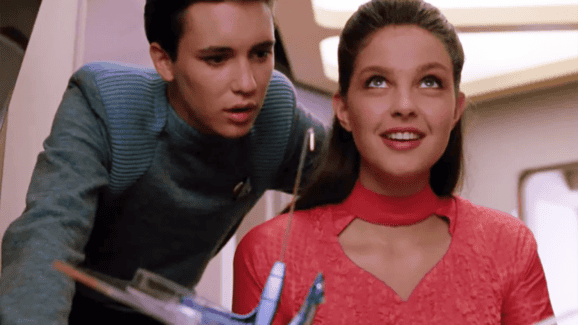
First, some context: in “The Game,” Starfleet Academy cadet Wesley Crusher has returned to the Enterprise, eager to catch up with his mother and his many shipboard friends. But they are more than a bit distracted because Riker got everyone hooked on a weird video game that feels insanely good to play. That’s because completing levels stimulates the pleasure centers of a player’s brain, causing intense addiction; this leads to the ship nearly getting hijacked, but Wesley and his new friend Robin Lefler (played by Ashley Judd) manage to re-activate Data and save the day.
Getting The High Score On Sex

One of the most notable features in “The Game” is that we can see the effect that the titular game has on fan-favorite Next Generation characters like Riker. When someone completes a level, the game lights up their pleasure centers, making them feel good right away. Most fans always assumed this was to emphasize the game’s addictive nature; after all, the faces these actors pull make it seem like their characters just replicated and consumed the finest heroin in the galaxy.
However, “The Game” writer Brannon Braga later set the story straight when discussing the Next Generation episode “Sub Rosa.” If you don’t already know, this episode is infamous for making Dr. Crusher impossibly horny: she reads her grandmother’s erotic journal entries and ultimately has ghost sex with grandma’s spooky slampiece. Oh, and Picard walks in on her, an interruption that prevents the, um, warp core breach that Dr. Crusher is working towards.
Paging Dr. Love

In Captains’ Logs: The Unauthorized Complete Trek Voyages, Brannon Braga mentions how he thought the sex in “Sub Rosa” (an episode he wrote) was “mild by comparison” to what he had written for his earlier episode. According to him, Dr. Crusher’s infamous scene in “Sub Rosa” wasn’t a big deal to him because, “I scripted the first orgasm in ‘The Game.’”
That’s right, Star Trek fans! Every time you see your favorite Next Generation characters making those happy faces in “The Game,” they are supposed to be experiencing honest-to-God orgasms. This is straight from Braga himself, who apparently took his own perverse pleasure sneaking a series of “O faces” past network censors without getting any real pushback.
A Raunchy Episode Hiding In Plain Sight

In retrospect, Braga wasn’t exactly subtle in his writing; pull up the script for “The Game” online, and his description of the game’s effect on the Enterprise’s first officer makes things quite clear. “Suddenly, Riker’s entire body tenses up,” the script reads. “A moment, then he relaxes and lets out a small gasp. Like he’s experienced a brief moment of internal pleasure.”
As he gets better, the erotic nature of the game gets the better of him. According to Braga’s script, after Riker completes the second level, he ‘lets out a gasp of even greater pleasure,” which is the last thing we see during the cold open. Riker’s own ecstatic O-face is the last thing you see before the opening credits, perfectly setting the tone for one of TNG’s naughtiest episodes.

Nobody ever really clocked how raunchy “The Game” was, and most fans chalked the characters’ apparent onscreen pleasure up to the drug-like effect of the game. Now, we know the truth: that our favorite characters were getting their rocks off onscreen, over and over again. Given this information, I don’t need to be a Betazed to read Brannon Braga’s mind: I sense great freakiness, captain!
Entertainment
Erupcja trailer: Charli XCX stars in explosive sapphic romance

Charli XCX is going from pop star to movie star with a string of films, including the queer fantasy 100 Nights of Hero, the mockumentary The Moment, and the sapphic romantic drama Erupcja.
Charli XCX co-wrote the script for Erupcja with director Pete Ohs and co-star Lena Góra. Set in Warsaw, the film focuses on two women, a local florist named Nel (Góra) and a tourist named Bethany (XCX), who has repeatedly crashed her love life. But this time, Bethany’s brought her current boyfriend Rob (Will Madden), who is looking for the perfect moment to propose.
In my review out of the film’s premiere at the Toronto International Film Festival, which is quoted in the above trailer, I cheered: “Shot with the kinetic yet poised cool of the French New Wave, this Polish production feels timeless. Its scenes play out with enough specificity for audiences to hook in, but enough ambiguity that they can feel like a dream. There’s a touch of fairy tale to that. Ohs keeps his characters curious and fluid, refusing to shove them into easy-to-define roles of hero and villain. Instead, Erupcja embraces the feral nature of love, messy and wondrous…. Erupcja is a thundering rumble of drama and romance, leaving its audience excited and rattled.”
Erupcja opens in theaters April 17.
Entertainment
Samsung finally sets a date: Galaxy Unpacked is coming Feb. 25
Our long national nightmare is over. We finally know when Samsung is going to show off the Galaxy S26 lineup.
The Korean tech giant confirmed that the next Galaxy Unpacked livestream will take place on Wednesday, Feb. 25 at 10 a.m. PT (9 a.m. ET). The event is in San Francisco this year, and it’s widely expected that Samsung will show off three new Galaxy S26 phones.
As per usual, you can watch the event on Samsung’s website or Samsung’s YouTube channel.
Mashable Light Speed
Mashable will be at the event and reporting live on all of the announcements, so keep checking back for the latest updates on Galaxy Unpacked.
Hosting the event this late in February is highly unusual for Samsung, which usually launches its next-gen Galaxy phones in January. It’s not really clear why Samsung took as long as it did to put Unpacked together this year, as it doesn’t seem like the S26 lineup is doing anything too wild to shake up the formula, though production delays and the global memory shortage may be factors.
All reports point to the usual lineup (S26, S26 Plus, and S26 Ultra) returning this year, with typical upgrades like a newer processor and bigger batteries.
It also wouldn’t be surprising to see some camera upgrades or new AI features, and we’ve already reported on a ton of S26-related leaks and rumors. We’ll all find out together in a couple of weeks.
Topics
Samsung
Samsung Unpacked
Entertainment
What I Won’t Tell My Friend About Dementia

“My dad got diagnosed on Tuesday, and I’m scared.” My friend’s text comes in the middle of the night.
I sit on the toilet at 3 a.m., considering how to welcome her to the most awful club.
My own mother was diagnosed with dementia a few weeks into COVID, shortly after my husband and I had asked her and my dad to move nearby and help with the kids, drowning as we were in online kindergarten. My mom had been a little “off” for years, and then forgetful, then increasingly paranoid. But she’d always been in love with the grandkids and our family. It was both a devastating surprise of a diagnosis, and not.
Now, years into this experience, the texts come regularly when friends’ parents are diagnosed. Every time I pause. What can I say that will help? What can I share of my experience that isn’t just the pain, the pain, the pain? There are so many things I want to tell her, and so many that I feel I can’t.
I lie awake feeling the chasm between myself now and myself the moment of my mom’s diagnosis, trying to find rocks to stand on in this river — something solid I can share with my friend, something that might steady her as the current pulls.
I’ll tell her what came before the diagnosis, because I know my friend’s loss has already started. The months or years before a diagnosis are their own kind of hell, not knowing what is happening. Questioning one’s own mother — wondering if she’s aging or sick or just being difficult — is a loss of its own, even before doctors are involved.
I’ll tell her about my mom showing up when my daughter was born, paranoid that our house had bed bugs despite no evidence, no bites. I took my newborn to the library when she was two days old so my husband and dad could inspect everything. I felt angry, abandoned, confused — I’d just given birth, but she was the one acting crazy. Now I know she wasn’t crazy, she was sick.
I’ll tell my friend that I hope now she is less lonely. My mom’s diagnosis at least gave a name to the pain I had been feeling of losing someone I loved, and it allowed me to talk about it more openly with friends. While there was so much grief in her diagnosis, there was also a clearer way to understand what my family had been moving through.
Along with the diagnosis came endless, impossible decisions. We spent a long time terrified of moving my mom into a care facility. She was the matriarch of our family, deeply in love with my dad and her garden, and it felt dehumanizing to take her away from what she knew. But she was wandering alone into the snow, waking up in the middle of the night to unplug every single appliance in the house, convinced the computer was going to catch fire. My dad wasn’t sleeping. My siblings and I became just as worried about his health as our mom’s.
There was a precise pain I felt the last time my mom was in my house — knowing it would be the last time, knowing she didn’t know that. She was joyful. We’d had Christmas with all the grandkids, and she and my dad had worn train conductor hats as the kids collected hot chocolate from them, Polar Express style. But she was also having bizarre mood swings and flashes of anger — at one point she tried to put out the fire with a large butcher knife.
The move to a care facility was clearly the right call. The experience reminded me of my kids starting daycare. It felt like a HUGE deal beforehand, then once she was there it was clear she was so happy. I slept better knowing my dad could rest and my mom was chatting with her new friend Martha over puzzles, and happy singing in the afternoon sessions. I fell in love with the people who cared for her, just as I had with my kids’ daycare teachers.
I’ll also tell my friend some small things that helped. When my mom had first shown signs of dementia, we encouraged her to complete a StoryWorth book. We now read her stories to her, and they calm her. My daughter reads them in her own bed every night. Sometimes that makes me cry. When she was still home and starting to wander, we put an AirTag in her shoe. We try to take care of the staff of her facility with the same care they give her — stocking the staff lounge with snacks, writing thank you cards, offering genuine gratitude.
Lying in bed in the middle of the night, I hold onto these practical steps like a life raft, because the emotional truth is harder. I’ll tell my friend that nothing anyone says will feel good. Things I hear regularly — “this has been so hard for so long” and “it’s happening so fast” — make me want to throw things even though (or, really, because) they are true.
But I’ll tell her what did help: friends who showed up without words. Junk food waiting at my parents’ house before a tough visit. Fancy shower products after I mentioned crying in the shower. Their presence in the hardest moments made me feel less alone.
Mostly, when I talk to my friend, I will tell her I am so sorry.
But I will not tell her everything. I will not tell her what’s coming, because if I had known how painful this was going to be, I would have welcomed the bed bugs, the fire, the knife.
I will not tell her about emergency calls to my therapist; the reports we get from my father’s daily visits; my mom currently being on her thirteenth month of hospice. I will not tell her I now understand the word agony.
Instead, I might tell her this: My mom was a woman who loved to help. A theater director and school librarian, she loved nothing more than telling people what to do. In some ways, helping friends now feels like honoring her — trying to make sense and meaning of her story.
When I’m talking to my friend, I also know I will have the exact same feeling that I still have when sitting by my mom’s bedside — there is so much more to say, so much left unsaid. I will want to say to my friend, as I want to say to my mom, she is doing great. The love won’t go away, it never could. Everything else may go, but as the current pulls us both forward, I can tell her this: the love remains.
And of course, I will tell my friend the one thing I cannot truthfully tell my mom, as much as I want to — she will survive this. She will. Most days, I remember I will too.
Kathleen Donahoe is a writer and poet living in Seattle. She has previously written for Cup of Jo about how she stopped drinking. She is writing her first novel and warmly invites you to follow her free Substack newsletter, A Little Laugh.
P.S. Rebecca Handler’s beautiful essay on loving her father through his final years of Alzheimer’s, and a parenting realization that really moved me.
(Photo by Darina Belonogova/Stocksy.)

Erupcja trailer: Charli XCX stars in explosive sapphic romance
Cavs, unbeaten with James Harden in action, clash with Wizards


