
Tech
The Minneapolis tech community holds strong during ‘tense and difficult time’
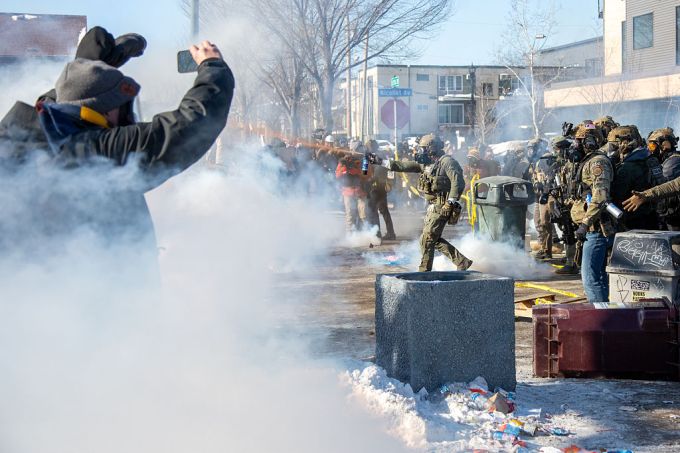
The city’s tech scene is reeling as U.S. immigration agents have escalated their crackdown in Minneapolis, killing several people, including at least two U.S. citizens.
Eight Minneapolis-based founders and investors told TechCrunch that they have put much of their work on hold and now spend their days focused on their communities, volunteering at churches, and helping buy food. It’s part of a grassroots effort, across race and class, that is seeing people speak out, donate money, protest, and offer emotional support to one another.
“There’s a lot of commonality between how a teacher is reacting right now and how a tech professional is reacting,” Scott Burns, an investor in the area, told TechCrunch. He said people are “very fatigued.” Burns is going to church more often to help pack food to deliver to those too frightened to leave their homes. “It was like what happens after a natural disaster,” he said of the effort.
Burns and other members of the Minneapolis tech industry told TechCrunch that the immigration raids have been very disruptive to their lives, describing a city that has seen itself united in the last several weeks in the face of escalating violence from U.S. Immigration and Customs Enforcement.
How can building a company remain a focal point when ICE agents appear to be everywhere, plainclothed and armed with military-grade weapons? Federal agents have been seen searching public transportation and prowling around workplaces. They are outside homes and in parking lots. They have been spotted circling schools.
One Black founder, who spoke on condition of anonymity to protect members of his staff, said he now carries his passport with him everywhere he goes. He is a U.S. citizen but has seen people of color throughout the city profiled and picked up by ICE and border patrol agents.
“People aren’t exaggerating how hard it has been. It’s hard to focus; it’s been a challenge just navigating even my team through it,” he said.
Techcrunch event
Boston, MA
|
June 23, 2026
He recalled a routine phone meeting with a colleague who suddenly fell silent. Lost for words, the colleague said she was watching ICE detain someone in the neighborhood, the same one his mother lived in.
“I had to get off the phone and call my mom to make sure she had her passport on her,” the founder said.

Efraín Torres, a Latino founder, works from home, listening tentatively to the immigration raids that happen in his neighborhood. “You can’t not hear them,” he told TechCrunch. Cars will beep. Protestors whistle alerts. “And if you miss it, you’ll see signs saying, ‘My neighbor was taken by ICE.’”
Officials even perform “citizen checks,” stopping people and asking them to prove immigration status — which the Supreme Court said last year can be done based on details like race or if a person has an “accent.” These checks have been conducted on people performing even mundane tasks, Torres said, like snow-blowing the lawn. He said he’s had a few run-ins himself with ICE, which is why he likes to stay low.
“The line separating me from being a victim of assault is just a chance encounter,” he said, adding that he knew people who were followed by ICE — something others have reported is happening alongside raids.
The Trump administration has escalated its immigration raids throughout the country, though the force deployed in the Twin Cities is especially large, with more than 3,000 federal agents deployed to Minnesota as part of the Trump administration’s “Operation Metro Surge.” ICE and border patrol agents now outnumber local police in Minneapolis almost 3 to 1, Senator Amy Klobucharof Minnesota has said.
The state is home to one of the largest populations of immigrants from Somalia, a group the administration has targeted before. That includes U.S. Representative Ilhan Omar, who has sparred with President Trump. Minnesota’s Democratic governor, Tim Walz, has also seen himself targeted by the president, as has the mayor of Minneapolis, Jacob Frey, whio is also a Democrat.
The surge in immigration enforcement is part of President Trump’s campaign promise to curb illegal immigration, though some argue that Trump has been specifically targeting cities and states that didn’t vote for him. More than 2,000 people have been arrested by ICE in Minnesota since Trump took office last January.
“It’s been difficult,” said one Black investor, who spoke on condition of anonymity. He, too, is a U.S. citizen and can trace his roots in the country back for a century. Still, living just outside the city, he carries his passport with him just in case.
“Where I go to the gym, they’re in rural Minnesota,” he said, meaning agents aren’t only in the city. “It’s just been a strange time.”

Everyone is doing what they can, however, to help others. This investor, for example, works with founders in college, many of whom are immigrants. He buys them food so they don’t have to risk going to the grocery store themselves. He also tries to work from home, when possible, as do many of the other people TechCrunch spoke with.
“It’s a tense and difficult time on the ground,” Mary Grove, another investor in the area, told TechCrunch.
Investor Reed Robinson, who has also been helping community members financially, said some of his founders with children have created a volunteer system to watch each other’s kids at school or daycare. It’s so common for ICE to detain the daycare staff, he said, adding that ICE agents frequently violate the law and court orders.
“It feels unnecessary, it feels intrusive, it feels like a violation of rights,” Robinson said about the immigration operation.
Like Robinson, many people feel anger beneath the unease and fear.
The emotional toll makes it hard to build, investors and founders said. Torres, for example, said his company now has a no-ride-sharing-app policy. Some of his engineers are on H-1B visas (which the Trump administration has also attacked) and have reported being followed by immigration officials.
“Each time, it was three to four armed men in tactical outfits,” Torres said, adding that he and his wife have spoken about fleeing the state. “They’re inflicting trauma everywhere they go.”
Grassroots efforts prevail as corporate leaders disappoint
The Minneapolis tech scene is still quite small, with companies raising just over $1 billion in the past few years. There are some notable companies in the ecosystem, such as the fintech Sezzle (now public), the clean water company Rorra, and the medtech Reema. There is an incredible history of innovation, Robinson said. “It’s not going to stop; we’re going to continue to do the work while we figure out this current situation.”
The Twin Cities — Minneapolis and St. Paul — are the headquarters of some of the biggest American companies, such as Target, Optum, Best Buy, UnitedHealthGroup, and General Mills, to name a few. Some founders and investors criticized the leadership of these big companies, mainly for their vague responses to the chaos gripping the cities, even as many of their own employees are detained.
“We haven’t had an adequate response,” one startup investor said.
Sixty top executives from the state signed a statement that called for an “immediate de-escalation of tensions” after ICE agents killed ICU nurse Alex Pretti. Large companies in the state have also come together to fund millions in grants through the Minneapolis Foundation for businesses impacted by the immigration operation.

But compared to what is happening on a grassroots level, many founders and investors said these actions are not enough. A recent CNBC poll found that a third of the executives they polled have stayed silent because they didn’t find speaking out relevant to the business. Eighteen percent were worried about “backlash from the Trump administration,” while 9% said they were still figuring out how to respond.
“When you see the failure of community institutions to demonstrate any kind of bravery, that’s really where it’s probably most disappointing,” Tim Herby, a local investor, told TechCrunch, calling the past two months heart-wrenching.
Grove, the investor, said her team routinely checks in with others in the community, including her portfolio companies, to ensure they are doing well. She said people are helping each other pay rent, while restaurants are offering free meals. A local tech nonprofit, Minnestar, is set to host a community event to bring people together and discuss next steps.
One Black investor said he found it ironic that today, the police are alongside many people in speaking out against the government, just a few years after people in the city were protesting against them after the murder of George Floyd. It’s a new day-to-day.
Another Black founder, meanwhile, said some of his white friends have started to drive him around the city for safety. He recalls one day sitting in a restaurant chatting with friends, when the television started giving live updates of ICE shooting another person. The mood fell somber, a reminder of how these raids have consumed every moment of life.
“I saw a friend yesterday,” he said. “It was the first time he left the house since New Year’s.”
Tech
Are AI tokens the new signing bonus or just a cost of doing business?

This week, a topic that has been boomeranging around Silicon Valley bounced into the spotlight: AI tokens as compensation. The idea is straightforward enough — rather than giving engineers only salary, equity, and bonuses, companies would also hand them a budget of AI tokens, the computational units that power tools like Claude, ChatGPT, and Gemini. Spend them to run agents, automate tasks, crank through code. The pitch is that access to more compute makes engineers more productive, and that more productive engineers are worth more. It’s an investment in the person holding them, is the idea.
Jensen Huang, the leather-jacket-wearing CEO of Nvidia, seemed to capture everyone’s imagination when he floated the notion at the company’s annual GTC event earlier this week that engineers should receive roughly half their base salary again — in tokens. His top people, by his math, might burn through $250,000 a year in AI compute. He called it a recruiting tool and predicted it would become standard across Silicon Valley.
It isn’t entirely clear where the idea was first, well, ideated. Tomasz Tunguz, a renowned VC in the Bay Area who runs Theory Ventures and focuses on AI, data, and SaaS startups — and whose writing on all things data has garnered a loyal following over the years — was talking about this in mid-February, writing that tech startups were already adding inference costs as a “fourth component to engineering compensation.” Using data from the compensation tracking site Levels.fyi, he put a top-quartile software engineer salary at $375,000. Add $100,000 in tokens and you’re at $475,000 fully loaded — meaning roughly one dollar in five is now compute.
That’s no coincidence. Agentic AI has been taking off, and the release of OpenClaw in late January accelerated the conversation considerably. OpenClaw is an open-source AI assistant designed to run continuously — churning through tasks, spawning sub-agents, and working through a to-do list while its user sleeps. It’s part of a broader shift toward “agentic” AI, meaning systems that don’t just respond to prompts but take sequences of actions autonomously over time.
The practical consequence is that token consumption has exploded. Where someone writing an essay might use 10,000 tokens in an afternoon, an engineer running a swarm of agents can blow through millions in a day — automatically, in the background, without typing a word.
By this weekend, the New York Times had put together a smart look at the so-called tokenmaxxing trend, finding that engineers at companies including Meta and OpenAI are competing on internal leaderboards that track token consumption. Generous token budgets are quietly becoming a standard job perk, the paper reported, the way dental insurance or free lunch once was. One Ericsson engineer in Stockholm told the Times he probably spends more on Claude than he earns in salary, though his employer picks up the tab.
Maybe tokens really will become the fourth pillar of engineering compensation. But engineers might want to hold the line before embracing this as a straightforward win. More tokens may mean more power in the short term, but given how fast things are evolving, it doesn’t necessarily mean more job security. For one thing, a large token allotment comes with large expectations. If a company is effectively funding a second engineer’s worth of compute on your behalf, the implicit pressure is to produce at twice the rate (or more).
Techcrunch event
San Francisco, CA
|
October 13-15, 2026
And there’s a muddier problem underneath that: at the point where a company’s token spend per employee approaches or exceeds that employee’s salary, the financial logic of headcount starts to look different to its finance team. If the compute is doing the work, the question of how many humans need to be coordinating it becomes harder to avoid.
Jamaal Glenn, an East Coast-based Stanford MBA and former VC turned financial services CFO, similarly points out that what may seem like a perk can be a clever way for companies to inflate the apparent value of a compensation package without increasing cash or equity — the things that actually compound for an employee over time. Your token budget doesn’t vest. It doesn’t appreciate. It doesn’t show up in your next offer negotiation the way a base salary or equity grant does. If companies successfully normalize tokens as pay, they may find it easier to keep cash comp flat while pointing to a growing compute allowance as evidence of investment in their people.
That’s a good deal for the company. Whether it’s a good deal for the engineer depends on questions most engineers don’t yet have enough information to answer.
Tech
Amazon working on new smartphone with Alexa at its core, report says
Looks like Amazon’s getting back into the smartphone game. More than 11 years after the e-commerce giant pulled the plug on its failed first effort, the Fire Phone, the company is now developing a new smartphone codenamed “Transformer,” Reuters reported, citing anonymous sources.
The device is being developed by the company’s Devices and Services division, and it would feature personalized features that would make it easier to use Amazon’s suite of apps, including Amazon Shopping, Prime Video, and Prime Music, the report said.
The smartphone would also support Alexa, the smart home assistant that Amazon has been investing heavily in, adding AI chops and expanding support to work with most of the company’s devices. AI features are said to be a big focus for the smartphone, which is being seen internally as a way to encourage Amazon customers to use its AI products, Reuters reported.
The smartphone is said to be developed by a relatively new unit within the Devices division called ZeroOne, which is led by J Allard, a former Microsoft executive who helped create the Xbox.
The news comes as Amazon has been going all-in on AI, investing $50 billion into OpenAI recently, and projecting $200 billion in capital expenditures toward its AI, chips, and robotics efforts in 2026.
The company spent more than a year revamping its Alexa assistant with generative AI features, finally launching it this February as Alexa+. The assistant keeps its smart home chops, and can now do most things that other AI chatbots can — like planning an itinerary for a trip, updating a shared calendar, finding and saving recipes to a library, making movie recommendations, helping with homework, exploring a topic, and more.
Amazon declined to comment.
Techcrunch event
San Francisco, CA
|
October 13-15, 2026
Tech
Cyberattack on vehicle breathalyzer company leaves drivers stranded across the US
A cyberattack on a U.S. vehicle breathalyzer company has left drivers across the United States stranded and unable to start their vehicles.
The company, Intoxalock, says on its website that it is “currently experiencing downtime” after a cyberattack on March 14. Intoxalock sells breathalyzer devices that fit into vehicle ignition switches, and is used by people who are required to provide a negative alcohol breath sample to start their car.
Intoxalock spokesperson Rachael Larson confirmed to TechCrunch that the company had been hit by a cyberattack. Larson said the company took steps to “temporarily pause some of our systems as a precautionary measure.”
These breathalyzer devices need to be calibrated every few months or so, but the cyberattack has left Intoxalock unable to perform these calibrations. The company said customers whose devices require calibration may experience delays starting their vehicles.
Drivers posting on Reddit say that cars are unable to start if they miss a calibration, effectively locking drivers out of their vehicles.
According to local news reports across Maine, drivers are experiencing lockouts and some have been unable to start their vehicles. One auto shop in Middleboro told WCVB 5 in Boston that it has had cars parked in its lot all week due to the cyberattack.
News reports from across the United States show drivers are affected from New York to Minnesota, and drivers have been unable to drive because their vehicle-based breathalyzers cannot be immediately calibrated.
Intoxalock would not say what kind of cyberattack it was experiencing, such as ransomware or if there was a data breach, or whether it had received any communications from the hackers, including any ransom demands. The company’s technology is used in 46 states, its website says, and it claims to provide services to 150,000 drivers every year.
Intoxalock did not provide an estimated timeline for its recovery.

Predators look to further cement playoff position in Chicago
Cubs OF Seiya Suzuki (knee) will not be ready for Opening Day


