
Tech
Tesla is killing off the Model S and Model X

Tesla is ending production of the Model S sedan and Model X SUV, CEO Elon Musk announced Wednesday during the company’s quarterly earnings call.
The company will make the final versions of both electric vehicles next quarter, he said, adding that his company will offer support for existing Model S and Model X owners “for as long as people have the vehicles.”
“It’s time to basically bring the Model S and X programs to an end with an honorable discharge, because we’re really moving into a future that is based on autonomy,” he said. “So if you’re interested in buying a Model S and X, now would be the time to order it.”
The Model S and Model X are both built at the company’s Fremont factory. Once production ends, Tesla will build Optimus robots in the same factory space in Fremont, California, according to Musk.
Tesla launched the Model S in 2012, and it is regarded as the first car that made electric vehicles widely appealing. The Model X was Tesla’s second major electric vehicle program.
Tesla always intended for its more affordable models — the Model 3 sedan and Model Y SUV — to greatly outsell their predecessors.
But sales of both models have flatlined in recent years, despite interior and exterior refreshes along the way. Tesla has faced increased competition in the luxury EV space from legacy automakers, as well as upstarts like Rivian and Lucid Motors.
Techcrunch event
San Francisco
|
October 13-15, 2026
“So that is slightly sad, but it’s… it is time to bring the S and X programs to an end,” Musk said.
This story is developing…
Tech
Hacktivist scrapes over 500,000 stalkerware customers’ payment records

A hacktivist has scraped more than half-a-million payment records from a provider of consumer-grade “stalkerware” phone surveillance apps, exposing the email addresses and partial payment information of customers who paid to spy on others.
The transactions contain records of payments for phone-tracking services like Geofinder and uMobix, as well as services like Peekviewer (formerly Glassagram), which purport to allow access to private Instagram accounts, among several other monitoring and tracking apps provided by the same vendor, a Ukrainian company called Struktura.
The customer data also includes transaction records from Xnspy, a known phone surveillance app, which in 2022 spilled the private data from tens of thousands of unsuspecting people’s Android devices and iPhones.
This is the latest example of a surveillance vendor exposing the information of its customers due to security flaws. Over the past few years, dozens of stalkerware apps have been hacked, or have managed to lose, spill, or expose people’s private data — often the victims themselves — thanks to shoddy cybersecurity by the stalkerware operators.
Contact Us
To contact Zack Whittaker securely, reach out via Signal username zackwhittaker.1337. Contact Lorenzo Franceschi-Bicchierai securely on Signal at +1 917 257 1382, or via Telegram, Keybase and Wire @lorenzofb, or email.
Stalkerware apps like uMobix and Xnspy, once planted on someone’s phone, upload the victim’s private data, including their call records, text messages, photos, browsing history, and precise location data, which is then shared with the person who planted the app.
Apps like uMobix and Xnspy have explicitly marketed their services for people to spy on their spouses and domestic partners, which is illegal.
The data, seen by TechCrunch, included about 536,000 lines of customer email addresses, which app or brand the customer paid for, how much they paid, the payment card type (such as Visa or Mastercard), and the last four digits on the card. The customer records did not include dates of payments.
TechCrunch verified the data was authentic by taking several transaction records containing disposable email addresses with public inboxes, such as Mailinator, and running them through the various password reset portals provided by the various surveillance apps. By resetting the passwords on accounts associated with public email addresses, we determined that these were real accounts.
We also verified the data by matching each transaction’s unique invoice number from the leaked dataset with the surveillance vendor’s checkout pages. We could do this because the checkout page allowed us to retrieve the same customer and transaction data from the server without needing a password.
The hacktivist, who goes by the moniker “wikkid,” told TechCrunch they scraped the data from the stalkerware vendor thanks to a “trivial” bug in its website. The hacktivist said they “have fun targeting apps that are used to spy on people,” and subsequently published the scraped data on a known hacking forum.
The hacking forum listing lists the surveillance vendor as Ersten Group, which presents itself as a U.K.-presenting software development startup.
TechCrunch found several email addresses in the dataset used for testing and customer support instead reference Struktura, a Ukrainian company that has an identical website to Ersten Group. The earliest record in the dataset contained the email address for Struktura’s chief executive, Viktoriia Zosim, for a transaction of $1.
Representatives for Ersten Group did not respond to our requests for comment. Struktura’s Zosim did not return a request for comment.
Tech
Ex-Googlers are building infrastructure to help companies understand their video data
Businesses are generating more video than ever. From years of broadcast archives to thousands of store cameras and countless hours of production footage, most of it just sits unused on servers, unwatched and unanalyzed. This is dark data: a massive, untapped resource that companies collect automatically but almost never use in a meaningful way.
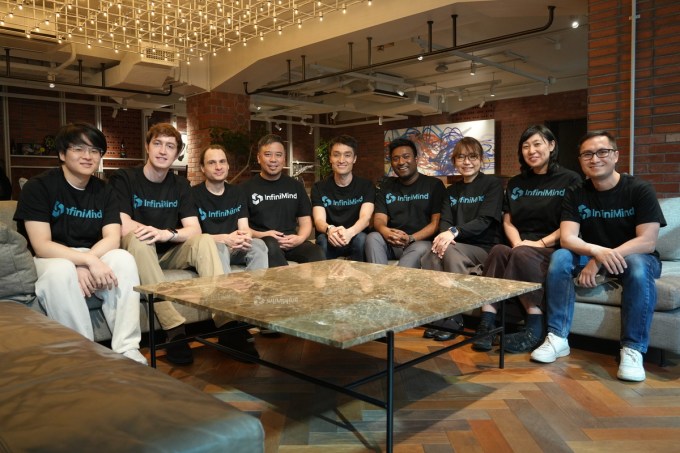
To tackle the problem, Aza Kai (CEO) and Hiraku Yanagita (COO), two former Googlers who spent nearly a decade working together at Google Japan, decided to build their own solution. The duo co-founded InfiniMind, a Tokyo-based startup developing infrastructure that converts petabytes of unviewed video and audio into structured, queryable business data.
“My co-founder, who spent a decade leading brand and data solutions at Google Japan, and I saw this inflection point coming while we were still at Google,” Kai said. By 2024, the technology had matured, and the market demand had become clear enough that the co-founders felt compelled to build the company themselves, he added.
Kai, who previously worked at Google Japan across cloud, machine learning, ad systems, and video recommendation models and later led data science teams, explained that current solutions force a trade-off. Earlier approaches could label objects in individual frames, but they couldn’t track narratives, understand causality, or answer complex questions about video content. For clients with decades of broadcast archives and petabytes of footage, even basic questions about their content often went unanswered.
What really changed was the progress in vision-language models between 2021 and 2023. That’s when video AI started moving beyond simple object tagging, Kai noted. Falling GPU costs and annual performance gains of roughly 15% to 20% over the last decade helped, but the bigger story was capability — until recently, models just couldn’t do the job, he told TechCrunch.
InfiniMind recently secured $5.8 million in seed funding, led by UTEC and joined by CX2, Headline Asia, Chiba Dojo, and an AI researcher at a16z Scout. The company is relocating its headquarters to the U.S., while it continues to operate an office in Japan. Japan provided the perfect testbed: strong hardware, talented engineers, and a supportive startup ecosystem, allowing the team to fine-tune its technology with demanding customers before going global.
Its first product, TV Pulse, launched in Japan in April 2025. The AI-powered platform analyzes television content in real time, helping media and retail companies “track product exposure, brand presence, customer sentiment, and PR impact,” per the startup. After pilot programs with major broadcasters and agencies, it already has paying customers, including wholesalers and media companies.
Techcrunch event
Boston, MA
|
June 23, 2026
Now, InfiniMind is ready for the international market. Its flagship product, DeepFrame, a long-form video intelligence platform capable of processing 200 hours of footage to pinpoint specific scenes, speakers, or events, is scheduled for a beta release in March, followed by a full launch in April 2026, Kai said.

The video analysis space is highly fragmented. Companies such as TwelveLabs provide general-purpose video understanding APIs for a broad range of users, including consumers, prosumers, and enterprises, Kai said, while InfiniMind focuses specifically on enterprise use cases, including monitoring, safety, security, and analyzing video content for deeper insights.
“Our solution requires no code; clients bring their data, and our system processes it, providing actionable insights,” Kai said. “We also integrate audio, sound, and speech understanding, not just visuals. Our system can handle unlimited video length, and cost efficiency is a major differentiator. Most existing solutions prioritize accuracy or specific use cases but don’t solve cost challenges.”
The seed funding will help the team continue developing the DeepFrame model, expand engineering infrastructure, hire more engineers, and reach additional customers across Japan and the U.S.
“This is an exciting space, one of the paths toward AGI,” Kai said. “Understanding general video intelligence is about understanding reality. Industrial applications are important, but our ultimate goal is to push the boundaries of technology to better understand reality and help humans make better decisions.”
Tech
Snapchat now lets you inform others when you have arrived at your destination
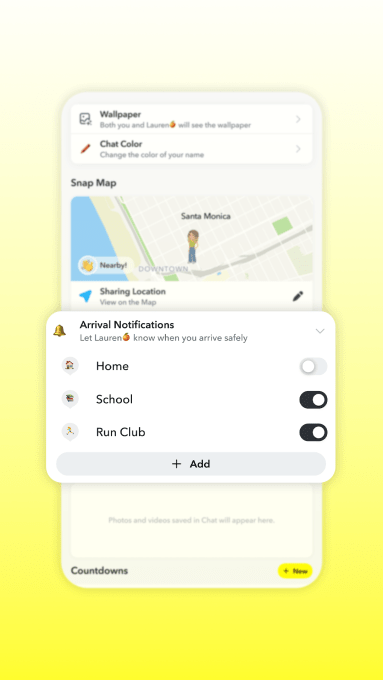
After launching a “Home Safe” feature that lets users notify friends and family when they’ve arrived home safely, Snapchat is now introducing additional alerts to inform others when users have arrived at other destinations.
The social media giant announced on Monday that with its new “Arrival Notifications,” users can now set one-time or recurring alerts for locations beyond their home, providing an automatic way to share when they’ve arrived at specific places.
“Arrival Notifications now work for everyday moments — like letting someone know you’re back for the night while traveling, or automatically sharing when you arrive at a weekly class, practice, or meeting — without needing to remember to send a message,” the company wrote in a blog post.

As with the platform’s Home Safe alerts, Arrival Notifications can only be sent to friends you choose to share your location with. It’s worth noting that location sharing on Snap Map is off by default. No one can see your location or receive an alert unless you choose to share it, Snapchat explained. One-time alerts expire after they’re sent or after 24 hours.
To use Arrival Notifications, you need to share your location with a trusted friend that you want to keep in the loop. Then, you need to tap on your friendship profile and scroll down to “Arrival Notifications.” You can pick a location on the map and give it a personal name. For example, you could set the location for your “run club” or the location for “piano lessons.” You can then choose a one-time or recurring alert, after which Snapchat will notify your friend when you arrive.
The new feature comes as Snapchat announced last summer that Snap Map now has more than 400 million monthly active users.
Snap Map, which launched in 2017, was originally a way for users to see their friends’ locations and browse public snaps from around the world. The feature now also offers ways for users to discover local hotspots and find things to do.
Techcrunch event
Boston, MA
|
June 23, 2026
With its Home Safe and Arrival Notifications features, Snapchat is looking to further compete with services like the family location-sharing app Life360 and Apple’s “Find My.”


Hacktivist scrapes over 500,000 stalkerware customers’ payment records

Ex-Googlers are building infrastructure to help companies understand their video data


