
Entertainment
Star Trek Just Ruined Its Best Alien Race, And The Explanation Makes No Sense

By Chris Snellgrove
| Updated

The fourth episode of Starfleet Academy, “Vox In Excelsio,” made some huge changes to the most famous alien race in all of Star Trek: The Klingons. The biggest change (and beware some spoilers the size of a warp core, this is your only warning!) is that the Klingon homeworld of Qu’onos has been completely destroyed because the Burn (introduced back in Discovery, Season 3) caused all of the planet’s dilithium reactors to explode. However, based on everything we know about dilithium from over 60 years of franchise history, this should have been completely impossible!
First, some context: since the days of Star Trek: The Original Series, we’ve seen starships traveling the galaxy thanks to the dilithium crystals that power their warp cores. After the crew of the USS Discovery jumped to the 32nd century, they discovered that both interstellar travel and the Federation had been devastated by an event called the Burn. The Burn caused dilithium throughout the galaxy to go inert, and this caused countless starships to explode because these crystals regulate the matter/antimatter reaction necessary to achieve warp speed.
Avoiding The Mistakes Of The Future, Today

Once the crystals went inert, the matter and antimatter collided in any ship with an active warp drive. This instantly caused the last thing any Starfleet captain wants to deal with: a warp core breach. Because of this, the Federation is still rebuilding by the end of Star Trek: Discovery, and Starfleet Academy is all about training the next generation of cadets who will make the galaxy a safer place as various planets and space empires continue recovering.
That brings us to the most recent episode of Starfleet Academy, “Vox Excelsius,” in which a reporter casually mentions that the Klingon homeworld of Qo’noS has previously been destroyed by the Burn. How did this work, mechanically speaking? The only explanation we get (aside from a dismissed conspiracy theory that “they blew it up themselves”) is that “the Burn caused dilithium reactors on Qo’noS and other worlds to explode.”
What The Experts Have To Say
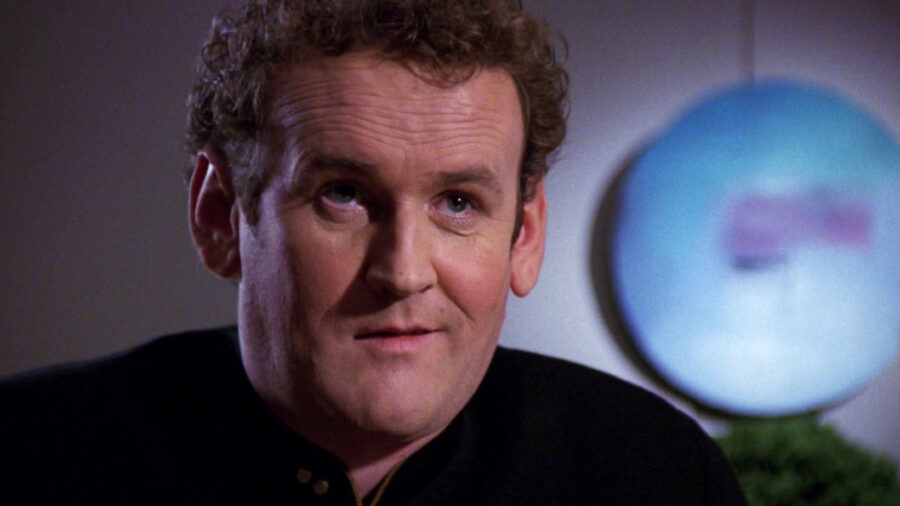
At first glance, this probably makes sense. After all, we know that the Burn affected dilithium in a way that made starships throughout the galaxy explode. Dilithium is both mined and stored on various planets, so the reporter’s breezy comment might make you think that the dilithium simply exploded with enough force to either destroy the Klingon homeworld outright or render it completely uninhabitable.
However, the starships destroyed by the Burn were only lost because the dilithium going inert caused instant warp breaches. While Starfleet Academy doesn’t really explain what a “dilithium reactor” is, it’s fair to assume that the Klingon homeworld was not attempting to travel anywhere at warp speed. The reactor is presumably meant to be a power source for Qo’noS, but at no point in Star Trek history has matter/antimatter been used to power anything other than warp drive.
Therefore, it’s only logical (Spock would be so proud) to determine that Paramount ruined the Klingons because the writers forgot how the Burn worked, which was established in the show that Starfleet Academy spun off from. This isn’t a case of the writers forgetting some obscure factoid introduced in The Original Series or even The Next Generation. Instead, they are ignoring a major story element that was introduced just a few years ago, a mistake made even worse by the other logical problems of this bizarre plot point.
Almost All Klingons Died For No Reason

For example, even though the Klingons are canonically stupid, why would they rely on dilithium as a power source? Even if we were to expect the idea (that flies in the face of established lore) that dilithium works as a planetary power source, Discovery previously established that dilithium had started becoming super scarce years before the Burn happened, which is why the Federation was researching alternative methods of achieving warp speed without dilithium crystals. Facing that same dilithium shortage, the Klingons could have easily traded out their dilithium reactors to power planets with fusion or solar power, both of which the Federation was relying on nearly a millennium ago.
Now, before the Star Trek fanboys come for me, I’ll concede that Starfleet Academy might explain all of this away in a future episode. Maybe we’ll get a technobabble explanation as to how dilithium reactors work, or we’ll get an in-universe reason why the Klingons never switched to another, more convenient power source once dilithium got insanely scarce. Heck, we might even get an explanation as to why the Klingons had these reactors on every single planet of their empire, something which seems like it would be overkill for smaller, more remote colonies.
Right now, though, none of this makes any sense, which is effectively bad news for Star Trek as a whole. The writers just ruined the franchise’s most iconic race, and they did so with a plot point that proves even they weren’t watching Discovery. You should act accordingly, when this kind of narrative stupidity causes you to unsubscribe from Paramount+, don’t forget to write in “exploding warp reactors” as the reason you are leaving.
Don’t think the Skydance Corporation will believe it? Trust me: if they bought Paramount, these guys will buy anything.
Entertainment
Discord defaults to teen experience for all users

The messaging platform Discord announced Monday that all user accounts will default to teen safety settings beginning in March.
Discord, which has more than 200 million global monthly active users, will restrict adult content and spaces. In order to access those parts of Discord or change related settings, an individual must verify their age. If the platform has independently assessed an account as having a high likelihood of belonging to an adult, the user will not need to go through an age assurance process.
Discord will use the third-party verification service k-ID for age and identification checks and rely on an inference model with hundreds of signals, like account tenure and activity data, to detect the accurate age of an account holder.
“We would like the experience to feel more like you are on Main Street,” Savannah Badalich, head of product policy at Discord, told Mashable. “If you’re going into an adult space, you do ID verification or something like that, whereas the Main Street itself is built for just generally [everyone].”
Badalich suggested to Mashable that users will not be able to circumvent the safety measures by relying on a virtual private network, or VPN, that conceals their location, since the default settings will be universal.
Discord under pressure on teen safety
The new policy arrives in the wake of sustained pressure on social media platforms to improve safety for minors.
A 2025 lawsuit filed against Discord and the gaming platform Roblox alleged that together the platforms created a “breeding ground for predators.” At the heart of the complaint is an anonymous 11-year-old girl who was allegedly groomed, sexually exploited, and raped by a perpetrator who used Roblox and Discord to communicate with her.
In late 2025, the platform launched a hub that allows parents or guardians to view the top five users a teen messaged and called, the servers they messaged most frequently, their total call minutes in voice and video, and all the purchases they’ve made.
Mashable Light Speed
At the time, Haley McNamara, executive director and chief strategy officer of the National Center on Sexual Exploitation, told Mashable in a statement that Discord’s new safety features fell short by placing the burden of youth safety on parents rather than implementing fundamental design changes.
Age-gated content and experiences on Discord
Badalich said that though Discord will have teen safety settings for all users by default, the platform will preemptively assess accounts that seem to belong to adults and permit them to access age-gated content and features.
While Discord hopes to keep false positives to a minimum, Badalich did not share the platform’s confidence in accurately predicting user age.
Beginning in March, any user whose age is unverified or whose account has been placed in teen settings will need to either submit an ID or go through the facial estimation process in order to have full access to Discord.
Only adults will be able to unblur sensitive content, or turn off the setting; access age-gated channels and servers; receive message requests directly, instead of to a separate inbox; and speak on a “stage” in a Discord server.
Badalich described the new policy as “a foundational change to how we think about Discord.”
Age verification on Discord
Discord began using age assurance measures in the UK and Australia last year, though not without challenges.
In the UK, some users also initially bypassed the age check requirement by submitting a realistic-looking selfie of a video game character, which was deemed adult. Badalich told Mashable that Discord and k-ID worked “tirelessly” to patch that vulnerability, and that the experience has informed its subsequent age assurance efforts.

Discord’s new age-assurance efforts will restrict adult servers.
Credit: Courtesy of Discord
“[W]e know that teens are creative,” Badalich said. ‘They’re going to try to find ways around it.”
There are privacy concerns, too. In October, Discord announced a third-party customer support vendor had been hacked, breaching 70,000 government IDs provided by users.
When users submit identity documents to k-ID, the documents will be deleted quickly, if not immediately, according to Discord.
Entertainment
Whats AI.com, the mysterious website with the Super Bowl commercial?

If you were one of the hundreds of millions of people watching Super Bowl LX on Sunday evening, you saw Bad Bunny, all the other Halftime Show celebrities, some viral commercials, and of course the Seahawks beating the Patriots in the football game.
One of the commercials that had people talking was for a new website called AI.com. The commercial informed users to go to the website so they can reserve a username of their choice, even suggesting that names like “Elon” were available. The site went down almost immediately after the Super Bowl commercial aired as it struggled with the influx of traffic.
And, that might make sense when you find out the story behind the domain name AI.com, which sold to its new owners for a record-breaking amount shortly before the Super Bowl.
What is AI dot com?
AI.com is a new website from the co-founder and CEO of Crypto.com, Kris Marszalek.
As of right now, users can simply go to the website, sign up with a Google login, and claim their own @ handle along with a separate handle for their AI. After finding two available handles, the user must then confirm their identity with a credit card. However, the site doesn’t charge users anything for the transaction confirmation. After that, users are informed that their handles are reserved.
There is a footnote on the website that says they will verify users who are a “celebrity with more than 100,000 followers” and allow them to reserve a handle that matches their X account.
Marszalek shared that AI.com will be an AI assistant platform, and it seems like there is some social media aspect, but anything more regarding AI.com unclear right now.
Mashable Light Speed
How much did AI dot com sell for?
Marszalek paid $70 million for the AI.com domain name, as confirmed by the domain name broker Larry Fischer of Get Your Domains.
In March 2025, Fischer announced that AI.com was for sale with an asking price of $100 million. The domain sold for $30 million less than that price. Perhaps the seller made even less than that, as the purchase was made entirely with cryptocurrency, which has seen prices fall dramatically in recent weeks.
Regardless, $70 million is still a new record high for a sale involving nothing more than a domain name. (No website or other assets were included in the sale. Just AI.com, the domain name.)
AI.com’s $70 million selling price shattered the record previously held by CarInsurance.com, which sold for $49.7 million in 2010.
This Tweet is currently unavailable. It might be loading or has been removed.
Marszalek first publicly announced the acquisition of the domain on his X account last week, saying he acquired the domain in April. The site went live, however, on the same day as the Super Bowl, just hours before the AI.com commercial aired.
Marszalek is no stranger to big acquisitions regarding domain names or even naming rights. The Crypto.com domain name was reportedly acquired for his crypto company’s use in 2018 for between $10 and $12 million. And, in 2012, Crypto.com acquired the naming rights for the Staples Center for a whopping $700 million.
Mashable previously reported on a prior sale of AI.com in 2021, after it became public knowledge in 2023. It first appeared as if OpenAI acquired the domain name, as the URL forwarded to ChatGPT’s website. However, AI.com later was updated to forward to Elon Musk’s xAI website, further muddying the waters surrounding its ownership.
With the latest $70 million sale to Marszalek, it appears that the mystery around the previous acquisition has been resolved. Early Bitcoin investor Arsyan Ismail is the current seller and appears to have been the person who last acquired the domain name for $10 million from domain name portfolio company Future Media Architects.
Entertainment
"Wuthering Heights" review: Margot Robbie and Jacob Elordi front a perplexing and provocative romance
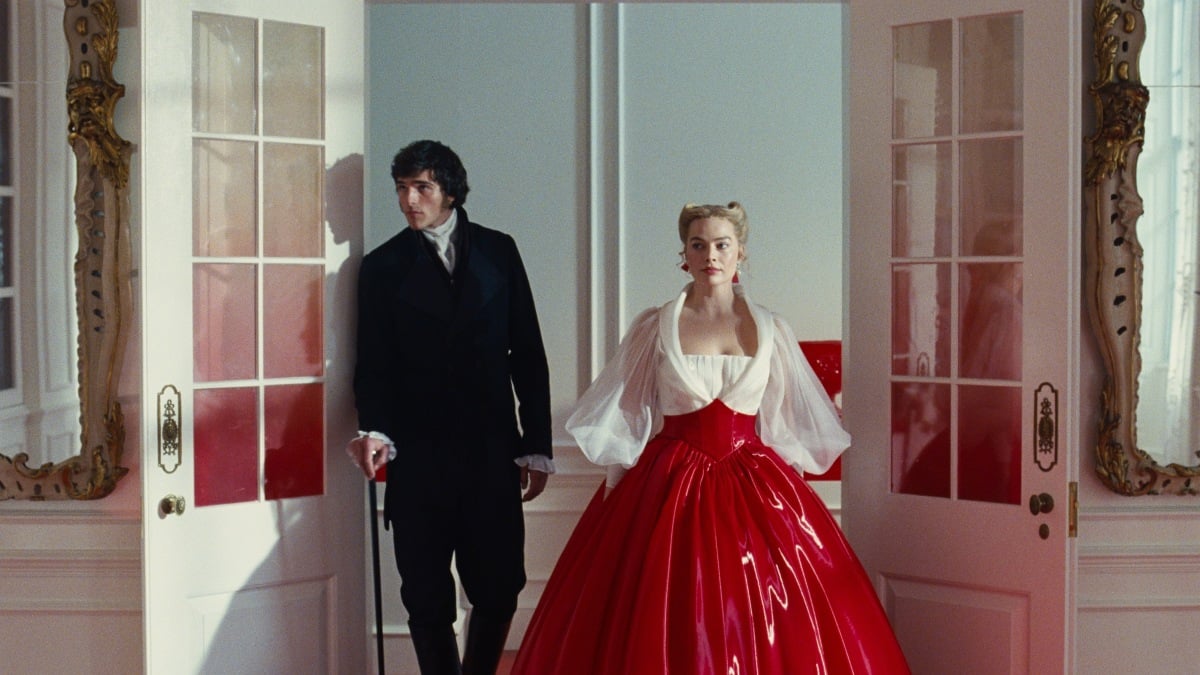
There’s no question: This is not the Wuthering Heights Emily Brontë wrote. But Emerald Fennell (Promising Young Woman, Saltburn) never intended that.
Ahead of the release of Fennell’s “Wuthering Heights,” (yes, the quotation marks are part of the title), the English filmmaker has dropped controversial clues that her film adaptation would reject much of what Brontë fans might anticipate. In casting Margot Robbie and Jacob Elordi as damned lovers Catherine and Heathcliff, Fennell ignited outrage from fans who decried the Barbie star as too old for her role and Elordi too white for his.
‘Wuthering Heights’ trailer: Emerald Fennell pairs Emily Brontë with Charli XCX and steamy romance
The movie’s ad campaign leaned into romance-novel tropes, featuring posters of the two locked in an embrace, on the verge of kissing, with the tagline “Come undone.” Then came assurances that Fennell’s film would be willfully anachronistic from the book’s late 18th-century setting, as Charli XCX teased the film’s dance-pop soundtrack, and production stills revealed a synthetic latex-like dress, a shimmery negligee, and teeny rose-colored glasses that evoke a far more modern feel.
Finally, in pre-release interviews for “Wuthering Heights,” Fennell spoke to her approach in adapting a book “as dense and complicated and difficult” as the Brontë classic. “I can’t say I’m making Wuthering Heights. It’s not possible,” she told Fandango. “What I can say is I’m making a version of it. There’s a version that I remembered reading that isn’t quite real. And there’s a version where I wanted stuff to happen that never happened. And so it is “Wuthering Heights,” and it isn’t. But really, I’d say that any adaptation of a novel, especially a novel like this, should have quotation marks around it.”
After all of this, it should surprise no one that Fennell’s “Wuthering Heights” is radically different from Brontë’s. The question is not if the film is faithful to the book, or even better than it. The question is, does this film work on its own terms, as a half-remembered fantasy of wild, enviable romance? And the answer is simply: No.
“Wuthering Heights” radically reimagines Catherine and Heathcliff.
The bones of our famed protagonists’ story remain: Catherine and Heathcliff meet as children in the moors of West Yorkshire, England, where she’s the spoiled daughter of a drunken landowner, and he’s a poor boy brusquely adopted to be raised alongside her. They share a wild nature in their remote surroundings, but as they grow, Catherine longs for luxury, which her gruff crush with no societal standing can’t promise. She breaks both their hearts by accepting the proposal of proper, aristocratic gentleman Edgar Linton (Shazad Latif), from the estate next door, which spurs Heathcliff to run away. Upon his return to Yorkshire five years later, he is rich, dashing, and determined to make a mess of Catherine’s life, for better or worse.
However, despite the familiar framework, the dynamic of Catherine and Heathcliff in Fennell’s film feels more like The Princess Bride than Wuthering Heights. For one thing, Heathcliff’s cruelty is considerably softened. Like Westley, the sweet stable boy, he will suffer any abuse if it means being close to his blonde ladylove. In particular, Heathcliff will endure a violent whipping from Catherine’s father, which gives the boy a chance to prove his immovable dedication to her.
Heathcliff’s own violence and wrath in adulthood are channeled by Elordi into smoldering and brooding, with a tame frisson of kink, whether he’s forcefully gripping Catherine’s mouth or later degrading his bride, Edgar’s ward Isabella (Alison Oliver) with pet play. Meanwhile, Catherine is a beautiful brat who, in the blink of an eye, goes from a rosy-cheeked child to a picture-perfect doll of a woman. So, of course, Fennell cast Barbie.
Mashable Top Stories
Draped in meticulously crafted skirts and dresses in bold reds and whites and corseted into an impossible waist, Robbie looks like a fashion doll, especially as she marries into wealth via Edgar. This metaphor is made blatant as Isabella presents her new sort-of sister-in-law with a doll made in her likeness, complete with a giant dollhouse that resembles their shared home, Thrushcross Grange. Yes, Catherine has achieved all the luxuries she dreamed of, but now she feels trapped, a pretty plaything in a dollhouse. The dream is not what she hoped.
“Wuthering Heights” is juvenile in its provocations.
To kick things off, two evocative sounds play over the film’s opening credits. One is the rustling of fabric, the other a man groaning, an ambiguous preview of an imminent scene of sex or violence.
The intensity of both sounds grows to reveal not a sexual scenario, but a man being hung at a public execution. However, Fennell still blends sex and violence here. A young Catherine (Charlotte Mellington) thrills at the depravity of it, while Fennell is sure to include a close-up of the dead man’s “stiffy,” obvious even through his pants. Such twisted melding of themes will thread throughout “Wuthering Heights,” but in ways more trashy than transgressive.
Brontë fans might clutch their pearls that Fennell has not just a sex scene between Heathcliff and Catherine, but a montage of them, spanning from beds to carriages to the sweeping plains between their estates. And yet, while these scenes have the iconography of classic romance novels — the rich settings, the posh clothes, the forbidden attraction, the beautiful characters on the cover feigning elation — they fall flat. While Robbie is rigorous in bringing Catherine’s ire and yearning to life, and Elordi is strong and seething, the pair have all the chemistry of Barbie and Ken dolls bumping rubber when they collide.
Perhaps to add Saltburn-like spice, BDSM is worked into various love scenes, bringing horse bridles, shackles, and a metal collar into sex games of degradation. This makes the depravity of the novel more playful than dark. Now, Heathcliff, who comes off like a towering Dom, is less threatening, as his violence is channeled through consensual kink. Yet this depiction of BDSM still feels half-hearted next to more successfully sexy and psychologically provocative films like Babygirl and Pillion.
The race-bending in “Wuthering Heights” is a problem Fennell created.
Heathcliff’s racial identity has been studied by Brontë scholars due to the author’s descriptions of his “dark-skinned” appearance, which is why Elordi’s casting incensed some fans of the novel. However, it’s not Heathcliff’s casting alone that becomes problematic in Fennell’s version. Perhaps the director looked to Bridgerton for inspiration, both in the show’s colorblind casting and barrage of sex scenes that have fueled debates on historical accuracy for the period. Fennell not only casts both of her romantic leads with white actors, but casts actors of color in the roles of Edgar and Nelly (Hong Chau), characters who are regarded in the film as less desirable than the protagonists, instead assigned roles of boring cuckold and bitter old maid.
In addition, the film’s cinematography and set design fetishize white skin. Following the childhood scene of Catherine consoling Heathcliff over his whipping by her father, the scene dissolves from the bloody, clothed back of a boy to the bared back of a man (Elordi), striped with whiplash scars. Cinematographer Linus Sandgren offers a close-up, leering over Heathcliff’s scars as if these are proof of his love — sweaty, plump, and terrible. Perhaps Fennell feared such fetishizing would be problematic if Heathcliff were “dark-skinned” as Brontë wrote. But she doubles down with this painting of whiteness as desirable with Catherine’s skin room.
After their wedding, Edgar is giddy to show Catherine the bedroom he designed for her, painted in the “most beautiful color,” that of her face. It’s not just white flesh or flushed cheeks that Edgar has had recreated. The room is lined with vinyl-padded panels, each bearing birthmarks and light blue veins translucent beneath the faux skin. Far from romantic, the gesture is repulsive, and only becomes more so when an intruding Heathcliff licks the wall as if it were his beloved’s flesh. And in this, it becomes clear how much of Brontë’s novel Fennell ignored or stripped away to make her version. And what is left?
As an admirer of Promising Young Woman and Saltburn, I was cautiously optimistic about Fennell’s “Wuthering Heights.” Adaptations are never what the book was, because the book is different depending on who reads it. This is why I like seeing movie adaptations of novels I loved and hated, because it’s like getting to walk around in someone else’s brain, seeing the story as they did. However, Fennell’s adaptation goes both too far and not far enough.
By slicing the book in half and cutting loose a clutch of relatives, she’s simplified the story to focus on the love between Heathcliff and Catherine. But for all the substance she’s cut away, only style has been put in its place. And it’s not enough to make this “Wuthering Heights” feel full or affecting. Instead of a cohesive re-imagining or even a titillating romance, “Wuthering Heights” feels like a passionate but incoherent collage of teenage lust and rebellion, the kind better suited to a high school locker than a movie theater.
Wuthering Heights opens in theaters on Feb. 13.


Why the New England Patriots Can Get Back to the Super Bowl After Ugly Loss

Discord defaults to teen experience for all users


