
Tech
OpenAI launches Prism, a new AI workspace for scientists
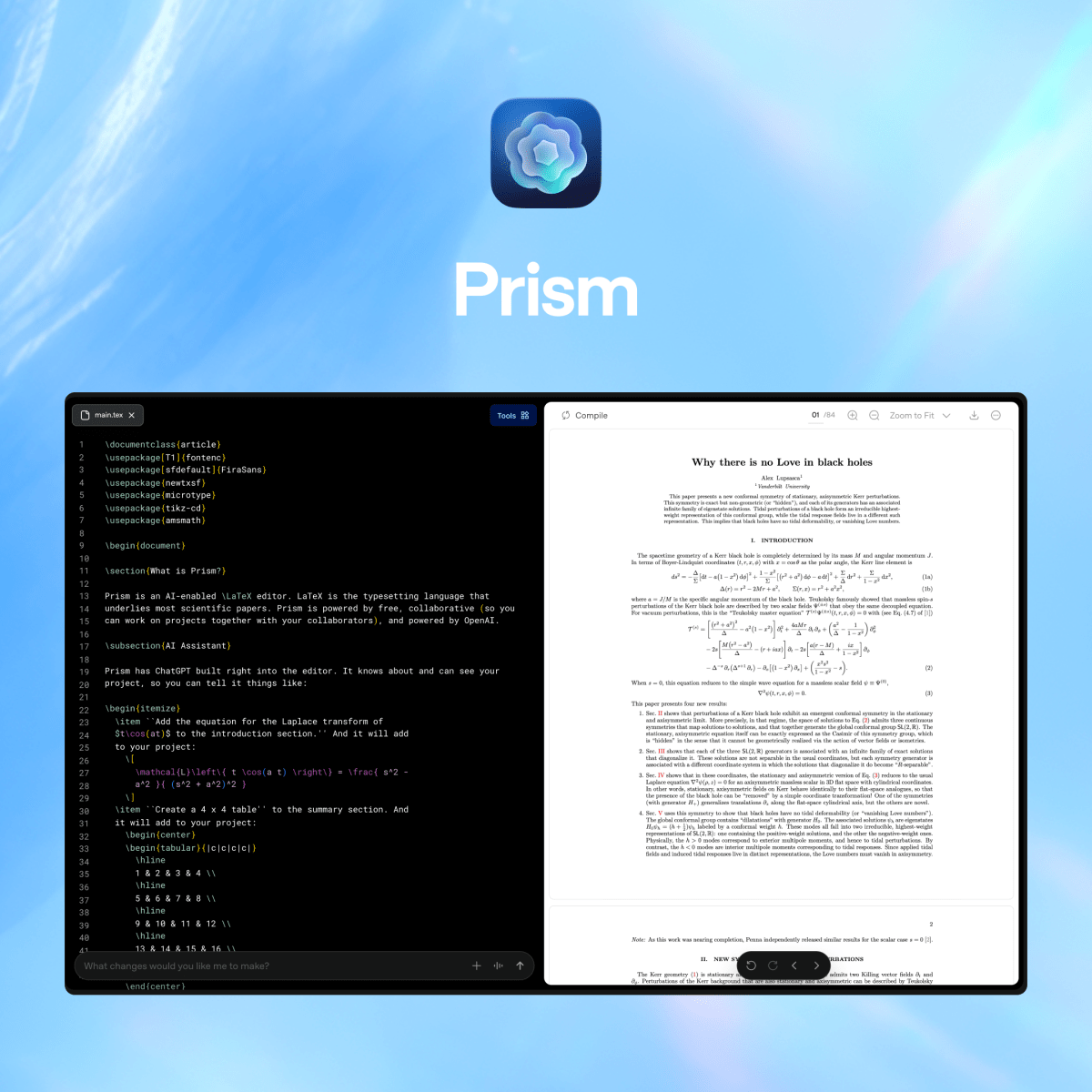
OpenAI launched on Tuesday a new scientific workspace program called Prism that is available for free to anyone with a ChatGPT account. Designed as an AI-enhanced word processor and research tool for scientific papers, Prism is deeply integrated with GPT-5.2, which can be used to assess claims, revise prose, or search for prior research.
Prism isn’t designed to conduct research on its own and without human guidance. Executives believe it will accelerate the work being done by human scientists, and compared Prism to coding interfaces like Cursor and Windsurf.
“I think 2026 will be for AI and science what 2025 was for AI and software engineering,” Kevin Weil, VP of OpenAI for Science, said in a press call announcing the tool.
The new software, which is accessed via a web app, comes as OpenAI is seeing a flood of scientific queries coming to its consumer products like ChatGPT. The company says that ChatGPT receives an average of 8.4 million messages a week on advanced topics in the hard sciences — although it’s difficult to know how many are from professional researchers.
AI-assisted research is also becoming more common among academic researchers. In mathematics, AI models have been used to prove a number of long-standing Erdos problems through a combination of literature review and new applications of existing techniques. While the significance of the proofs is still hotly debated, the results have been an early victory for proponents of AI models and formal verification systems.
A statistics paper published in December used GPT 5.2 Pro to establish new proofs for a central axiom of statistical theory, with human researchers only prompting and verifying the model’s work. OpenAI applauded the result in a blog post, presenting it as a model for human-AI collaboration in research going forward.
“In domains with axiomatic theoretical foundations,” the post reads, “frontier models can help explore proofs, test hypotheses, and identify connections that might otherwise take substantial human effort to uncover.”
Techcrunch event
San Francisco
|
October 13-15, 2026
Much of the value of OpenAI’s new system comes from simple product work on existing standards. Prism integrates with LaTeX, an open source system used to format and typeset scientific papers, but goes significantly beyond most available LaTeX software tools. The program also leverages GPT 5.2’s visual capabilities to allow researchers to assemble diagrams from online whiteboard drawings, which can be a significant pain point with existing tools.
Perhaps the most powerful feature comes from combining the usual powers of an AI model with more rigorous context management. When users open up a ChatGPT window through Prism, the model can access the full context of the research project, making responses both more germane and more intelligent.
Much of that would be possible for a savvy user of GPT-5.2, but OpenAI is hoping that a cleaner interface will draw in scientific researchers more quickly. Weil described it as the same combination of factors that made AI tools so powerful in software engineering.
“Software engineering accelerated in part because of amazing models,” he told reporters, “and in part because of deep workflow integration.”
Tech
Call for speakers: TechCrunch Founder Summit 2026

Have real-world scaling experience? The TechCrunch Founder Summit 2026 stage is calling.
On June 23 in Boston, this annual founder-focused event will bring together 1,100+ founders and investors to explore the realities of scaling startups across every stage. We’re seeking experienced founders, VCs, and startup operators to lead interactive roundtable discussions rooted in practical, real-world insight.
Experienced leaders from across the startup ecosystem will convene to host interactive roundtable sessions designed to spark real conversations. This is where founders get honest guidance, tactical takeaways, and clarity on the challenges that come with growth. Apply here to get started.
Apply to lead a roundtable session
Roundtables at TC Founder Summit are built for depth, not decks. Each session is a 30-minute, informal discussion led by up to two speakers, with no slides or video — just meaningful dialogue and practical insight. These intimate conversations create space for founders to ask real questions and connect directly with experts who’ve been there before.
To apply, click Apply to Speak on the event page, submit your proposed topic, and share your experience as a scaling expert. TC Founder Summit is the ideal platform to contribute to the next generation of startup leaders.

Speaker benefits
Speaking at TC Founder Summit is more than visibility. It’s full access to the experience. Along with elevating your authority and brand, you’ll gain premium entry to breakout sessions, roundtables, and curated networking with founders seeking guidance and VCs scouting what’s next.
Plus, TechCrunch will amplify your participation through:
Techcrunch event
Boston, MA
|
June 23, 2026
- Event agenda placement on the web and mobile app.
- Inclusion in a shared TechCrunch.com article.
- Social media promotion across TechCrunch channels.
Make your impact by applying today
Lead the conversation. Share what you’ve learned. Help founders navigate the highs and lows of scaling, and strengthen your reputation as a trusted voice in the startup community.
Apply early. TC Founder Summit takes place on June 23, but speaker applications close well before then. Submit now and be part of TechCrunch’s annual founder bootcamp.
Tech
Uber to buy delivery arm of Turkey’s Getir
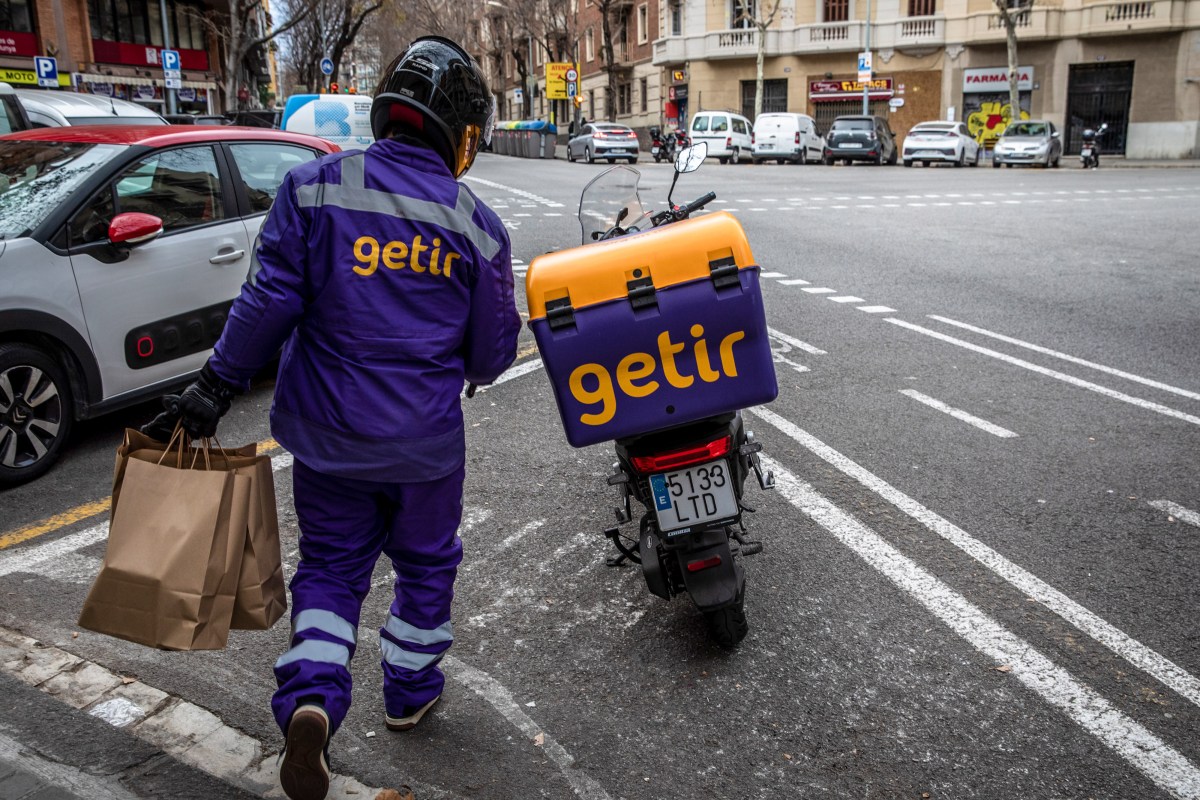
Uber has agreed to acquire the delivery business of Turkey’s Getir, once one of the biggest success stories of the country’s startup ecosystem, the company announced on Monday.
The deal will see Uber paying $335 million at the outset to purchase Getir’s food delivery business. The ride-hailing giant will also pay $100 million for a 15% stake in Getir’s grocery, retail, and water delivery business, and said it would complete the acquisition of the division over the next few years.
Uber is buying the business from Getir’s biggest shareholder, the Emirati sovereign wealth fund Mubadala. The investment firm was reportedly seeking to sell its stake in the company last year.
The deal comes after a turbulent few years for Getir, which once enjoyed a valuation of $12 billion, that saw the startup scale down its operations massively. The company launched to great traction in 2015, and invested aggressively to expand its operations in the U.S. and Europe, both organically and via acquisitions, especially during the pandemic.
But after the pandemic lockdowns eased, broader consumer demand for food and grocery delivery also wavered, and Getir chose to cut its losses in 2024, shutting shop and laying off thousands of staff in the U.S., U.K., and Europe in order to focus on business back home.
Nearly a year ago, the company went through a struggle for control over a restructuring plan proposed by Mubadala. The plan was opposed by one of Getir’s co-founders, who eventually sued to fight the “illegal coup,” but a Dutch court rejected the founder’s appeals.
The company has raised a total of $2.40 billion so far, according to PitchBook. Documents filed by Getir in court last year show the company valued its group assets at $374 million.
Techcrunch event
Boston, MA
|
June 23, 2026
“This transaction reflects the strength of the business and the progress it has made, particularly over the last year,” Waleed Al Mokarrab Al Muhairi, deputy group CEO at Mubadala, said in a statement.
Uber said it would combine the new unit’s services with Trendyol Go, a food and grocery delivery service in Turkey that the ride-hail giant bought for $700 million last May. Uber said Getir’s food delivery business alone recorded gross bookings of more than $1 billion in 2025, up 50% from a year earlier.
The deal follows a strong showing by Uber’s delivery business in the fourth quarter, reporting revenue of $4.89 billion, up 30% from a year earlier. The company said Europe, the Middle East, and Asia proved the fastest-growing regions for the business in 2026.
Tech
Discord to roll out age verification next month for full access to its platform
Discord is rolling out age verification globally starting next month, the company announced on Monday. All users will be put into a “teen-appropriate experience” by default unless they prove they’re adults. Age verification will be required to change certain settings and access age-restricted content.
Discord users will need to be confirmed as adults in order to unblur sensitive content or turn off the setting, and only adults can access age-restricted channels, servers, and app commands. Additionally, messages from people a user may not know are routed to a separate inbox by default, and only verified adults can modify this setting.
People will receive warning prompts for friend requests from users they may not know, and only adults will be able speak onstage in servers.
To complete age verification, users need to either complete a facial age estimation or submit an ID to Discord’s vendor partners. The platform plans to add more options in the future. Discord notes that some users may be asked to use multiple methods when additional information is needed to assign an age group.
The facial age estimation requires video selfies, which Discord says never leave your device. Additionally, the company says IDs submitted to its vendor partners are deleted quickly and, in most cases, immediately after age confirmation.
It’s worth noting that Discord disclosed last October that around 70,000 users may have had sensitive data, such as their government ID photos, exposed after hackers breached a third-party vendor that the platform uses for age-related appeals. The breach reflected digital rights activists’ concerns over the use of age checks as a way to make the internet “safer.”
Discord’s global launch of age verification follows the company’s decision to establish age checks for users in the U.K. and Australia last year.
Techcrunch event
Boston, MA
|
June 23, 2026
“Rolling out teen-by-default settings globally builds on Discord’s existing safety architecture, giving teens strong protections while allowing verified adults flexibility,” said Savannah Badalich, head of product policy at Discord, in a press release. “We design our products with teen safety principles at the core and will continue working with safety experts, policymakers, and Discord users to support meaningful, long term wellbeing for teens on the platform.”
The announcement mirrors similar moves made by other online platforms, reflecting growing international efforts to strengthen child safety. Most recently, Roblox introduced mandatory facial verification for access to chats on its platform. Last July, YouTube launched its age-estimation technology in the U.S. to identify teen users in order to provide a more age-appropriate experience.
Discord’s age-verification changes will begin in early March, and both new and existing users will need to verify their age to access age-restricted content.

Call for speakers: TechCrunch Founder Summit 2026

Sukhie’s Lipstick Trick Is Too Good


