
Entertainment
NYT Strands hints, answers for March 18, 2026

Today’s NYT Strands hints are easy if you’re good with compound words.
Strands, the New York Times‘ elevated word-search game, requires the player to perform a twist on the classic word search. Words can be made from linked letters — up, down, left, right, or diagonal, but words can also change direction, resulting in quirky shapes and patterns. Every single letter in the grid will be part of an answer. There’s always a theme linking every solution, along with the “spangram,” a special, word or phrase that sums up that day’s theme, and spans the entire grid horizontally or vertically.
By providing an opaque hint and not providing the word list, Strands creates a brain-teasing game that takes a little longer to play than its other games, like Wordle and Connections.
If you’re feeling stuck or just don’t have 10 or more minutes to figure out today’s puzzle, we’ve got all the NYT Strands hints for today’s puzzle you need to progress at your preferred pace.
NYT Strands hint for today’s theme: It follows
The words are related to vitality.
Mashable Top Stories
Today’s NYT Strands theme plainly explained
These words describe the circle of life.
NYT Strands spangram hint: Is it vertical or horizontal?
Today’s NYT Strands spangram is vertical.
NYT Strands spangram answer today
Today’s spangram is Afterlife.
NYT Strands word list for March 18
-
Cycle
-
Preserver
-
Hack
-
Afterlife
-
Style
-
Coach
-
Lesson
-
Blood
Looking for other daily online games? Mashable’s Games page has more hints, and if you’re looking for more puzzles, Mashable’s got games now!
Check out our games hub for Mahjong, Sudoku, free crossword, and more.
Not the day you’re after? Here’s the solution to yesterday’s Strands.
Entertainment
The Channing Tatum Action Movie That Blew Away The Competition
By Phillip Moyer
| Updated
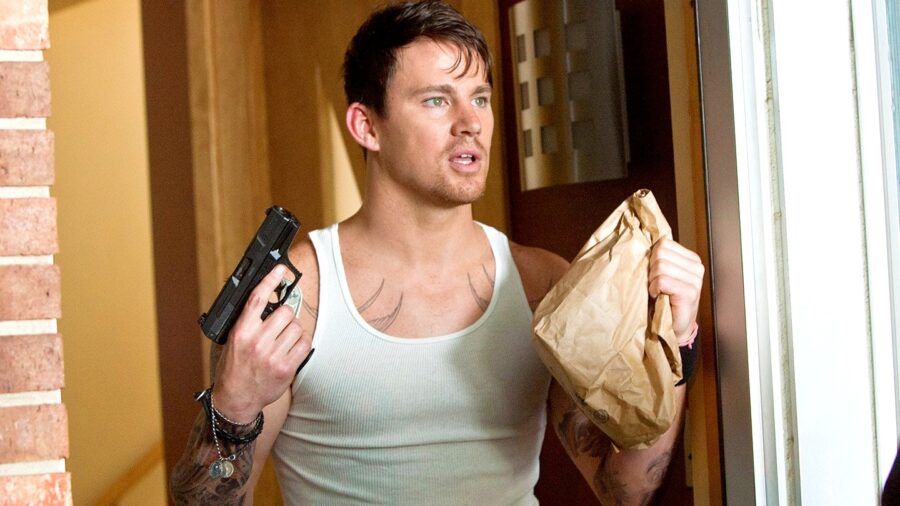
White House Down stars Channing Tatum as Marine Corps veteran John Cale, who is working as a Capitol Police officer who applied for a job in the Secret Service before getting rejected as unqualified. However, after a paramilitary group seizes the White House, it’s up to Cale to save the president and stop the terrorists from starting a nuclear war.
While not seen as a bad movie, per se, White House Down wasn’t warmly received by critics when it was released in 2013, leaving the film with a 52 percent Tomatometer rating. The film, directed by Independence Day and Moonfall director Roland Emmerich, was praised for the chemistry between Channing Tatum and co-stars Jamie Foxx and Maggie Gyllenhaal, but derided for its overuse of action movie tropes.
Some critics noted the level of self-awareness the movie had, leading them to consider White House Down a parody rather than a straightforward action thriller.
A Box Office Disappointment

Audiences seemed to enjoy the White House Down, with CinemaScore giving the film an A- audience rating. However, those who took to the internet to share their reviews were similarly lukewarm towards the film, as demonstrated by the film’s 62 percent Popcornmeter score.
Regardless of how audiences felt about White House Down, the movie ended up with disappointing box office returns. The film made $205 million worldwide and only $73 million domestically. With a production budget of $150 million, these numbers were probably not enough for the film to break even after marketing and distribution costs are taken into consideration.
Another Film Hurt White House Down’s Chance Of Box Office Success

One thing that probably didn’t help White House Down was the fact that it was released three months after Olympus Has Fallen; another movie about a terrorist attack on the White House. Olympus Has Fallen starred Gerald Butler as a secret service agent tasked with rescuing President Benjamen Asher (played by Aaron Eckhart) after North Korean terrorists take over the White House.
When raw numbers are taken into account Olympus Has Fallen actually performed slightly worse than White House Down. While both films received an A- CinemaScore, Olympus Has Fallen received a 49 percent Tomatometer score and made $170 million at the box office. However, Olympus Has Fallen only cost $70 million to make, making the less-watched film yield a higher financial return.

While White House Down quitely left theaters, never to be heard from again, Olympus has Fallen spawned two sequels, London Has Fallen (2016) and Angel Has Fallen (2019). Neither sequel ended up selling more tickets than White House Down, but each sequel in the Has Fallen film series cost less to produce than the previous film making each entry into the series a box office success.
Channing Tatum’s Career After White House Down
Channing Tatum went on to receive top billing in a wide variety of films after the moderate failure of White House Down.

This includes reprising the role of the undercover cop Jekno in 22 Jump Street, the villainous Jody Domergue in Quentin Tarantinos The Hateful Eight, and the American spy Tequila in Kingsman: The Golden Circle. He also reprised the role of the male stripper Mike Lane in the sequels Magic Mike XXL and Magic Mike’s Last Dance.
Magic Mike’s Last Dance, coincidentally enough, is another poorly-performing movie that has proved its staying power on streaming. The film only made $57 million off of a $45 million budget. However, after being released on Max, the conclusion of Channing Tatum’s stripper trilogy spent several days in the streaming service’s top three films.

While it’s probably far too late for a White House Down sequel to ever materialize, it remains to be seen whether the recent surge in White House Down’s popularity on streaming will lead to Channing Tatum being given more lead roles in straightforward action films.
White House Down is streaming on Paramount+.
Entertainment
Metas VR Metaverse takes one more step into the grave
When Facebook changed its name to Meta a few years ago, the idea was that the VR metaverse would become a huge pillar for the company. I think we can safely say that’s not going to happen.
On its community forums, Meta confirmed that Horizon Worlds, the flagship “hanging out and doing work meetings in VR” app for Quest headsets, will no longer be available in VR after June 15. It’s not going away entirely, as Meta recently reoriented its metaverse efforts toward a Horizon Worlds mobile app. But Mark Zuckerberg’s COVID-era dream of people spending huge portions of their days wearing VR headsets and messing around in Horizon Worlds seems to be dead.
In fairness to Meta, the multi-platform approach to Horizon Worlds isn’t new. It’s been available on mobile and desktop since 2023, and it must be successful enough in the mobile format for Meta to keep supporting and building upon that version of the Horizon Worlds metaverse. But when it was supposed to be a VR system seller, Horizon Worlds was often the subject of mockery online for its underwhelming visual quality, initial lack of legs for avatars, and its reputation as a virtual ghost town.
Mashable Light Speed
Of course, as of right now, that doesn’t mean Meta is giving up on VR. When it announced that Horizon was going mobile earlier this year, Meta reaffirmed its commitment to VR as a format.
“We have a robust roadmap of future VR headsets that will be tailored to different audience segments as the market grows and matures,” Meta said in a press release. “And Meta remains the single biggest investor in the VR industry. Why? Because we believe in VR as a critical technology on the path to the next computing platform.”
The enduring popularity of things like VRChat signals that there is a market for these sorts of virtual hangout spaces, but Zuckerberg’s specific vision of the metaverse just never really took off as intended. At least we got a few memes out of it.
Entertainment
Shocking, Unrated Horror Flick No One Saw Will Destroy Your Suburban Dreams
By Robert Scucci
| Published

I was having a really good day before I fired up 2009’s Morris County, a three-part horror anthology written and directed by Matthew Garrett about the darkness hiding just beneath the idyllic sheen of modern suburbia. I didn’t know what to expect going into this low-budget romp through the neighborhood, but I figured it would carry the same “everybody has skeletons in their closet” messaging that most films like this do. American Beauty, The Burbs, Happiness, and countless other films have played with this motif with wildly different results, so I went into Morris County with an open mind.
For a film that looks like it was shot for less than $500 (budget information is not publicly available), Morris County still manages to get under your skin and make you want to take a long shower when it’s over. I live in a pretty modern apartment, but still found that I couldn’t get the water hot enough to shock the final sequence out of my brain.
While I can’t say this is the most groundbreaking film of all time, it works with what it has and proves genuinely upsetting on more than one occasion.
Three Stories From The Same Neighborhood

Morris County has a structure that feels deliberate, though it may be coincidental. The first story focuses on a teenage girl named Ellie (Darcy Miller) who has clearly lost her way. She’s shut out her parents and taken to drinking and drugging. It’s implied that she regularly trades sexual favors with the liquor store employees so she can buy booze as a minor. Ellie meets her friends in the woods, and they party like teens do.
She’s not yet fully aware of how her behavior will catch up with her, but she soon finds out and has to make peace with herself when she realizes how far gone she actually is.
Chapter two moves away from teenage chaos and into adult misery. This section focuses on Noah (Albie Selznick), a Jewish man struggling to reconcile his latent homosexuality with his faith. Making matters worse is his wife’s affair, which she thinks she’s successfully concealing even though he’s fully aware of it.

He takes solo trips to the adult video store and attempts to hook up with male suitors, which lands him in more trouble than he anticipated. Broken, miserable, and convinced he’s stepping further away from God’s light, Noah finds himself staring down his family, the bottom of a bottle, and the barrel of a gun. It plays out exactly how you’d expect.
Now that Morris County has progressed through middle age, the final story moves into the golden years through the eyes of Iris (Alice Cannon). Forced into early retirement because of her age, Iris suddenly feels lost without the routine she followed for her entire adult life.

On her first day of retirement, her husband Elmer (Erik Frandsen) dies while watching TV on the couch. In her profound state of grief, Iris decides to live with Elmer’s rotting corpse and go about her daily routine as if nothing has changed. The first few days are manageable, but as Elmer continues to decompose, it becomes painfully clear that the romance and sense of fulfillment Iris is chasing is just as dead as her husband.
A Horrifying Glimpse At Humanity
While its production values leave quite a bit to be desired, Morris County ultimately does everything it sets out to accomplish. It moves through three phases of life, each one more disturbing than the last, highlighting the uncomfortable truth that growing up, growing old, and dying are rarely graceful experiences.

Everybody is fighting a silent battle, and every so often those battles boil over in the ugliest ways imaginable. From an isolated and angsty teenager barreling through life on hard mode to an elderly woman who refuses to let go of her past and plan her next steps, the film has no trouble getting its point across.
Behind the picket fences and locked front doors, silent suffering hides in the most unassuming places. When people build walls around themselves and let their demons consume them from the inside out, you get exactly what Morris County is showing you.

As of this writing, Morris County is streaming for free on Tubi.

Mave Health aims to improve attention and mood with its brain-stimulating headset
DOD says Anthropic’s ‘red lines’ make it an ‘unacceptable risk to national security’


