
Tech
Lidar-maker Ouster buys vision company StereoLabs as sensor consolidation continues
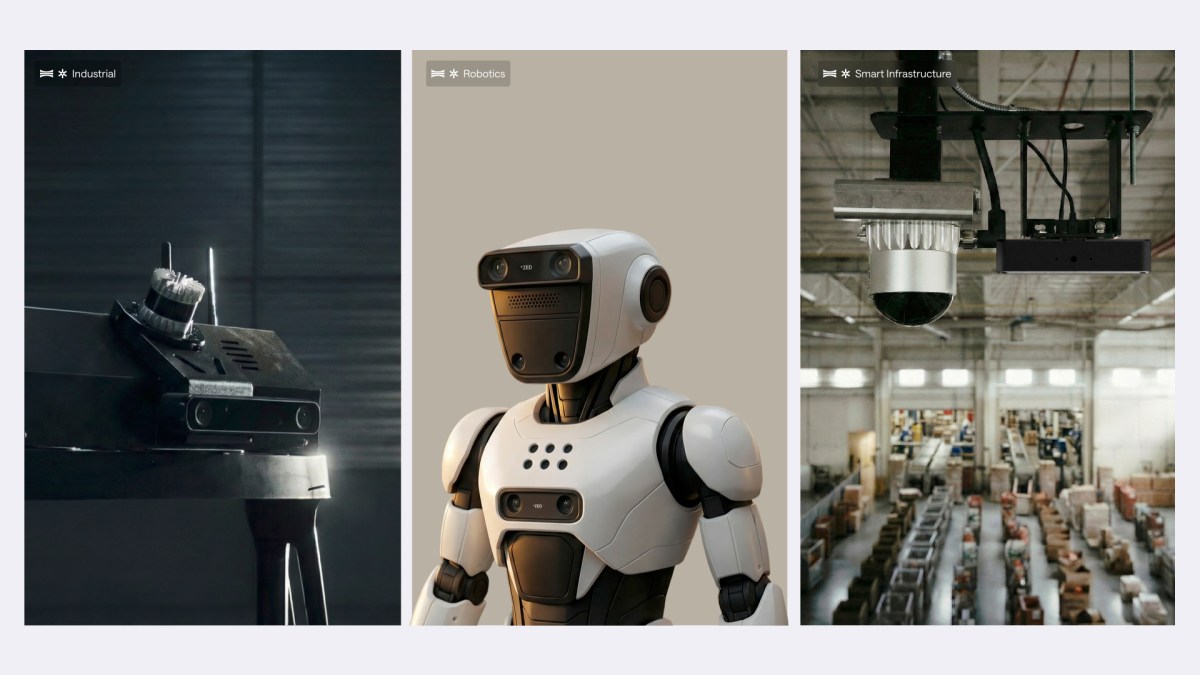
Lidar-maker Ouster has acquired StereoLabs, a company that makes vision-based perception systems for robotics and industrial applications, for a combination of $35 million and 1.8 million shares.
The deal is the latest in a march toward consolidation among perception sensor suppliers. Just last month, MicroVision bought the lidar assets of the buzzy-but-now-bankrupt Luminar for $33 million. Ouster itself has played the M&A game a fair amount, too. In 2022, the company merged with rival player Velodyne. The year before that, it bought lidar startup Sense Photonics.
This consolidation is happening right as companies and investors rush to build businesses around “physical AI” — a broad term that encompasses everything from humanoid robotics and drones to self-driving cars and automated systems in warehouses. Even more obscure suppliers are raising big funding rounds as these technologies develop. Some startups are even trying to spin up entirely new sensor modalities.
Ouster co-founder and CEO Angus Pacala told TechCrunch in an interview that he had been eyeing StereoLabs for years. He said he sees lidar as “the core component of safety-critical, capable systems,” but that he wanted to “move up the stack.”
The “obvious additional sensors” to start working with in addition to lidar, Pacala said, are cameras. Pacala said 15-year-old StereoLabs is “best in class” on the hardware side, but he was especially drawn to how the company has been getting the most out of those cameras by being “incredibly savvy in adopting the cutting edge of AI models and edge compute.”
In particular, Pacala highlighted StereoLabs’ development of a foundational AI model that can determine depth of objects from stereo cameras.
“It was a no-brainer for us to go out and approach them and basically pitch this vision of working with us to become a unified sensing and perception platform — a tier one [supplier] for these advanced physical AI systems,” Pacala said.
Techcrunch event
Boston, MA
|
June 23, 2026
Despite the focus on integration, Ouster said StereoLabs will operate as a wholly owned subsidiary.
And while the hype has been feverish, Pacala said he didn’t buy StereoLabs simply because of the attention and money being thrown at physical AI. In fact, he committed maybe the gravest sin one can during a hype cycle: he poured some cold water on the buzz, especially around humanoid robotics.
“The business model here is not to just sell the fervor, it’s to actually make working systems that are certified, that are safe, that are really solving customer problems,” he said. “There’s going to be a little bit of disillusionment in physical AI as it turns out that it’s much longer time to market for all these humanoids.”
Pacala isn’t the only one trying to take a realistic view. In a recent interview with TechCrunch, MicroVision CEO Glen DeVos said the sensor industry is “ripe for consolidation” because he believes there isn’t enough revenue to support all the current competition.
“You’re going to get consolidation, or you’re going to get kind of a weeding out of the industry as people fall to the wayside,” he said.
Tech
Ex-Tesla engineer’s startup taps Pronto to help automate a copper mine

There is a lot of attention on domestic manufacturing in the United States these days. But for Turner Caldwell, who spent nearly a decade at Tesla, there’s not enough attention on the minerals and metals that sit at the very bottom of the supply chain.
It’s why he left Tesla and started Mariana Minerals in 2024. The purpose of his startup is to become a modern mining (and refining) operation that is set up for growth, because Caldwell has essentially one goal: bring more refined metal into the ecosystem. To do that, his company is trying to automate almost every aspect of a mining operation imaginable.
The latest piece is vehicles. On Thursday, Mariana Minerals announced a partnership with Pronto, a startup that’s developed self-driving systems for haulage trucks and other off-road vehicles used at construction and mining sites.
It’s the first deal that Pronto has struck since being acquired by Atoms, the new robotics venture run by Uber co-founder Travis Kalanick. The acquisition reunites Kalanick with Pronto founder Anthony Levandowski, the former star Google self-driving project engineer and controversial entrepreneur behind Otto, which Uber acquired in 2016.
The partnership with Pronto will see autonomous haulage trucks begin operating next week at Copper One, a formerly idled copper mine in Utah that Mariana purchased last year. Terms of the deal were not disclosed.
But the partnership is about more than just having autonomous trucks operating onsite, Caldwell told TechCrunch in an exclusive interview. Pronto’s autonomy system will be directly integrated into the software Mariana has developed to run operations at the mine, which it calls “MineOS.” That will make it possible to autonomously dispatch the trucks and coordinate their routes without a human in the loop, he said.
This is part of Caldwell’s broader vision for how a mine should be run going forward. It involves multiple operating systems that use reinforcement learning to automate and, eventually, coordinate operations across the entire mine.
Techcrunch event
San Francisco, CA
|
October 13-15, 2026
“The big Western mining companies look exactly like Ford and GM before Tesla. They look a lot like NASA before SpaceX. They look a lot like the big defense primes before Anduril,” he said. “The rate at which software is up-taken and technology is up-taken into the space is fundamentally set by the operating teams who don’t really have incentive to change how they operate, right? If they’re able to make their KPIs, you know, the spreadsheets, the walkie talkies, the paper reporting — it works just fine.”
In Caldwell’s view, this limits a mine’s output and leaves obvious efficiencies on the table. But he also thinks it’s existential.
“Because Western mining companies don’t build a lot of net new infrastructure, the talent pool hasn’t been actively attracted to it, and so the labor force is diminishing,” he said. That means mines are going to be stuck trying to do more with less. Caldwell sees Mariana’s software-first approach as the solution to this problem.
That could be good for Mariana, clearly. But if the approach is successful, it could also benefit other mines. Selling Mariana’s coordination software is on the table, especially once it’s proven out, Caldwell said.
But Caldwell said he was not interested in doing that from the start. The “core business should be selling metal,” he said.
“The company is the coordination layer. And so, if you’re doing that, like, at that point, you might as well go and vertically integrate, and go down into making the metal, instead of just selling software,” he said. “I think SpaceX would not be a very large company selling [rocket] re-landing software to NASA.”
Plus, owning and running the mine is crucial to the reinforcement learning loop, Caldwell said — not just because it allows for better control and higher-fidelity data, but also because it could eventually help inform decisions that are hard for humans to see right now. Caldwell likened this to how AlphaGo, the chess-playing software developed by DeepMind a decade ago, began making moves humans hadn’t considered once it had trained on enough data.
Despite all this talk of automation, Caldwell said he’s not trying to remove humans from mining operations. Like many other founders working in the sector, he believes Mariana will actually expand that already winnowing talent pool.
“Part of this is a labor cost reduction, but that’s not really the goal,” he said. “The goal is actually enabling more productivity with the constrained labor pool that we have. Automation, and autonomy, is going to create more jobs, because we will have more mines that are operating.”
Tech
This founder helped build SpaceX’s most powerful rocket engine. Now he’s building a ‘fighter jet for orbit’
Jeff Thornburg helped turn a government research project into SpaceX’s most powerful rocket engine. Now, he’s trying to do the same thing at his startup Portal Space Systems, which is taking an idea set aside by NASA and turning it into high-powered propulsion for the next generation of spacecraft.
Portal, founded in 2021, announced a $50 million Series A funding round Thursday that values the company at $250 million. The round was led by Geodesic Capital and Mach33, alongside Booz Allen Ventures, ARK Invest, AlleyCorp, and FUSE.
The company is developing a technology called solar thermal propulsion. Today’s standard satellite engines either burn chemical fuel or convert the sun’s energy to electricity, using that to power efficient but low-powered thrusters. Portal’s engines would instead concentrate the heat of the sun, using that to heat propellant and move the spacecraft along at high speed.
The technology has been the subject of investigation in government research labs since the 1960s, most recently as a concept for sending a probe into interstellar space, but has yet to make it into orbit. Thornburg, along with co-founders Ian Vorbach and Prashaanth Ravindran, plans to change that in the next two years.
Thornburg began his career in the U.S. Air Force, where he worked on a program to develop an efficient, powerful next-generation kind of rocket engine that engineers call full-flow staged combustion. A decade later, he was wooed to SpaceX by Elon Musk to turn those concepts into the Raptor engine that now powers the company’s massive Starship.
After stints working at Stratolaunch and Amazon’s Project Kuiper, he turned to propulsion once again.
A new kind of rocket engine
Solar thermal power is, in Thornburg’s view, the next logical step in rocket tech. NASA had studied the technology extensively in the late nineties and concluded it provides better performance in many cases. It wasn’t developed further because there wasn’t enough demand for in-space mobility, according to a 2003 report commissioned by NASA.
Techcrunch event
San Francisco, CA
|
October 13-15, 2026
With satellites and space probes flying much more rarely back then, it was simpler just to use a more powerful rocket than invest in in-space propulsion. Now, with thousands of new satellites flying every year and the U.S. military demanding spacecraft that can fly quickly between orbits to surveil or threaten rivals, that calculus has been turned on its head.
“It’s no longer acceptable to move slowly on orbit,” Thornburg told TechCrunch. “You know, China’s running circles around our spacecraft. We need equivalent capability.”
Portal has already received $45 million in strategic funding from the U.S. military, on top of $67.5 million in private capital, thanks to the potential for using its technology for orbital warfare, according to Booz Allen Ventures’ managing director Travis Bales.
And in a future where we may see millions of satellites in orbit around the Earth providing communications and computing services, satellite operators will need cheaper means of maneuvering spacecraft out of each other’s way, notes Aaron Burnett, the CEO of the aerospace-focused venture fund Mach33. Burnett sees Portal becoming a “space mobility prime,” providing propulsion to a variety of users.
The path to orbit
To get there, the company will need to get its technology working in orbit. Its flight electronics were launched on a shakedown cruise around the planet last week, and another prototype spacecraft is expected to launch in October. The company will demonstrate a working prototype of its engine with the launch of its first SuperNova spacecraft — a “fighter jet for orbit,” per Thornburg — expected in 2027.
Portal benefits from recent advancements in additive manufacturing and materials science, which have led to the development of the company’s combined solar concentrator and nozzle, the Hex thruster.
Rocket nerds think that nuclear-powered rockets are the next step to unlock transportation throughout the solar system, but the regulatory and legal challenges of building such a system make it beyond a startup’s pay grade.
But Portal’s engine also gives the company a head start on one version of an atomic rocket, a nuclear thermal propulsion system — essentially replacing the heat of the sun with that of a reactor. When the U.S. government is ready to build it, Thornburg’s team will have already proved out many of the moving parts in orbit.
“I’ll be able to help mature this technology much faster on orbit than we ever will by trying to build a $2 billion ground test facility that’s nuclear safe,” Thornburg said.
Tech
Collide Capital raises $95M fund to back fintech, future-of-work startups
Collide Capital, founded by Brian Hollins and Aaron Samuels, announced Thursday the close of a $95 million Fund II. The firm, founded in 2021, backs early-stage companies in fintech, supply chain, and the future of work.
It’s backed 75 companies to date after closing its inaugural $66 million Fund I in 2022. Hollins said it took them around 13 months to raise this latest fund, which they hope to deploy over the next 3.5 years. The landscape for many emerging fund managers is tough, but the Collide Capital team comes with a track record and strong pedigree (Hollins spent a decade at Goldman, Lightspeed, and Slow, while Samuels worked at Bain, Lightspeed, and co-founded AfroTech, one of the largest tech conferences in the world).
Limited partners (LPs) in Fund II include the University of California Endowment (UC Regents) — which anchored their last fund — Accolade Partners, Fairview Capital, Goldman Sachs, and JPMorgan. The average check size will be between $1 million and $3 million, and the team hopes to back at least 30 companies, having already cut checks to five. (Other companies in the firm’s portfolio include Culina Health and Helios).
“We’re most interested in platforms enabling automation, real‑time collaboration, and faster, data‑driven decision making,” Hollins said.
Aside from technology, Hollins and Samuels said the firm is also excited to expand its Collide Campus program, launched in 2022 to help mentor the next generation of founders and venture capitalists. The expansion is separate from the fund raise. The program encompasses an undergraduate initiative that trains students in VC and entrepreneurship, and a graduate fellowship program that sees students working alongside the Collide team as investors and apprentices.
The undergraduate campus program is on more than 20 campuses, including Harvard and John Hopkins, and Samuels said more than 50 students have passed through the program so far and have landed top jobs at places like General Catalysts and, of course, Collide. Overall, the program helps the firm source deals and talent. Samuels said they started the program as it was something they wished they had when they were students.
“We’re connecting the best and the brightest with venture capital to match their grit and determination to build businesses the world needs,” he said.
Techcrunch event
San Francisco, CA
|
October 13-15, 2026

Tesla is developing a smaller, cheaper SUV, report says
Home Depots Spring Black Friday sale is packed with free cordless tools — find the best BOGO deals on DeWalt, Ryobi, and Milwaukee


