
Tech
Last 24 hours to grab your plus-one pass at 50% off to TechCrunch Disrupt 2026

This is it. The clock is running out. With demand surging and early inventory nearly gone, tonight is your last chance to lock in record-low pricing for TechCrunch Disrupt 2026 and secure a plus-one pass at 50% off while limited passes remain.
If Disrupt has been on your must-attend list, now is the moment to act. Save up to $680 on your pass and bring a plus-one for half the price before this offer disappears.
This pricing ends tonight, January 30, at 11:59 p.m. PT, or the moment the last plus-one pass sells out. No extensions. No exception. Register now to secure yours with the lowest-priced offer.
What Disrupt delivers year after year
This year, Disrupt takes over San Francisco’s Moscone West from October 13–15, bringing together 10,000 founders, VCs, operators, and tech leaders for a tightly curated, three-day experience focused on real outcomes.
Attendees return for:
- High-signal access to people actively building and investing.
- Conversations that turn into deals, partnerships, and hires.
- Tactical insights you can use immediately.
- A front-row view into the future of tech before it breaks mainstream.
With 300+ startups expected to showcase their innovations, the intensity of Startup Battlefield 200, and curated networking designed to drive results, Disrupt isn’t just another conference. It’s where momentum is built.

A more curated way to experience a tech event
Disrupt isn’t about wandering between sessions. It’s about intentional connections and curated experiences designed for how people actually grow in tech.
Techcrunch event
Boston, MA
|
June 23, 2026
Founders meet investors actively backing breakthrough ideas. VCs cut through the noise to discover startups aligned with their investment focus. Operators exchange real-world lessons on building, scaling, and shipping what’s next. Aspiring innovators get a front-row seat to tomorrow’s tech.
If you’re hands-on in tech, Disrupt was built for you.
Insights delivered straight to you from tech’s top voices
Each Disrupt brings together 250+ of the most influential names in tech, leaders who have shaped the industry and continue to define what’s next:
Keep an eye on the Disrupt 2026 event page as the agenda goes live to see who will take the stage this year.
Final warning: Plus-one passes almost gone
The 50% off plus-one passes are nearly sold out, and the countdown to the best offer of the year ends tonight at 11:59 p.m. PT. Register now to lock in your TechCrunch Disrupt 2026 ticket. Save up to $680 and bring a plus-one at half the price while you still can.
Tech
ElevenLabs CEO: Voice is the next interface for AI
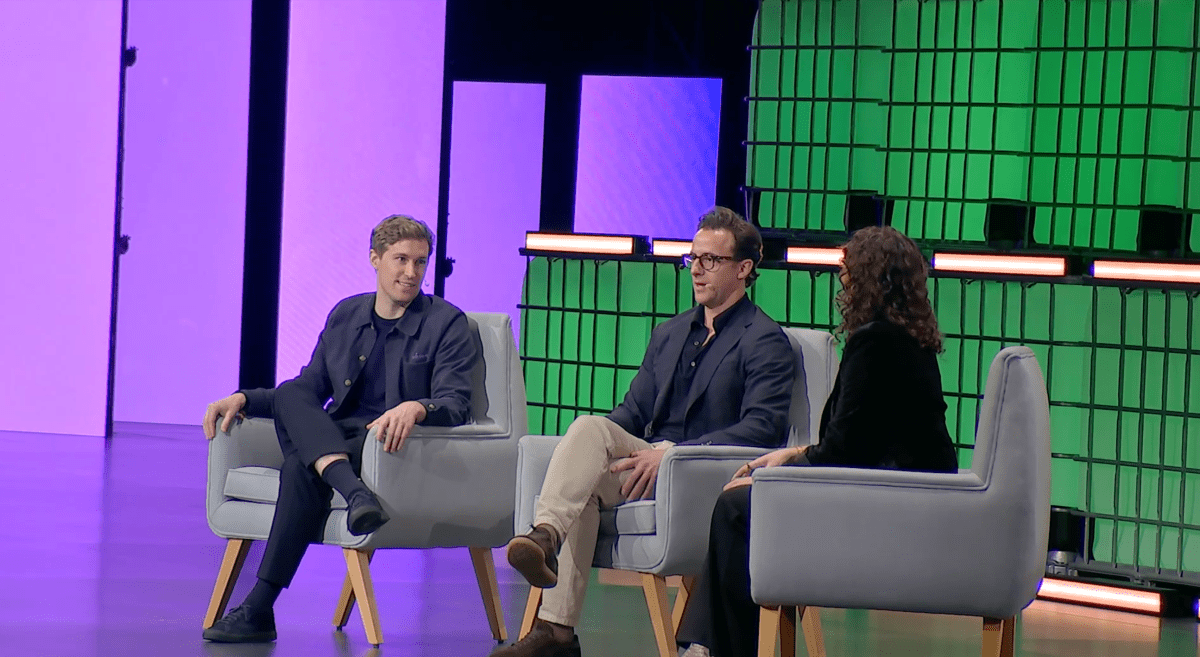
ElevenLabs co-founder and CEO Mati Staniszewski says voice is becoming the next major interface for AI – the way people will increasingly interact with machines as models move beyond text and screens.
Speaking at Web Summit in Doha, Staniszewski told TechCrunch voice models like those developed by ElevenLabs have recently moved beyond simply mimicking human speech — including emotion and intonation — to working in tandem with the reasoning capabilities of large language models. The result, he argued, is a shift in how people interact with technology.
In the years ahead, he said, “hopefully all our phones will go back in our pockets, and we can immerse ourselves in the real world around us, with voice as the mechanism that controls technology.”
That vision fueled ElevenLabs’s $500 million raise this week at an $11 billion valuation, and it is increasingly shared across the AI industry. OpenAI and Google have both made voice a central focus of their next-generation models, while Apple appears to be quietly building voice-adjacent, always-on technologies through acquisitions like Q.ai. As AI spreads into wearables, cars, and other new hardware, control is becoming less about tapping screens and more about speaking, making voice a key battleground for the next phase of AI development.
Iconiq Capital general partner Seth Pierrepont echoed that view onstage at Web Summit, arguing that while screens will continue to matter for gaming and entertainment, traditional input methods like keyboards are starting to feel “outdated.”
And as AI systems become more agentic, Pierrepont said, the interaction itself will also change, with models gaining guardrails, integrations, and context needed to respond with less explicit prompting from users.
Staniszewski pointed to that agentic shift as one of the biggest changes underway. Rather than spelling out every instruction, he said future voice systems will increasingly rely on persistent memory and context built up over time, making interactions feel more natural and requiring less effort from users.
Techcrunch event
Boston, MA
|
June 23, 2026
That evolution, he added, will influence how voice models are deployed. While high-quality audio models have largely lived in the cloud, Staniszewski said ElevenLabs is working toward a hybrid approach that blends cloud and on-device processing — a move aimed at supporting new hardware, including headphones and other wearables, where voice becomes a constant companion rather than a feature you decide when to engage with.
ElevenLabs is already partnering with Meta to bring its voice technology to products, including Instagram and Horizon Worlds, the company’s virtual-reality platform. Staniszewski said he would also be open to working with Meta on its Ray-Ban smart glasses as voice-driven interfaces expand into new form factors.
But as voice becomes more persistent and embedded in everyday hardware, it opens the door to serious concerns around privacy, surveillance, and how much personal data voice-based systems will store as they move closer to users’ daily lives — something companies like Google have already been accused of abusing.
Tech
Substack confirms data breach affects users’ email addresses and phone numbers
Newsletter platform Substack has confirmed a data breach in an email to users. The company said that in October, an “unauthorized third party” accessed user data, including email addresses, phone numbers, and other unspecified “internal metadata.”
Substack specified that more sensitive data, such as credit card numbers, passwords, and other financial information, was unaffected.
In an email sent to users, Substack chief executive Chris Best said that the company identified the issue in February that allowed someone to access its systems. Best said that Substack has fixed the problem and started an investigation.
“I’m reaching out to let you know about a security incident that resulted in the email address and phone number from your Substack account being shared without your permission,” said Best in the email to users. “I’m incredibly sorry this happened. We take our responsibility to protect your data and your privacy seriously, and we came up short here.”
It’s not clear what exactly the issue was with its systems, and the scope of the data that was accessed. It’s also not yet known why the company took five months to detect the breach, or if it was contacted by hackers demanding a ransom. TechCrunch asked the company for more details, and we will update our story if we hear back.
Substack did not say how many users are affected. The company said that it doesn’t have any evidence that users’ data is being misused, but did not say what technical means, such as logs, it has to detect evidence of abuse. However, the company asked users to take caution with emails and texts without any particular indicators or direction.
On its website, Substack says that its site has more than 50 million active subscriptions, including 5 million paid subscriptions — a milestone it reached last March. In July 2025, the company raised $100 million in Series C funding led by BOND and The Chernin Group (TCG), with participation from a16z, Klutch Sports Group CEO Rich Paul, and Skims co-founder Jens Grede.
Techcrunch event
Boston, MA
|
June 23, 2026
Tech
Fundamental raises $255M Series A with a new take on big data analysis

An AI lab called Fundamental emerged from stealth on Thursday, offering a new foundation model to solve an old problem: how to draw insights from the huge quantities of structured data produced by enterprises. By combining the old systems of predictive AI with more contemporary tools, the company believes it can reshape how large enterprises analyze their data.
“While LLMs have been great at working with unstructured data, like text, audio, video, and code, they don’t work well with structured data like tables,” CEO Jeremy Fraenkel told TechCrunch. “With our model Nexus, we have built the best foundation model to handle that type of data.”
The idea has already drawn significant interest from investors. The company is emerging from stealth with $255 million in funding at a $1.2 billion valuation. The bulk of it comes from the recent $225 million Series A round led by Oak HC/FT, Valor Equity Partners, Battery Ventures, and Salesforce Ventures; Hetz Ventures also participated in the Series A, with angel funding from Perplexity CEO Aravind Srinivas, Brex co-founder Henrique Dubugras, and Datadog CEO Olivier Pomel.
Called a large tabular model (LTM) rather than a large language model (LLM), Fundamental’s Nexus breaks from contemporary AI practices in a number of significant ways. The model is deterministic — that is, it will give the same answer every time it is asked a given question — and doesn’t rely on the transformer architecture that defines models from most contemporary AI labs. Fundamental calls it a foundation model because it goes through the normal steps of pre-training and fine-tuning, but the result is something profoundly different from what a client would get when partnering with OpenAI or Anthropic.
Those differences are important because Fundamental is chasing a use case where contemporary AI models often falter. Because Transformer-based AI models can only process data that’s within their context window, they often have trouble reasoning over extremely large datasets — analyzing a spreadsheet with billions of rows, for instance. But that kind of enormous structured dataset is common within large enterprises, creating a significant opportunity for models that can handle the scale.
As Fraenkel sees it, that’s a huge opportunity for Fundamental. Using Nexus, the company can bring contemporary techniques to big data analysis, offering something more powerful and flexible than the algorithms that are currently in use.
“You can now have one model across all of your use cases, so you can now expand massively the number of use cases that you tackle,” he told TechCrunch. “And on each one of those use cases, you get better performance than what you would otherwise be able to do with an army of data scientists.”
That promise has already brought in a number of high-profile contracts, including seven-figure contracts with Fortune 100 clients. The company has also entered into a strategic partnership with AWS that will allow AWS users to deploy Nexus directly from existing instances.


How to watch the 2026 Six Nations online for free

Google reveals Pixel 10a with one subtle change


