
Tech
Ex-Googlers are building infrastructure to help companies understand their video data
Businesses are generating more video than ever. From years of broadcast archives to thousands of store cameras and countless hours of production footage, most of it just sits unused on servers, unwatched and unanalyzed. This is dark data: a massive, untapped resource that companies collect automatically but almost never use in a meaningful way.
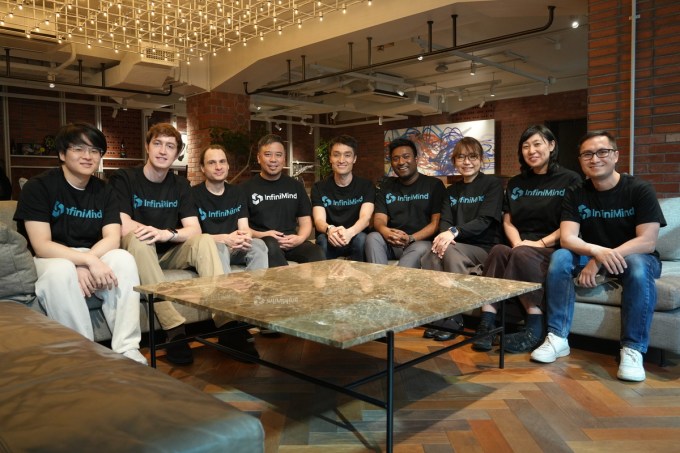
To tackle the problem, Aza Kai (CEO) and Hiraku Yanagita (COO), two former Googlers who spent nearly a decade working together at Google Japan, decided to build their own solution. The duo co-founded InfiniMind, a Tokyo-based startup developing infrastructure that converts petabytes of unviewed video and audio into structured, queryable business data.
“My co-founder, who spent a decade leading brand and data solutions at Google Japan, and I saw this inflection point coming while we were still at Google,” Kai said. By 2024, the technology had matured, and the market demand had become clear enough that the co-founders felt compelled to build the company themselves, he added.
Kai, who previously worked at Google Japan across cloud, machine learning, ad systems, and video recommendation models and later led data science teams, explained that current solutions force a trade-off. Earlier approaches could label objects in individual frames, but they couldn’t track narratives, understand causality, or answer complex questions about video content. For clients with decades of broadcast archives and petabytes of footage, even basic questions about their content often went unanswered.
What really changed was the progress in vision-language models between 2021 and 2023. That’s when video AI started moving beyond simple object tagging, Kai noted. Falling GPU costs and annual performance gains of roughly 15% to 20% over the last decade helped, but the bigger story was capability — until recently, models just couldn’t do the job, he told TechCrunch.
InfiniMind recently secured $5.8 million in seed funding, led by UTEC and joined by CX2, Headline Asia, Chiba Dojo, and an AI researcher at a16z Scout. The company is relocating its headquarters to the U.S., while it continues to operate an office in Japan. Japan provided the perfect testbed: strong hardware, talented engineers, and a supportive startup ecosystem, allowing the team to fine-tune its technology with demanding customers before going global.
Its first product, TV Pulse, launched in Japan in April 2025. The AI-powered platform analyzes television content in real time, helping media and retail companies “track product exposure, brand presence, customer sentiment, and PR impact,” per the startup. After pilot programs with major broadcasters and agencies, it already has paying customers, including wholesalers and media companies.
Techcrunch event
Boston, MA
|
June 23, 2026
Now, InfiniMind is ready for the international market. Its flagship product, DeepFrame, a long-form video intelligence platform capable of processing 200 hours of footage to pinpoint specific scenes, speakers, or events, is scheduled for a beta release in March, followed by a full launch in April 2026, Kai said.

The video analysis space is highly fragmented. Companies such as TwelveLabs provide general-purpose video understanding APIs for a broad range of users, including consumers, prosumers, and enterprises, Kai said, while InfiniMind focuses specifically on enterprise use cases, including monitoring, safety, security, and analyzing video content for deeper insights.
“Our solution requires no code; clients bring their data, and our system processes it, providing actionable insights,” Kai said. “We also integrate audio, sound, and speech understanding, not just visuals. Our system can handle unlimited video length, and cost efficiency is a major differentiator. Most existing solutions prioritize accuracy or specific use cases but don’t solve cost challenges.”
The seed funding will help the team continue developing the DeepFrame model, expand engineering infrastructure, hire more engineers, and reach additional customers across Japan and the U.S.
“This is an exciting space, one of the paths toward AGI,” Kai said. “Understanding general video intelligence is about understanding reality. Industrial applications are important, but our ultimate goal is to push the boundaries of technology to better understand reality and help humans make better decisions.”
Tech
Call for speakers: TechCrunch Founder Summit 2026

Have real-world scaling experience? The TechCrunch Founder Summit 2026 stage is calling.
On June 23 in Boston, this annual founder-focused event will bring together 1,100+ founders and investors to explore the realities of scaling startups across every stage. We’re seeking experienced founders, VCs, and startup operators to lead interactive roundtable discussions rooted in practical, real-world insight.
Experienced leaders from across the startup ecosystem will convene to host interactive roundtable sessions designed to spark real conversations. This is where founders get honest guidance, tactical takeaways, and clarity on the challenges that come with growth. Apply here to get started.
Apply to lead a roundtable session
Roundtables at TC Founder Summit are built for depth, not decks. Each session is a 30-minute, informal discussion led by up to two speakers, with no slides or video — just meaningful dialogue and practical insight. These intimate conversations create space for founders to ask real questions and connect directly with experts who’ve been there before.
To apply, click Apply to Speak on the event page, submit your proposed topic, and share your experience as a scaling expert. TC Founder Summit is the ideal platform to contribute to the next generation of startup leaders.

Speaker benefits
Speaking at TC Founder Summit is more than visibility. It’s full access to the experience. Along with elevating your authority and brand, you’ll gain premium entry to breakout sessions, roundtables, and curated networking with founders seeking guidance and VCs scouting what’s next.
Plus, TechCrunch will amplify your participation through:
Techcrunch event
Boston, MA
|
June 23, 2026
- Event agenda placement on the web and mobile app.
- Inclusion in a shared TechCrunch.com article.
- Social media promotion across TechCrunch channels.
Make your impact by applying today
Lead the conversation. Share what you’ve learned. Help founders navigate the highs and lows of scaling, and strengthen your reputation as a trusted voice in the startup community.
Apply early. TC Founder Summit takes place on June 23, but speaker applications close well before then. Submit now and be part of TechCrunch’s annual founder bootcamp.
Tech
Uber to buy delivery arm of Turkey’s Getir

Uber has agreed to acquire the delivery business of Turkey’s Getir, once one of the biggest success stories of the country’s startup ecosystem, the company announced on Monday.
The deal will see Uber paying $335 million at the outset to purchase Getir’s food delivery business. The ride-hailing giant will also pay $100 million for a 15% stake in Getir’s grocery, retail, and water delivery business, and said it would complete the acquisition of the division over the next few years.
Uber is buying the business from Getir’s biggest shareholder, the Emirati sovereign wealth fund Mubadala. The investment firm was reportedly seeking to sell its stake in the company last year.
The deal comes after a turbulent few years for Getir, which once enjoyed a valuation of $12 billion, that saw the startup scale down its operations massively. The company launched to great traction in 2015, and invested aggressively to expand its operations in the U.S. and Europe, both organically and via acquisitions, especially during the pandemic.
But after the pandemic lockdowns eased, broader consumer demand for food and grocery delivery also wavered, and Getir chose to cut its losses in 2024, shutting shop and laying off thousands of staff in the U.S., U.K., and Europe in order to focus on business back home.
Nearly a year ago, the company went through a struggle for control over a restructuring plan proposed by Mubadala. The plan was opposed by one of Getir’s co-founders, who eventually sued to fight the “illegal coup,” but a Dutch court rejected the founder’s appeals.
The company has raised a total of $2.40 billion so far, according to PitchBook. Documents filed by Getir in court last year show the company valued its group assets at $374 million.
Techcrunch event
Boston, MA
|
June 23, 2026
“This transaction reflects the strength of the business and the progress it has made, particularly over the last year,” Waleed Al Mokarrab Al Muhairi, deputy group CEO at Mubadala, said in a statement.
Uber said it would combine the new unit’s services with Trendyol Go, a food and grocery delivery service in Turkey that the ride-hail giant bought for $700 million last May. Uber said Getir’s food delivery business alone recorded gross bookings of more than $1 billion in 2025, up 50% from a year earlier.
The deal follows a strong showing by Uber’s delivery business in the fourth quarter, reporting revenue of $4.89 billion, up 30% from a year earlier. The company said Europe, the Middle East, and Asia proved the fastest-growing regions for the business in 2026.
Tech
Discord to roll out age verification next month for full access to its platform
Discord is rolling out age verification globally starting next month, the company announced on Monday. All users will be put into a “teen-appropriate experience” by default unless they prove they’re adults. Age verification will be required to change certain settings and access age-restricted content.
Discord users will need to be confirmed as adults in order to unblur sensitive content or turn off the setting, and only adults can access age-restricted channels, servers, and app commands. Additionally, messages from people a user may not know are routed to a separate inbox by default, and only verified adults can modify this setting.
People will receive warning prompts for friend requests from users they may not know, and only adults will be able speak onstage in servers.
To complete age verification, users need to either complete a facial age estimation or submit an ID to Discord’s vendor partners. The platform plans to add more options in the future. Discord notes that some users may be asked to use multiple methods when additional information is needed to assign an age group.
The facial age estimation requires video selfies, which Discord says never leave your device. Additionally, the company says IDs submitted to its vendor partners are deleted quickly and, in most cases, immediately after age confirmation.
It’s worth noting that Discord disclosed last October that around 70,000 users may have had sensitive data, such as their government ID photos, exposed after hackers breached a third-party vendor that the platform uses for age-related appeals. The breach reflected digital rights activists’ concerns over the use of age checks as a way to make the internet “safer.”
Discord’s global launch of age verification follows the company’s decision to establish age checks for users in the U.K. and Australia last year.
Techcrunch event
Boston, MA
|
June 23, 2026
“Rolling out teen-by-default settings globally builds on Discord’s existing safety architecture, giving teens strong protections while allowing verified adults flexibility,” said Savannah Badalich, head of product policy at Discord, in a press release. “We design our products with teen safety principles at the core and will continue working with safety experts, policymakers, and Discord users to support meaningful, long term wellbeing for teens on the platform.”
The announcement mirrors similar moves made by other online platforms, reflecting growing international efforts to strengthen child safety. Most recently, Roblox introduced mandatory facial verification for access to chats on its platform. Last July, YouTube launched its age-estimation technology in the U.S. to identify teen users in order to provide a more age-appropriate experience.
Discord’s age-verification changes will begin in early March, and both new and existing users will need to verify their age to access age-restricted content.


When will Wicked: For Good be streaming? What to know to watch it at home.
Call for speakers: TechCrunch Founder Summit 2026


