
Entertainment
A mindfulness-themed browser is (calmly) shaking up search
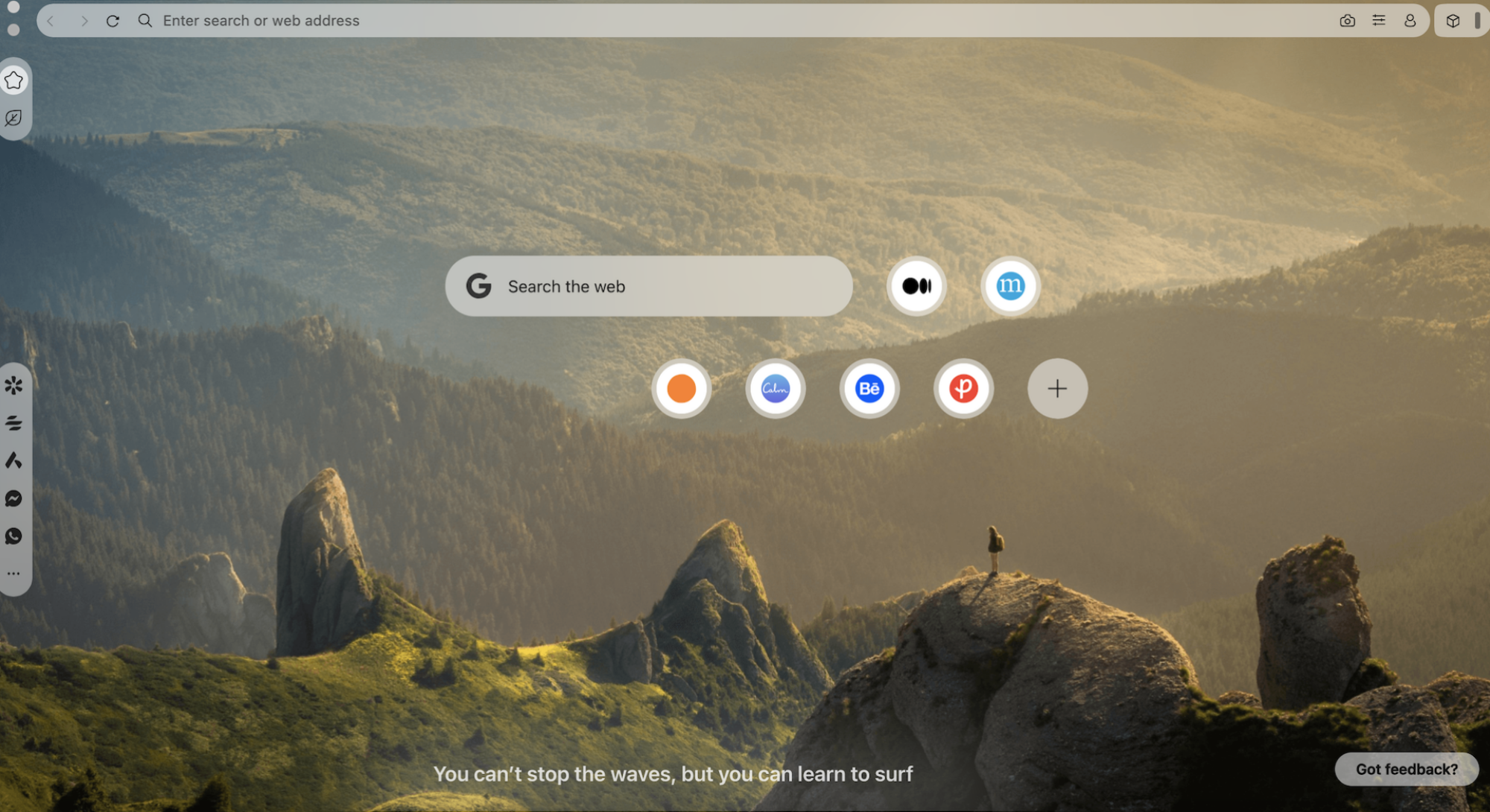
An internet browser with built-in mindfulness and meditation tools? Sounds a little like buzzword fodder to me. However, I’m a tired, jaded journalist who’ll try anything to feel more alive, so I tested the early access release, mindfulness-focused Opera Air and found its features straightforward and genuinely beneficial in the short period I played around with it.
Built by Norwegian browser maker Opera, Opera Air claims to be “the first browser built around the concept of mindfulness.” Opera has released thematic versions of its own browsers in the past, including a gaming-focused browser with a “Panic Button,” and a crypto browser. The latest, Air, is designed as a browser that both functions like Chrome, Firefox, and Safari but also “helps its users manage stress, enhance their focus, and maintain emotional clarity throughout their day.”
Tech platforms, apps, and wearables aimed at boosting mindfulness have made companies and startups a mint for years, so it’s understandable why eyebrows disappear into hairlines when a shiny new one comes along. However, the internet is a truly shitty place of late, a veritable tidal wave of misinformation and tech bros getting rich off unbridled abuse and harassment. We’re all on it, day after day, so a browser pinging me to “Take a Break” on the regular doesn’t seem like the worst thing in the world. So I tried it out.
Opera Air is instantly recognizable as a modern mindfulness offering
When you first install Opera Air, you’ll meet the requisite verdant landscape of rolling hills and a lone hiker, overlaid with an inspirational Jon Kabat-Zinn quote: “You can’t stop the waves, but you can learn to surf.” Drenched in that overt earnestness, let’s take a look around. You can choose a different wallpaper from mountaintop clouds, a meditation rock in a forest, or the company’s signature bubble overlaid on some naturescapes.
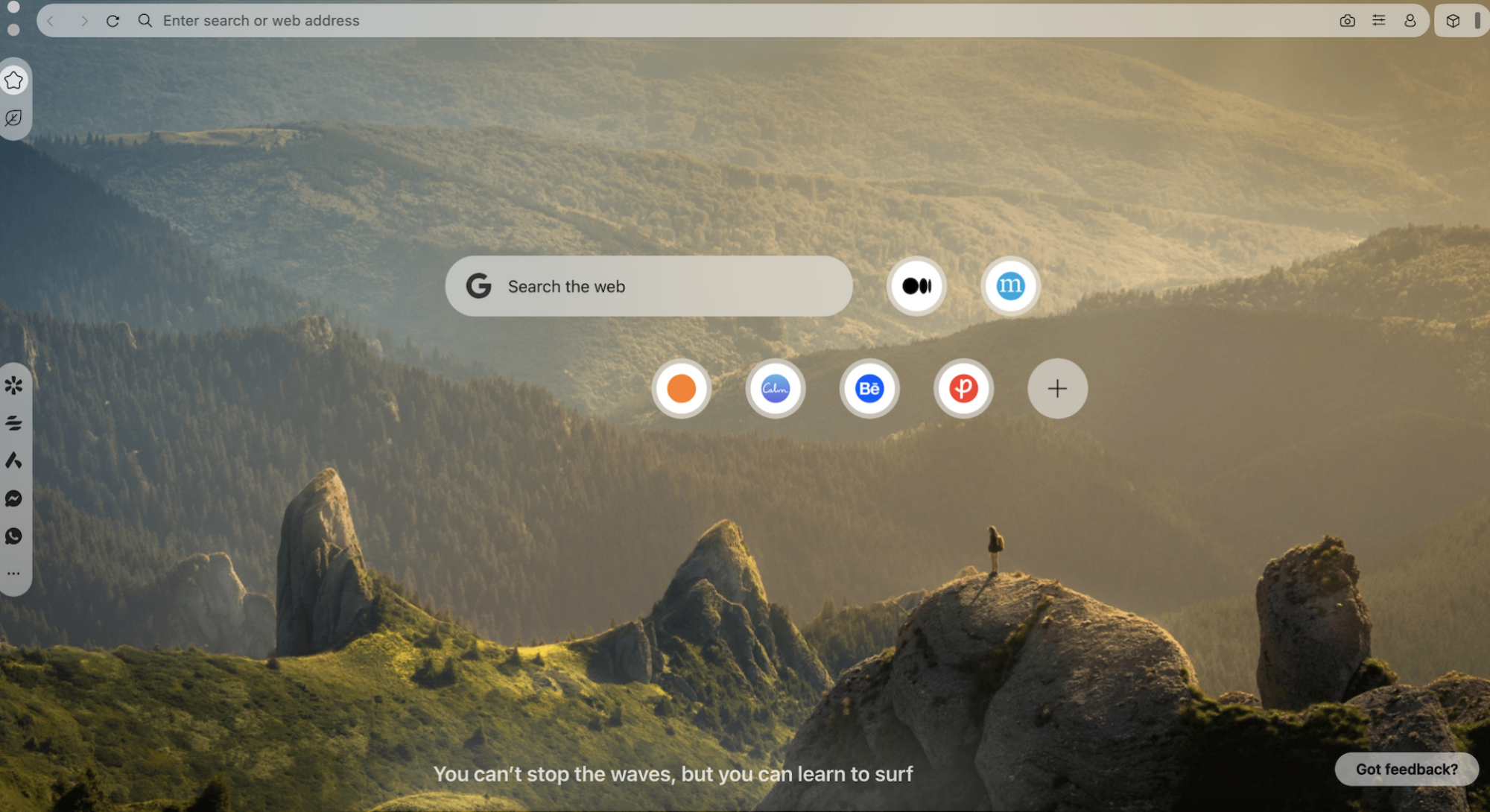
Mountains, check. Inspirational quote, check.
Credit: Opera Air / Mashable screenshot
You can connect Opera Air with your Chrome or Firefox account, which will bring in all your bookmarks, or you can start fresh. On the homepage, Opera Air features default buttons for leading mindfulness apps including Headspace and Calm, professional creative database Behance, social publishing platforms Medium and Penzu, and mindfulness publisher Mindful.
Mashable asked Opera about whether these buttons were sponsored placements, and the company said they were not: “Currently, we do not have any partnerships or affiliations with other apps or sites. This is a selection of inspiring apps and websites that our users can find helpful. Of course they have full control to remove these sites if they don’t want them and wish to have a more minimalist experience.”
Mashable Top Stories
Testing the “Take a Break” and “Boosts” features
Probably the most overt mindfulness plug-in here is the “Take a Break” button on the left hand menu. Pressing the icon that looks like three horizontal dashes will bring up a menu of options: breathing and neck exercises (3D-camera enabled or not), and guided meditations including a full body scan. You can actively seek the feature out or set your timer to enable break reminders for as regularly as you’d like (60 minutes seems to be a good ballpark number).
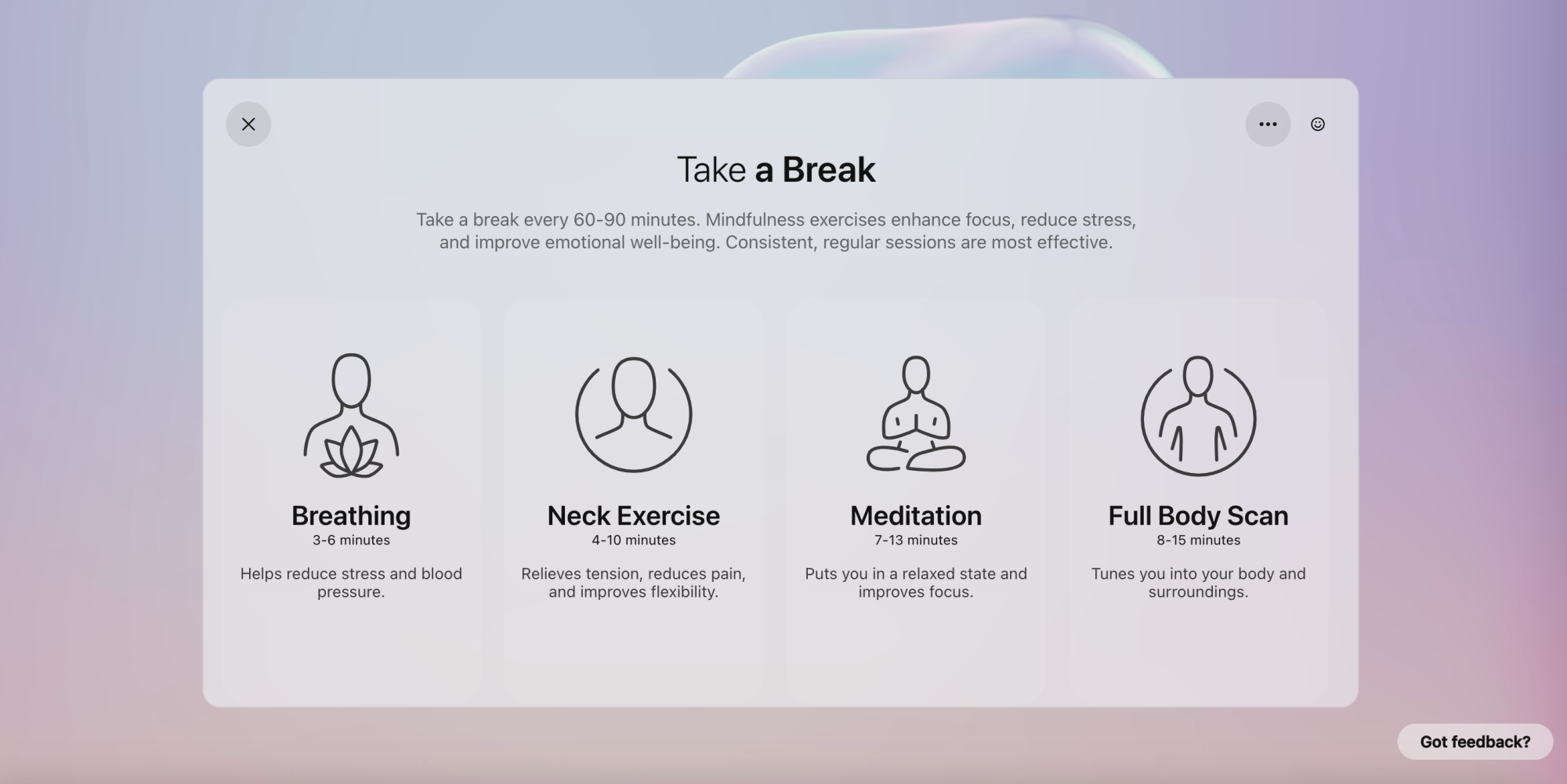
The “Take a Break” menu.
Credit: Opera Air / Mashable screenshot
Opera told Mashable the company produced the exercises in-house and the sounds through an agency, all using licensed lo-fi music tracks and ambient sounds — you can change up the ambient sound if you prefer “vinyl record crackling” to “walking in mid shallow water” (I do). You can choose between voice guides (Emma or Alex, both voice actors) and Opera told Mashable they’re available in English for now, with Brazilian Portuguese, Polish, and German planned to roll out soon.
These types of meditation are available on many mindfulness and meditation apps, some of which cost money and some which don’t, so this is nothing new. But it’s free (for now, and remember the cardinal rule of apps and software: if it’s free, you’re probably the product). Conveniently, however, it’s right there in your browser, so if you’re like me, doing a small meditation before heading into a video call meeting might be more likely for you than pulling out your phone.
I tried a seven-minute mindfulness meditation to “increase focus, ground the mind, and reduce stress.” The meditation uses techniques like controlled breathing, identifying thoughts and emotions and letting them pass by without judgment, checking in with your posture, noticing the space around you, and other long-used hallmarks of the practice. And yeah, I felt focused afterward, and could potentially use this every day to make a real effort to make meditation a habit.
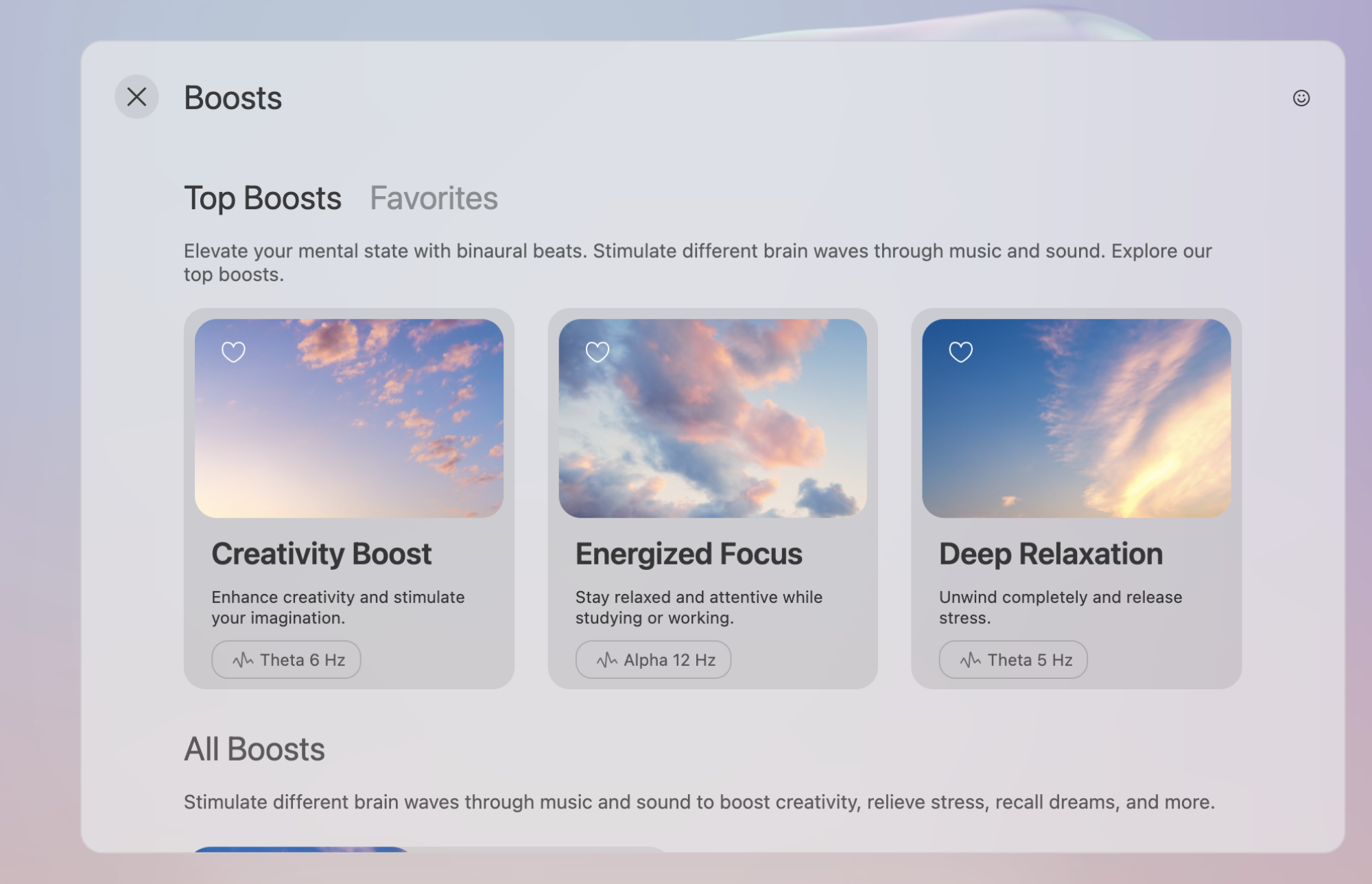
The “Boosts” are binaural beats.
Credit: Opera Air / Mashable screenshot
The other mindfulness tool Open Air features is “Boosts,” sitting above the “Take a Break” option in the left menu. It’s a menu of binaural beats, a long prevalent auditory technique that generates a unique frequency in the brain when you listen to two different frequencies at once — Opera told Mashable the platform uses pure sine waves and carrier frequencies of 120hz and 240hz to deliver a range of binaural beats between 1hz and 40hz. There are different frequency states, several of which help with focus and attention, some which are associated more with relaxation; Opera Air’s binaural beats offerings are titled Creativity Boost, Energized Focus, Deep Relaxation and more.
Other bits in Opera Air that aren’t mindfulness-related
Like its standard Opera browsers, Opera Air also features the company’s ad blocker and Opera’s own free VPN, which you can switch on and off in the Settings. Here, you can also take control of your privacy and data settings.
On the sidebar, there’s also an inbuilt AI chatbot called Aria that’s been built using a combination of AI models GPT-4o, Gemini 1.5, and Imagen 3. Meta platforms WhatsApp and Messenger are also built into this menu, which feels weird to see underneath the mindfulness tools, but hey, this is a browser after all. Plus, you can switch these on or off in the Settings.
As I said, in 2025, with everything simmering online, an internet browser with an in-built mindfulness reminder seems like a pretty good idea. There’s plenty of online spaces to get free meditation and mindfulness guidance right now, and this is one of them, one that’s close at hand during your work day.
Entertainment
Skate developer Full Circle announces layoffs ahead of new game release

Full Circle, the gaming studio behind the new iteration of Skate, has recently announced a restructuring involving layoffs at its headquarters in Burnaby, British Columbia. Founded in 2021 as a subsidiary of Electronic Arts, Full Circle is just the latest in a series of AAA gaming studios to be hit by layoffs, with Ubisoft Toronto laying off 40 employees last week.
In their public-facing announcement, entitled “skate.’s Next Chapter,” the company lamented that the people affected by layoffs “are talented colleagues and friends who helped build the foundation of skate,” while shouting out the “tens of millions” of people who have explored the Early Access version of skate. released last September. “To our departing teammates: thank you. skate. exists because of your hard work and dedication to the craft.”
The original Skate games were released in the late 2000s for the Xbox 360 and PlayStation 3 and marketed as more realistic skateboarding games compared to the rival Tony Hawk’s Pro Skater series. Fans responded well to the tight controls, inventive city settings, and fun soundtrack, which won the first Skate game the “Sports Game of the Year” award at the 11th Annual Interactive Achievement Awards, and resulted in commercial success, but the series had been on indefinite hold until the announcement of skate. (known among fans as Skate 4), which was to be a live-service game built around a sandbox-style multiplayer experience, a move that didn’t sit well with many long-time fans of the series.
Mashable Light Speed
While the latest Skate game has not yet had a final release, the Early Access version has been available to fans for almost half a year now, and early reviews are mixed. Critics have pointed to the inclusion of microtransactions ($25 clothing for your digital character), the online-only gameplay restriction, and the homogenized character design, while others have praised the free-to-play accessibility.
We don’t yet know how many employees lost their jobs at Full Circle, as the company was not forthcoming, but the parent company, EA, lost approximately 5% of its workforce in 2024, during its last round of layoffs. As for the fate of skate. after these layoffs, much is still unknown and the game still doesn’t have a final release date.
Entertainment
Xiaomi 17 Ultra hands-on: The cameraphone with a monstrous zoom
Xiaomi’s Ultra line of phones has always been about one thing: Peak camera performance. The new Xiaomi 17 Ultra, launched ahead of MWC 2026 in Barcelona, pushes the boundaries once more, though it suffers from similar setbacks as its predecessors.
Note that there was no Xiaomi 16 Ultra; the company decided to skip that number and go straight from the Xiaomi 15 and 15 Ultra to Xiaomi 17 and 17 Ultra, likely to “catch up” with Apple, whose latest models also bear the number seventeen. Despite the change, the new Xiaomi phones are very much an evolution of last year’s flagship models.
On the phone side of things, the Xiaomi 17 Ultra is an extremely capable Android smartphone, with a 6.9-inch, 120Hz OLED display, a Snapdragon 8 Elite Gen 5 chip, 16GB of RAM, 512/1024GB of storage, and a 6,000mAh battery with 90W fast charging and 50W wireless charging. It comes in three colors: Black, White, and the sparkly Starlit Green (Xiaomi sent me a black unit, but the Starlit Green looks way cooler).

The 6.9-inch OLED display is excellent.
Credit: Stan Schroeder/Mashable
Where the Xiaomi 17 Ultra differs from the regular Xiaomi 17, which also debuted here in Barcelona, is mainly in screen size (6.9 vs. 6.3 inches), and the camera. The Ultra’s got a massive, Leica-branded camera array on the back, with a 50-megapixel main camera, a 200-megapixel telephoto camera, and a 50-megapixel ultra-wide camera, coupled with a 50-megapixel selfie camera on the front.

At 8.29mm thickness and 218 grams of weight, it’s the thinnest and lightest Xiaomi Ultra phone ever.
Credit: Stan Schroeder/Mashable
The 200-megapixel, 75-100mm telephoto camera gives this phone otherworldly zoom capabilities, with up to 17.2x of “optical-level zoom.” I’ve tried it out, and was able to take usable photos at 100x zoom or more, far beyond in the distance than what my naked I could see.
Mashable Light Speed

Left:
This is what the XIaomi 17 Ultra’s telephoto camera can do.
Credit: Stan Schroeder/Mashable
Right:
Credit: Stan Schroeder/Mashable
Venture that far out, and AI takes the reins quite heavy handedly, which you’ll see in the way the system recreates the letters of a sign you took in the distance. Still, if you like the idea of having a camera that can take sharp photos of a flower that’s a hundred yards away, this is the phone to do it with.

Left:
Credit: Stan Schroeder/Mashable
Right:
The zoom on this phone is so good, it’s worth providing another example. It’s like having a set of binoculars.
Credit: Stan Schroeder/Mashable
To add an exclamation point to the phone’s camera capabilities, Xiaomi also sells two optional photography kits which consists of two different cases that turn the phone into something that really looks like a compact camera, and add a few buttons, visual details, and battery life to the mix. The smaller Xiaomi 17 Ultra Photography Kit makes more sense to me as the phone still retains somewhat normal dimensions; the two-part Xiaomi 17 Ultra Photography Kit Pro makes it a bit too big for my taste.

The photography kits look cool, but they make the phone a lot bulkier.
Credit: Stan Schroeder/Mashable
The kits, as cool as they may be, illustrate the most obvious drawback of this phone: it’s too much of a camera. It’s top heavy, has a smaller battery than the regular Xiaomi 17, and – due to its massive camera bump on the back – doesn’t support Xiaomi’s wireless, magnetic battery. Don’t get me wrong, this is one powerful phone, but it’s primarily aimed at photography enthusiasts. Kudos to Xiaomi for making the Ultra lighter than ever, though at 218 grams it’s still not exactly lightweight.
If you want your Xiaomi 17 Ultra to be a little more…Leica, there’s a special version just for you, shown as a surprise announcement during Xiaomi’s big unveiling in Barcelona. Called the Leica Leitzphone, it shares most of the specs with the Xiaomi 17 Ultra, but has a somewhat retro design which calls to mind classic Leica cameras, and a couple of Leica-specific photography modes.

This one is for the Leica fans.
Credit: Stan Schroeder/Mashable
It also has one extra feature: The ring surrounding its camera bump can be rotated to increase or decrease zoom. I’ve tried it out, and it appears to be quite precise, though you do have to be careful not to place your fingers in front of the lens while shooting.
The Xiaomi 17 Ultra starts at 1,499 euros in Europe; there’s no info on U.S. availability yet. The Leica Leitzphone is starting at a hefty price of 1,999 euros, and it will be available in select markets and locations.
Topics
Mobile World Congress
Xiaomi
Entertainment
Xiaomis new hyper car concept has the strangest cockpit weve ever seen
Xiaomi likes to bring cars to Barcelona; the company gave us the first glimpse of its SU7 Ultra supercar during last year’s MWC in March.
This year, however, Xiaomi has unveiled something that’s pretty far out there, even by its own standards. Called the Xiaomi Vision Gran Turismo, it’s a hypercar that was designed to go really fast while slicing through the air in a way not many cars (or race cars, for that matter) can (Xiaomi says it’s been “sculpted by the wind”).

It feels kinda empty in there.
Credit: Stan Schroeder/Mashable
The company will bring the concept car to its MWC show floor in Barcelona on March 2, presumably when we’ll learn more about its powertrain, acceleration, battery, and other trivialities. Today, however, Xiaomi was mostly focused on how the air flows through the car, using a variety of wind tunnels and channels (and even a moving part on the car’s bottom) to make it more efficient.

The wheels and wheel covers are special, too.
Credit: Stan Schroeder/Mashable
Even the car’s wheels have special covers that are (somehow) magnetically set in place so they don’t rotate while the car moves, as that would also increase drag.
Mashable Light Speed

I bet your car doesn’t have a cocoon-shaped sofa.
Credit: Stan Schroeder/Mashable
Inside, it gets even nuttier. The seats are out; instead, you sit in a “cocoon-shaped sofa” with an x-wing steering wheel with five tiny displays, some of which apparently double as (contextual?) buttons. Most of the things you associate with a traditional car are gone; instead, it’s you in that sofa-shaped cockpit, that steering wheel, and the road. The car’s a two-seater, so don’t expect to bring your family on a trip in this one.

Fortunately, you might be able to get a cocoon-shaped sofa/cockpit for your home.
Credit: Stan Schroeder/Mashable
In fact, most people probably won’t be able to afford a car like this, but Xiaomi’s got you covered, as it plans to release a gaming console/cockpit shaped just like the car’s cockpit, so you can race around in your own little cocoon in the relative safety of your home.
We don’t know how fast it goes. We don’t know where the batteries are, given that the car appears to be mostly wind tunnels under that cockpit. We don’t know if it’s ever going to make it to market. But boy, does it all look cool.
We’ll hopefully find out more on March 2 when that show floor opens, so stay tuned for pics and videos.
Topics
Mobile World Congress
Xiaomi

Luka Doncic has happy birthday as Lakers crush Warriors
Ole Miss snaps losing skid at Auburn's expense


