
Entertainment
Star Trek’s Original Opening Was So Bad It Never Made It To Air

By Chris Snellgrove
| Published

One of the first signs that Star Trek: The Original Series had become a pop culture phenomenon was the success of its theme song. People who barely even knew what the show was about could hum its iconic opening tune. Equally famous was William Shatner’s monologue describing the mission of the starship Enterprise: to explore strange new worlds, to seek out new life and new civilizations. To boldly go where no man had gone before! The whole thing felt like pure television magic. It wasn’t magic, though: a lot of work went into this intro, including earlier attempts most fans have never seen.
Before the final version of the Original Series opening (“final” being relative, since it was tweaked slightly for Season 2 and again for Season 3), there was a completely different opening. This was attached to the version of “Where No One Has Gone Before” (Trek’s second pilot episode) that Gene Roddenberry showed to NBC executives. They were pleased with what they saw and gave this seminal sci-fi show the green light. Once they did, one of the first things Roddenberry set out to do was to create a new intro. That’s a good thing, because the intro that never made it to air is one of the worst things in the entire franchise!
An Intro Straight Out Of The Mirror Universe
When you watch this unaired Star Trek: The Original Series title sequence, the first thing you’ll notice is how spooky it is. The show did not yet have its iconic, soaring score that hinted at all the high adventure our heroes would encounter on the final frontier. Instead, we get a mostly muted score, one that makes way for William Shatner’s very different narration. The music only really comes to life when the words “Star Trek” pop up onscreen. Even then, it sounds less triumphant and more like something you’d hear when one of the Red Shirts was busy getting himself killed on an exotic alien planet.
This version of the show’s intro sequence is relatively short. Once the narration ends, we get the title of the show and the words “Starring William Shatner.” After that, it jumps right into the opening of the episode. The whole thing is just over a minute long, which is slightly longer than the final intro we ended up with (which lasts for about 49 seconds). Ironically, though, this unaired intro feels much longer because of the muted, ominous music and the somewhat plodding nature of Shatner’s narration.
William Shatner’s Narration Was Completely Different

What does Captain Kirk say in this unaired intro? “Enterprise log, Captain James Kirk commanding. We are leaving that vast cloud of stars and planets which we call our galaxy. Behind us, Earth, Mars, Venus, even our sun, are specks of dust,” he says. “The question: What is out there in the black void beyond? Until now, our mission has been that of space law regulation, contact with Earth colonies, and investigation of alien life. But now, a new task: A probe out into where no man has gone before.”
For Star Trek lorehounds, this is a lot to process. For one thing, this narration seems to conflate leaving the solar system with leaving the galaxy. While Star Trek has gotten fuzzy about things like galactic barriers and galactic centers, every single show and movie takes place firmly within our own galaxy, so that part of Shatner’s unused narration is pure nonsense. The rest of it is fascinating (as Spock might say) from a canon perspective because it implies that Starfleet has, up to this point, mostly played the role of space police who occasionally investigate aliens. Now, he says, they are tasked with exploring the final frontier.
Does This Intro Fit With The Current Canon?
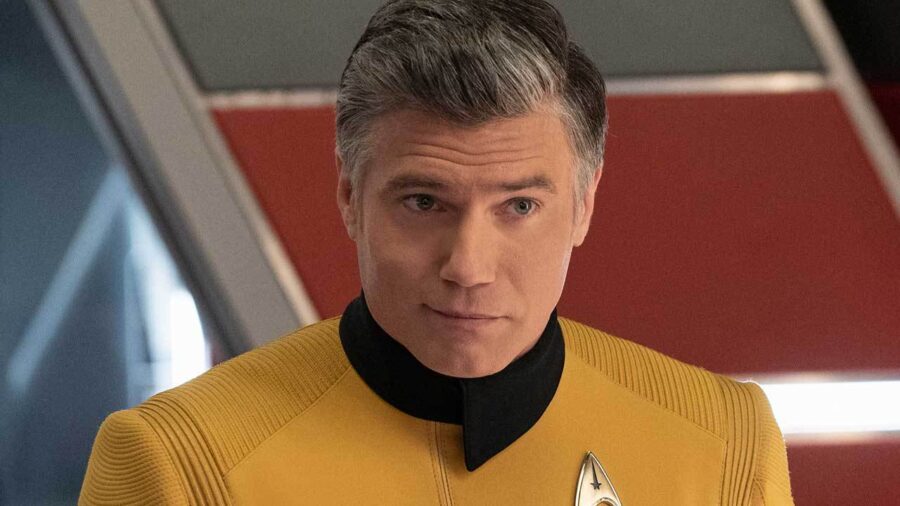
Interestingly, this contradicts parts of later franchise lore while lining up with other parts. For example, Star Trek: Enterprise takes place about a century before The Original Series, and it portrays Captain Archer making first contact, discovering strange new life, and generally going where no man had gone before; all of this would contradict this original narration. But it does line up with Discovery emphasizing that Pike and other captains of Constitution-class ships were charged with deep space exploration, something Starfleet considered more important than staying home and playing cowboy.
All of this makes the unaired intro to Star Trek: The Original Series a fascinating part of franchise history. It’s also, surprisingly enough, part of national history, as Gene Roddenberry was invited to submit this, Trek’s first pilot, and other production materials to the Smithsonian Air and Space Museum. He did so back in 1967 and, in prime Roddenberry tradition, made a big show of it to make himself and his new series look better. A bit of shameless self-promotion? Sure. But Roddenberry certainly deserved a victory lap for creating something that truly went where no TV show had gone before!
Entertainment
The Best New Show Of The Year Is A Supernatural Comedy Horror On AppleTV
By Jonathan Klotz
| Published

The 2026 television season has been a little lackluster so far when it comes to original, new series. The Boroughs was a fun binge on Netflix, Margo’s Got Money Troubles was a good comedy, but nothing can compare to the surprising success of Widow’s Bay on AppleTV. It’s a horror comedy, which might be the hardest combination of genres to pull off, that plays out like Twin Peaks meets Parks and Recreation. No show will leave you laughing so hard in one episode, before traumatizing you in the next.
Widow’s Bay Is The Most Original Show In Years

That odd mix of shows makes sense since Widow’s Bay was created by Katie Dippold, a writer for Parks and Recreation. The series takes place in the island town of Widow’s Bay in New England when Mayor Tom (Matthew Rhys) decides to boost tourism to the small community. The catch is that the community, primarily Wyck (Stephen Root) believes the island is cursed.
It’s not a spoiler to say that yes, yes it is cursed, and yes, there are real horrors at work on the island. That’s not surprising. What is surprising is the dry humor and Matthew Rhys’ perfect facial expressions, as the town’s residents will deliver the most absurd lines with a perfectly straight face. If you vibed with the humor of Parks and Recreation, you know what you’re getting into with the odd residents of Widow’s Bay, especially Kate O’Flynn as Tom’s assistant, Patricia. There’s a sequence with her involving a shotgun that is destined to be a social media hit for years to come, and one of those moments that you’ll think, “I’d do the same thing.”
Slapstick Comedy, Horror, And Amazing Sight Gags

Before starting your binge of the first season, avoid as many spoilers as you can. Widow’s Bay sets up mysteries early on with the chained church bell, the strange basement room, a rolling fogbank, and, while it’s not a supernatural mystery, how many Diet Cokes can Town Hall employee Dale consume? His desk is filled to the brim with cans. That can’t be healthy.
Keep your eyes peeled while watching Widow’s Bay as the production team was heavily influenced by The Simpsons usage of sight gags. Some are called out with blatant shots, others exist in the background of a conversation, but put together, they make the town of Widow’s Bay an absurdist version of Twin Peaks.
No one had supernatural slapstick down on their 2026 Bingo card, but here we are. While Netflix pulled the plug on The Boroughs, Widow’s Bay has already been confirmed for a second season, which is good considering the stakes-raising season finale ends by revealing a whole new layer to the mystery of the island. We have a long wait until Season 2 premieres, giving you plenty of time to watch the show of the Summer, and you can still convince your friends you were a fan of Widow’s Bay before it was cool. ]
Widow’s Bay Season 1 is now streaming on AppleTV.
Entertainment
Don’t pay $199 for Windows 11 Pro when it’s currently just $13
TL;DR: Microsoft Windows 11 Pro is down to just $12.97, giving users an easy OS upgrade with advanced security, productivity tools, gaming features, and Copilot AI.
Some upgrades just feel right. This is one of them.
If your PC has been running a little sluggish or you’ve been meaning to bring your system up to speed, Windows 11 Pro is just $12.97 (reg. $199) — a rare, time-sensitive offer that rewards quick, savvy decisions.
Mashable Deals
This isn’t about chasing trends; it’s more about giving your computer the modern foundation it deserves. Windows 11 Pro brings a sleeker UI, better multitasking, and enhanced security — all in a one-time lifetime license.
Think of it as the difference between driving a reliable car and suddenly upgrading to one with a smarter dashboard, smoother handling, and built-in security features.
For professionals, creators, and power users, this upgrade also unlocks features like Hyper-V, Windows Sandbox, BitLocker encryption, and seamless Azure AD integration — tools that make a real difference when you’re working across projects or managing sensitive data.
And yes, Windows 11 comes with Copilot, Microsoft’s AI-powered assistant that can summarize pages, change settings, or even help you generate code on the fly. It’s like having a co-pilot (literally) inside your OS.
Mashable Deals
But you don’t need convincing — you already know a smart upgrade when you see one. Get Windows 11 Pro for just $12.97 (reg. $199).
StackSocial prices subject to change.
Entertainment
Gene Roddenberry Secretly Fixed Star Trek’s Earliest Plot Hole
By Chris Snellgrove
| Published

Star Trek is celebrating its 60th anniversary this year. Part of why that is so impressive is that this franchise has managed to maintain the same continuity for so many years. Sure, the Kelvinverse rebooted everything for a few movies, and we occasionally get glimpses of alternate universes with their own twisted history. But the main Trek timeline, from The Original Series through Starfleet Academy, has remained the same, which is an amazing creative achievement. But it also leads to something as annoying as it is inevitable: plot holes!
There are many seeming plot holes throughout the franchise. Heck, Starfleet Academy introduced more than its fair share in only one season. However, the earliest plothole goes back to William Shatner’s very first episode, “Where No Man Has Gone Before.” This episode features a mock grave for James Tiberius Kirk that reads “James R. Kirk.” This weird screwup inspired decades of attempts by fans and creators to explain what happened. However, Star Trek creator Gene Roddenberry had a simple explanation from the very beginning. That is, the godlike character who created the tombstone was still fallible, meaning that this would be an in-universe screwup rather than a production error.
A Ghoulish Plot Hole

“Where No Man Has Gone Before” was actually the second pilot episode of Star Trek: The Original Series. It’s the episode that sold NBC on this new show, which isn’t surprising, because this is a great hour of television. Strange energy from the galactic barrier gives one of Captain Kirk’s best friends, Gary Mitchell, godlike powers. Those powers are getting stronger by the minute, so Kirk eventually has to make the difficult decision to kill his buddy in the name of keeping the entire ship (and quite possibly the entire galaxy) safe.
At one point, Mitchell uses his powers to summon a tombstone that reads “James R. Kirk.” It makes for a great threat, but there’s just one problem: the character’s name is James Tiberius Kirk. Incidentally, Gene Roddenberry seemingly knew Kirk’s middle name early on, even though it wasn’t officially revealed (outside of The Animated Series) until The Undiscovered Country. In the introduction to Star Trek: The Classic Episodes 1, Original Series writer D.C. Fontana claimed that once Roddenberry noticed the mistake, he came up with a quick and easy explanation. “Gary Mitchell had godlike powers, but at base he was human. He made a mistake.”
Powers Like A God, Mind Like A Human

Unfortunately, Roddenberry kept this plot hole explanation to himself. I say “unfortunately” because this mistake sent fans into a tizzy trying to explain the discrepancy. On top of that, various Star Trek writers tried their hands at providing explanations. One such explanation came from Michael Jan Friedman’s non-canonical My Brother’s Keeper series. In these books, when the future captain meets Gary Mitchell, he claims his middle name is “Racquetball.” Later, when Kirk steamrolls through a discussion, Mitchell says the man’s middle name should be “Rhinoceros.” Therefore, Friedman explained that the “James R. Kirk” on the tombstone is just an in-joke between former friends.
Additionally, the late, great Star Trek writer Peter David tried his hand at an explanation. In his novel Q-Squared, the events of “Where No Man Has Gone Before” take place in a parallel reality in which Kirk’s middle initial really is “R.” In this non-canonical book, we also find out that Mitchell’s powers came from briefly being possessed by Q, who had to pull himself together across all of time and space. Quick side note: while Marvel has really played out the concept of multiverses, Q-Squared is an amazing novel, and every Trek fan should read it at least once.

These writers did their best to explain where “James R. Kirk” came from. On top of this, fans have constantly debated this issue, all trying to one-up each other in coming up with a suitable explanation for this plothole. As it turns out, though, none of this debating and speculating was necessary because Gene Roddenberry had the perfect explanation ready. Namely, that having the power of a god isn’t the same as having the unlimited knowledge of a god. It’s short, it’s simple, and it’s effective. Most of all, it does what Star Trek has always done best: keep the sci-fi storytelling centered around humanity.

The Best New Show Of The Year Is A Supernatural Comedy Horror On AppleTV
FURIA, Team Falcons set to clash for IEM Cologne crown


