
Entertainment
Why Sci-Fi's Sexiest Robot Couldn’t Stop Channeling Marvel’s Deadliest Hero

By Chris Snellgrove
| Published

Ronald D. Moore’s Battlestar Galactica reboot has a well-earned reputation for being a very serious show. Sure, there are moments of levity here and there, but the series never loses its endlessly grim dark tone.
That’s understandable, of course: the show follows the last surviving members of the human race as they flee from extinction at the hands of relentless robot killers. When your TV show is about a slow-rolling apocalypse set in space, there’s not much room (even in the vacuum) for jokes and laughter.

However, Moore has a pretty quirky sense of humor. If you look closely enough, you can find some hilariously off-kilter references to other media that are sure to make you laugh.
In the episode “Litmus,” for example, has a scene in which brilliant, egocentric scientist Gaius Baltar is threatened by the version of Six that lives in his head. As viewers, we’re supposed to take the threat very, very seriously. But that’s hard to do once you realize that she is quoting the Incredible Hulk right to the man’s face!
The Incredible Six

This bizarre Battlestar Galactica tale will require a bit of frakkin’ context. In the show, there are multiple versions of Six, the statuesque Cylon played to sexy perfection by Tricia Helfer. The most mysterious version is one that lives inside Baltar’s head: it frequently talks to him and offers surprising advice from time to time.
In “Litmus,” for example, Baltar decides to destroy the Cylon detector because he thinks it has made him a target. When she learns of his plan, though, Six tells the scientist, “You’re gonna complete the project, like I told you.”

To this, a defiant Baltar says, “Really. Will I? Or what?” A visibly angry Six then gets in his face to utter something quite intimidating. “Don’t make me angry, Gaius. You wouldn’t like me when I’m angry.” At least, the line is delivered in an intimidating way.
It’s tough for audiences to be scared, though, once they realize the hilarious truth. Six is inexplicably quoting a line made famous by Bill Bixby when he played the titular lead of the Incredible Hulk TV show. Later, Mark Ruffalo would do a callback to this line in Avengers, when he tells Captain America, “That’s my secret, Cap. I’m always angry.”
A Marvel Of A Woman
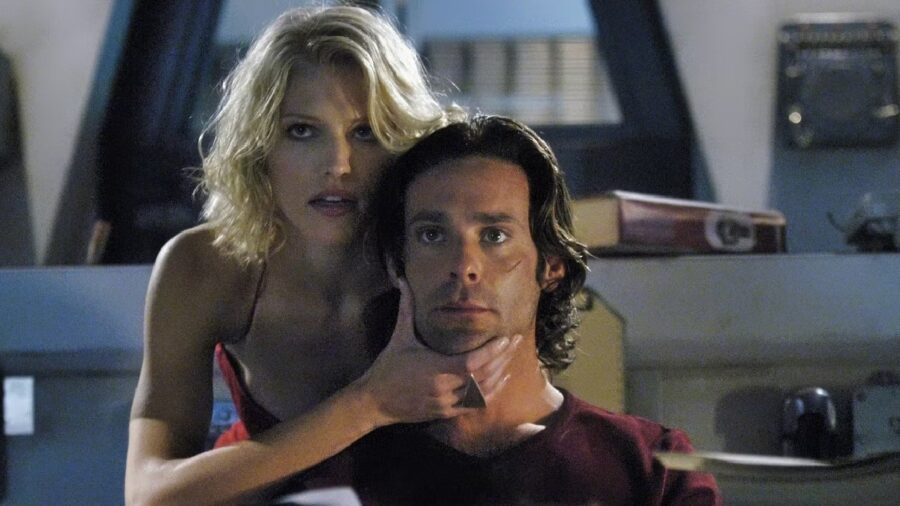
So, what’s a goofy line from a goofier Marvel show doing in Battlestar Galactica? Nobody knows for sure, but it seems a safe bet that Ronald D. Moore or others on his staff were big fans of the old Incredible Hulk TV show. That’s because we get at least two more homages to this classic television line.
In “Six Degrees of Separation,” Six repeats the “don’t make me angry” part when she threatens Baltar again. Later, in “Collaborators,” there’s a bizarre dream sequence where Sx says, “Don’t make me angry,” only for Adama to complete the quote: “You wouldn’t like her when she’s angry.”

There you have it, you frakkin’ toasters: Battlestar Galactica might be a fairly serious show, but it’s filled with silly homages to the goofiest line in Marvel history. Of course, what makes this tale even stranger is that, canonically, the events of this sci-fi show take place long before the advent of our own modern civilization.
That means that Tricia Helfer’s character isn’t actually quoting the Incredible Hulk. She might (given that this “Head Six” version is seemingly immortal) be the one who inspired Bill Bixby to say it in the first place!
Entertainment
Liam Neeson's Most Overlooked Action Thriller Was A Violent Hit With Women
By Zack Zagranis
| Published
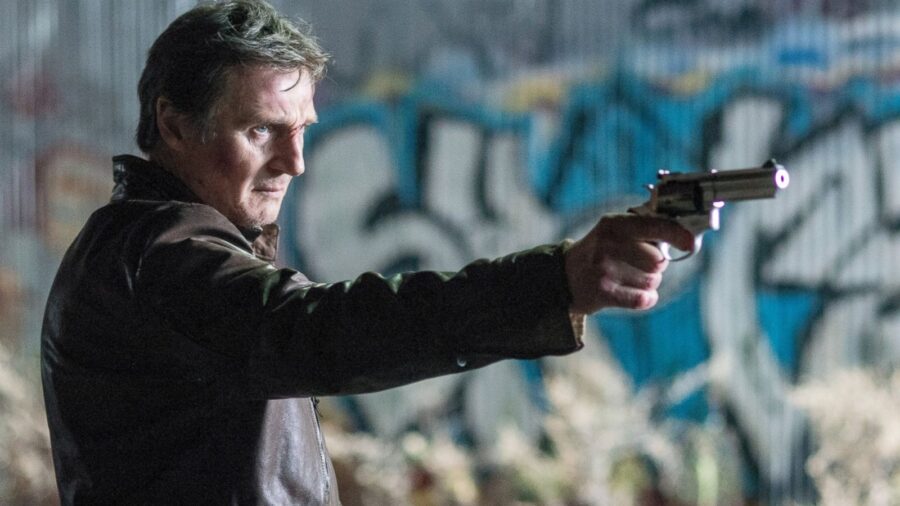
Everyone knows by now that Liam Neeson has a particular set of skills that he’s acquired over a long career in Hollywood. Skills that make him a dream come true for action movie fans. Those skills are on full display in the 2015 underrated action gem Run All Night.
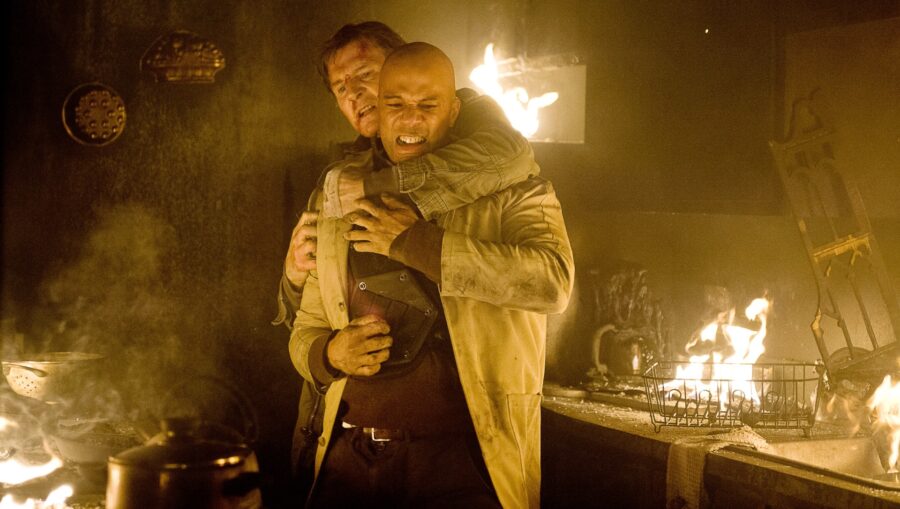
In Run All Night, Liam Neeson plays a perpetually drunk former hitman, Jimmy “The Gravedigger” Conlon, forced to go against his best friend and former boss Shawn Maguire, played by Ed Harris, in order to save his son, Mike Conlon, played by Joel Kinnaman. Along with Neeson and Harris, the film also stars Daredevil‘s Vincent D’Onofrio as Detective John Harding and Genesis Rodriguez of Tusk fame.
Run All Night was directed by Jaume Collet-Serra from a screenplay written by Brad Ingelsby, creator of the popular HBO Max mini-series Mare of Easttown. The film marked the 3rd collaboration between Liam Neeson and Collet-Serra. The duo previously worked together on the movies Unknown and Non-Stop.
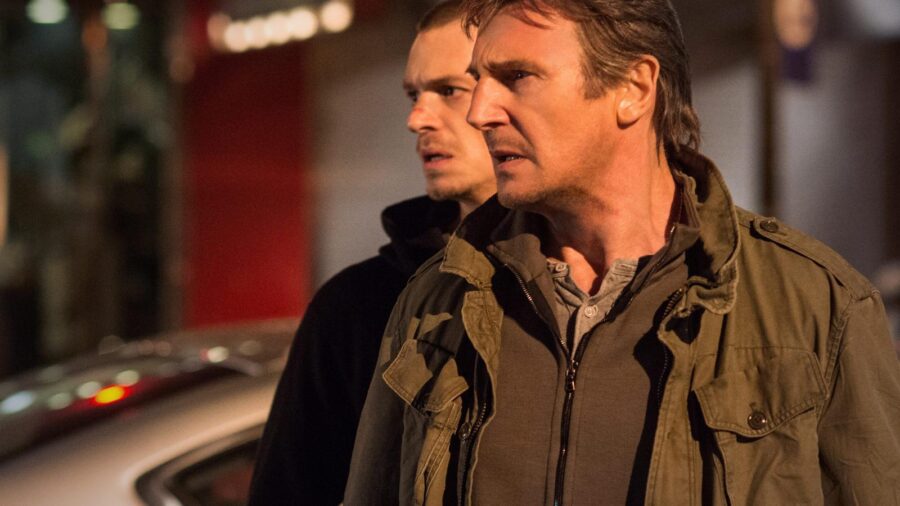
In 2012, Warner Bros. purchased Ingelsby’s script, then titled The All-Nighter, for six figures. The following year, Liam Neeson joined the cast right around the time Jaume Collet-Serra came aboard the project. The movie was scored by frequent Zack Snyder collaborator Junkie XL, who thought it would be more interesting to base the score on emotional beats rather than let the action dictate the musical direction.
Run All Night was a minor Box-Office success, grossing $26.5 million domestically and another $45.1 million overseas, for a grand total of $71.56 million, against a production budget of $50 million. Interestingly, the audience for the Liam Neeson action-thriller was 52% female on its opening weekend, a number considered high for an all-male action movie. The figure just helps to further dispel the stereotype that only guys like to see people crashing cars and beating the crap out of each other.
Run All Night is just one of several action movies starring late-career Liam Neeson. Ever since 2008’s Taken, Neeson has focused almost exclusively on action/crime movies. In addition to Taken 2 and 3, Neeson has appeared in at least 20 other movies that IMDb considers either action, crime, or both.
To say the man is being typecast is an understatement. To put it another way, when a trailer for a Liam Neeson movie comes on, most fans assume it’s a Taken sequel until told otherwise.
That’s not to say that the Northern Ireland-born actor hasn’t dabbled in other genres in the last 15 years. In the last decade and a half, Liam Neeson has managed to squeeze in a few romantic dramas, such as Made in Italy and Ordinary Love, along with a handful of cameos here and there. Perhaps Neeson’s oddest collaborations have been with American Dad creator Seth MacFarlane, who cast him as the lead in 2025’s The Naked Gun reboot.
MacFarlane lso put Liam Neeson in his other live-action endeavors like A Million Ways to Die in the West, Ted 2, and The Orville, as well as using the actor for a few bits on Family Guy. Neeson is known primarily for serious roles, making it even weirder that Seth casts him exclusively as comedy relief. For whatever reason, it works.
Neeson’s cameo in Ted 2 as a grocery store customer buying Trix is easily the funniest gag in the movie.
Cameos aside, action movies really have become Liam Neeson’s bread and butter lately. Not just any action movies, either, but the kind where an old, grizzled ex-CIA agent/mob hitman/bank robber comes back and grimaces his way through one last job. His characters are the grimdark versions of the wisecracking, one-liner-spouting action heroes of the ’80s played by actors like Schwarzenegger and Stallone.
Where Arnold’s characters would snap a foe’s neck on an airplane and then tell the flight attendant, “Don’t disturb my friend. He’s dead tired.” Liam Neeson’s character gives the bad guys a speech that basically amounts to “I’m a highly trained killer, and I’m gonna hunt you down and murder you.”
But that’s ok. Liam Neeson, after all, has a particular set of skills that includes playing badasses over 60. Why not stick to what you’re good at? If Neeson’s particular kind of bleak, gritty action movie is your thing, you could do a lot worse than Run All Night.
Entertainment
How The Office's Funniest Actress Was Fired From Back To The Future
By Henry Hards
| Published
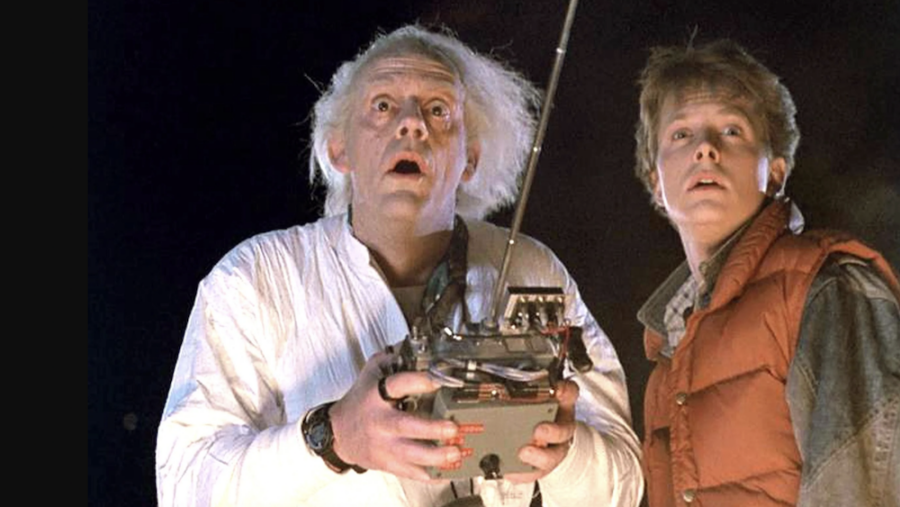
Over the course of three movies, the Back to the Future movies played around with lots of variables – parallel timelines created by the smallest change in the past, characters whose entire nature flipped to their polar opposite, and sometimes back again. While the films explored multiple Biffs and the perils of Marty McFly almost hooking up with his own mother, the character of Marty underwent some equally dramatic changes in the real world.
By now, most fans have heard the stories (and seen the footage) about how Eric Stoltz was hired to play Marty and was then replaced by Michael J. Fox after five weeks of filming. What you might not have heard is that the Marty-That-Wasn’t also had a Jen-That-Wasn’t. Actress Melora Hardin (The Office, Monk) was originally cast as Marty’s girlfriend, Jennifer Parker.

These days, Melora Hardin is best known for playing Michael Scott’s crazy boss-turned-girlfriend, Jan, on The Office. In the 1980s, she was a struggling young actress who’d done guest spots on shows like Quincy or Magnum, P.I., and thought she’d landed the part of a lifetime.
When Stoltz was replaced, they decided to pair Fox with a different gal pal as well, and Melora Hardin was let go, without ever having filmed a single scene. The role of Jennifer was eventually played by Claudia Wells in the first film and by Elisabeth Shue in Parts II and III.

Melora Hardin’s brush with the trilogy may have become just another interesting cinematic footnote, but the actress provides a few insights into the experience in an interview with Wired.
Melora Hardin said of her close call with Back to the Future, “When [Eric Stoltz and I] read together, we had great chemistry. I got the part and was so happy, it would have really been my first big movie. It was supposed to be a two-picture deal – they already had the future idea for Back to the Future Part II and knew this character was going to be in it. Even though the script was completely secret, you had to sign a deal for both.”
So what ultimately kept Melora Hardin from keeping a part in what would become one of the most beloved movie trilogies of all time? Maybe they didn’t think she had the right chemistry to match up with McFly? Or perhaps Fox had somebody in mind and called in a favor? None of the above. She was just too tall for Back to the Future.
Melora Hardin told Wired about that Back to the Future casting that wasn’t, “I just remember getting a phone call in my parents’ kitchen, Bob Gale and Zemeckis both called me. They said, ‘Unfortunately we had to let Eric go and we think you’re too tall for the new guy we cast. His name is Michael J. Fox, but you’ll be towering over him. This has nothing to do with you, we think you’re lovely.’ I burst into tears.”

There you have it. A budding young actress was stripped of the role of a lifetime simply because Michael J. Fox is a little man. If it’s any consolation, at least she can remember that she’s probably a huge star in Fringe’s alternate universe. And, of course, she had the epic run as Jan Levinson (don’t call me Gould) on The Office.
Entertainment
The Forgotten Star Trek Episode That Created Two Spinoff Series
By Chris Snellgrove
| Published

What do you think the most important episode of Star Trek is? Some fans might say “The Man Trap” because it was the first episode ever aired, creating TV’s longest-lasting sci-fi franchise. Others might be tempted to name episodes like “The Inner Light” and “The Visitor” because they confront us with our own morality. Still other fans might name episodes like “Far Beyond the Stars” for using sci-fi as a vehicle to explore the more problematic aspects and social injustices of American history.
Arguably, though, the most important adventure in the franchise is the largely forgotten Star Trek: The Next Generation episode “The Price.” Now, if you do remember this episode, you probably remember it for that thirst trap scene where Dr. Crusher and Counselor Troi are exercising in their space spandex. While that scene had the fandom giving new meaning to the term “space seed,” It’s not what’s most important about “The Price.” You see, this episode singlehandedly sets up the premises for both Star Trek: Deep Space Nine and Star Trek: Voyager!
Paying “The Price”

What’s “The Price” about? In this episode, the Enterprise crew must negotiate with some exotic aliens for the rights to use a newly-discovered stable wormhole. Ships can fly through the wormhole in the Alpha Quadrant and, conveniently enough, end up in the far-flung Gamma Quadrant. The crew checks the wormhole and discovers that while the entrance is stable, the exit isn’t; it periodically moves, having gone from the Gamma Quadrant to the Delta Quadrant. Unfortunately, two Ferengi who went through the wormhole ignore the Enterprise crew’s warning about the unstable exit and get trapped in the Delta Quadrant once the wormhole moves yet again.
What makes “The Price” so special to Star Trek history? For one thing, this is the first episode to break the galaxy into four quadrants: Alpha, Beta, Gamma, and Delta. Before that, it was hard to understand the geography of this franchise’s sprawling cosmos. This made it difficult to know where, say, the center of the galaxy is supposed to be located. That might not sound like much of an issue, but you might be surprised at the sheer number of times various shows and movies make reference to that mysterious area of space.
Wormhole Shenanigans Are In Full Swing

More importantly, “The Price” laid the groundwork for the next two major Star Trek spinoffs after The Next Generation. Before the Enterprise crew realizes it’s a dud, the main selling point of the wormhole in this episode is that it provides a stable passage from the Alpha Quadrant to the Gamma Quadrant. Later, the discovery of an actual stable wormhole from Bajor to the Gamma Quadrant becomes the inciting incident for Deep Space Nine. Once everyone finds out about the wormhole, this broken-down space station suddenly becomes one of the most important places in the entire galaxy.
Weirdly enough, a minor plot in “The Price” also sets up the premise for Star Trek: Voyager. When those two scheming Ferengi ignore the warnings from the Enterprise crew, they end up stuck in the Delta Quadrant, with no easy way home. In Voyager, this is exactly what happens to Captain Janeway and the Maquis she is chasing. They are sent to the Delta Quadrant and must make their way home without the support of Starfleet. Eventually, Voyager did an homage to “The Price” with “False Profits,” which had the crew run into the same two bumbling Ferengi who got stuck on the other side of the galaxy after the wormhole moved.

“The Price” is a very solid episode of Star Trek: The Next Generation for many reasons, including the fact that it gives Marina Sirtis plenty to do while she looks drop-dead gorgeous. But for fans of Deep Space Nine and Voyager, this is possibly the most important episode in the entire franchise. Without it, those fan-favorite spinoffs might have never been made. Because of this, you might say that the entire Golden Age of Star Trek owes itself to this humble TNG episode!

Lucid Motors doesn’t know how many EVs it will build this year
Liam Neeson's Most Overlooked Action Thriller Was A Violent Hit With Women


