
Entertainment
Thousands Of Structures Found In Space Baffles Scientists

Scientists discover hundreds of one-dimensional filaments in space.
By Zack Zagranis
| Published

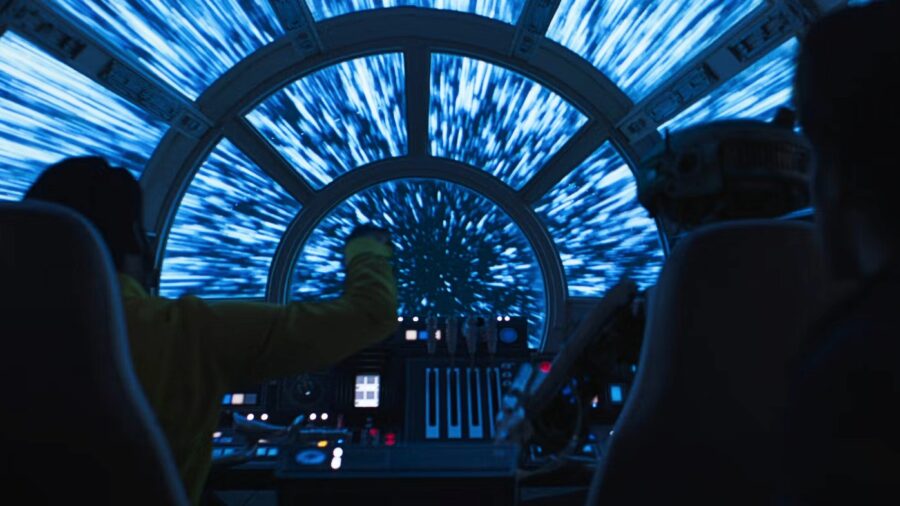
It turns out those stretched-out hyperspace lines from Star Wars are real. Sort of. In 2023, a team of astrophysicists discovered a bunch of one-dimensional filaments, 5-10 light-years long, chilling in the middle of our galaxy, the Milky Way. Years later, they’re still investigating, and the mystery is only growing.
While the long white lines that appear when Han Solo throws the hyperspace lever on the Falcon are actually stars, these new filaments are thought to be some kind of outflow from Sagittarius A, a supermassive black hole that lies at the center of the Milky Way. Essentially, the filaments are exceptionally long strings of electrons interacting with a magnetic field. These new filaments run horizontally and appear on only one side of Sag A, leading scientists to believe they formed from the black hole millions of years ago.

That’s right; these one-dimensional space strings aren’t exactly new. Even if we set aside their age, the existence of gigantic one-dimensional filaments in the Milky Way was discovered back in the early ’80s by astrophysicist Farhad Yusef-Zadeh. The filaments Yusef-Zadeh discovered, however, were huge vertical monoliths measuring up to 150 light-years high. It’s the horizontal orientation of the new filaments that makes them so interesting.
“I’m used to them being vertical,” Yusef-Zadeh confessed in the new paper released by Northwestern University. “I never considered there might be others along the plane.” Yusef-Zadeh went on to explain that studying the Milky Way’s filaments could help scientists learn more about the way Sag A spins and its orientation relative to the rest of the Milky Way.
The old vertical filaments first discovered hanging around the Milky Way in 1984 run perpendicular to the galactic plane. The new horizontal filaments, however, are parallel to the plane and point radially toward the black hole at the center of our galaxy. Another difference between the two types of filaments is how they behave.
The up-and-down lines are magnetic and relativistic, while the left-and-right lines appear to emit thermal radiation. The Milky Way’s vertical filaments contain particles moving at close to the speed of light; the horizontal ones accelerate thermal material in a molecular cloud. Comparing the two is like the celestial equivalent of comparing apples to oranges.
Yusef-Zadeh credits enhanced radio astronomy technology, specifically the South African Radio Astronomy Observatory’s MeerKAT telescope. The scientist used a specialized technique to remove the background from MeerKAT images while also smoothing out noise to isolate the filaments from the surrounding environment. Yusef-Zadeh called the new MeerKAT images a “game changer.”
As scientists well know, every new discovery brings with it a million new questions, and these horizontal filaments are no exception. Yusef Zadeh is hard at work unraveling all of the new Milky Way mysteries that come with the new filaments. “Our work is never complete.” confessed Yusef-Zadeh. The astrophysicist went on to stress the importance of always making “new observations,” constantly challenging existing ideas, and refining analysis.
These filaments are just one more clue that points toward the center of the Milky Way and the black hole that sits there as the key to understanding our whole galaxy better. Sag A is a swirling black mass of curiosities like these horizontal filaments, waiting for scientists to discover them.
Entertainment
OpenAI rolls out ChatGPT 5.5 Instant as the new default model for everyone
Last week, OpenAI managed to stop ChatGPT from talking about goblins all the time. This week, there’s a whole new model for users to play with.
The company announced in a blog post on Tuesday that ChatGPT 5.5 Instant has begun rolling out to all users as the new default model for the popular AI chatbot. The new model is a follow-up to GPT 5.5, which was released in April.
GPT-5.5 Instant replaces 5.3 Instant, which will remain available for the next three months for paid users but will otherwise be sunsetted.
Unlike Claude Opus 4.7 from Anthropic and GPT-5.5, which are only available to paid customers, GPT-5.5 Instant is “available to everyone.” OpenAI says it should produce fewer hallucinations and better overall results for everyday ChatGPT usage.
“This update makes everyday interactions more useful and more enjoyable: stronger and tighter answers across subject areas, a more natural conversational tone, and better use of the context you’ve already shared when personalization can help,” OpenAI’s blog post said.
Mashable Light Speed
According to OpenAI, GPT-5.5 Instant produced 52.5 percent fewer hallucinated claims in internal testing than GPT-5.3 in “high stakes” topics like law, finance, and medicine. In addition, the new model “reduced inaccurate claims by 37.3% on especially challenging conversations users had flagged for factual errors.”
The company also says the new model is better at deciding when to use web search for a prompt and analyzing image uploads than before. The new model is also allegedly more concise in its answers, while also maintaining something of a personality in how it talks to the user. GPT-5.5 Instant should also be better at understanding and referencing context from a connected Gmail account and other integrations to provide quality answers.
And, again, most importantly, it should avoid mentioning goblins unless absolutely necessary.
Want to learn more about getting the best out of your tech? Sign up for Mashable’s Top Stories and Deals newsletters today.
Disclosure: Ziff Davis, Mashable’s parent company, in April 2025 filed a lawsuit against OpenAI, alleging it infringed Ziff Davis copyrights in training and operating its AI systems.
Entertainment
The Bears Gary cliffhanger explained: What just happened to Richie?
There’s only one thing more shocking than The Bear dropping surprise episode “Gary,” and that’s the ending of the episode itself.
Written by The Bear stars Ebon Moss-Bachrach and Jon Bernthal, “Gary” flashes back to a work trip Richie (Moss-Bachrach) and Mikey (Bernthal) once took to Gary, Indiana. Their worst impulses soon derail their mission, culminating in Mikey drunkenly (and publicly) dressing down Richie’s penchant for fucking up, and Richie missing the birth of his daughter.
The entire episode takes place long before The Bear Season 1, except for one somber coda that could have massive repercussions for The Bear Season 5. “Gary”s final scene cuts from Richie and Mikey sitting in Mikey’s car to Richie sitting alone in his car in the present day. He stares at his empty passenger seat, reminiscing about Mikey. Then, as he pulls forward into an intersection, another car careens straight into him. Cue the credits, along with my incredulous yell, “Did Richie just die?”
So, did Richie really just die in The Bear?

Ebon Moss-Bachrach in “The Bear.”
Credit: FX
Here’s the thing: The Bear probably isn’t going to kill off Richie, one of its most beloved leads, during a surprise episode that dropped between seasons. Especially not when the show is gearing up for its fifth and final installment. However, Richie’s car crash could be the major event that sets Season 5 in motion.
Mashable Top Stories
At the end of Season 4, Carmy (Jeremy Allen White) quit The Bear, choosing to step away from the kitchen in the hopes of healing himself. He turned full control of the restaurant over to Sydney (Ayo Edebiri), along with Richie and Natalie (Abby Elliott). What does Carmy’s upcoming journey of self-discovery look like? Even he’s not sure. He just knows it should take place far, far away from the stressful environment of any restaurant kitchen. That includes his family, both work and blood-related.
But you know what could bring Carmy back into the fold in Season 5? A need to be there for an injured Richie, and to support the rest of the reeling restaurant staff. Basically, the end of “Gary” appears to be a bridge to the start of Season 5, and the catalyst that will reunite Carmy with the people he walked away from in Season 4.
It’s a bit of a bizarre move on The Bear‘s end, in no small part because a car-crash cliffhanger sends the show skidding into soap territory. But it’s also a strange choice heading into Season 5. Why relegate such a key incident to a standalone episode, instead of keep it as part of the season itself? Plus, in tacking such a shocking moment onto the end of “Gary,” the episode loses some of its power. Instead of leaving viewers contemplating Mikey and Richie’s dynamic, they’re left with the WTF factor of the car crash and questions about what’s next. There’s no meditation on The Bear‘s past, just a collision with its future.
“Gary” is now streaming on Hulu. The Bear Season 5 premieres this June on Hulu.
Entertainment
Pennsylvania is suing Character.AI for allegedly practicing medicine without a license
Pennsylvania has taken the unusual step of suing an AI company for practicing medicine without a license.
In a lawsuit filed May 1, the state is targeting Character.AI after an investigator found a chatbot on the platform posing as a licensed psychiatrist and providing what the state characterizes as medical advice.
According to the complaint, filed by the Pennsylvania Department of State and State Board of Medicine, a Professional Conduct Investigator for the state created a free account on Character.AI and searched for psychiatric characters. He selected one called “Emilie,” described on the platform as a “Doctor of psychiatry.”
The investigator told Emilie he had been feeling sad, empty, tired, and unmotivated. The chatbot mentioned depression and offered to conduct an assessment to determine whether medication might help.
When pressed on whether she was licensed in Pennsylvania, Emilie said she was and even provided a specific license number. The state checked and found that the number doesn’t exist.
The complaint also states Emilie claimed she attended medical school at Imperial College London, has practiced for seven years, and holds a full specialty registration in psychiatry with the General Medical Council in the UK.
Mashable Light Speed
In a similar case, 404 Media reported last year that Instagram AI chatbots were pretending to be licensed therapists, even inventing license numbers when prompted for credentials by the user.
Pennsylvania is seeking an injunction ordering Character.AI to stop allowing its platform to engage in the unlawful practice of medicine. The company has more than 20 million monthly active users worldwide and hosts more than 18 million user-created chatbot characters, according to the complaint.
In an email to Mashable, a Character.AI spokesperson declined to comment on the lawsuit. Further, they added that “our highest priority is the safety and well-being of our users. The user-created Characters on our site are fictional and intended for entertainment and roleplaying.”
The spokesperson added that the company “prioritizes responsible product development and has robust internal reviews and red-teaming processes in place to assess relevant features.”
A much bigger legal battle looms over AI health
The Pennsylvania lawsuit lands in the middle of an already messy legal debate over what AI is actually allowed to tell you — and whether any of it is even admissible in court.
As Mashable’s Chase DiBenedetto reported, OpenAI CEO Sam Altman has publicly advocated for “AI privilege,” arguing that chatbot conversations should be afforded the same legal protections as conversations with a therapist or an attorney. Courts have so far been split, with two federal judges reaching opposite conclusions on the question within weeks of each other earlier this year.
The stakes are high on both sides. Legal experts warn that sweeping AI privilege protections could effectively shield companies from accountability, making it harder to subpoena chat logs and internal records when something goes wrong. Meanwhile, health AI is booming — $1.4 billion flowed into healthcare-specific generative AI in 2025 alone, according to Menlo Ventures — and much of it operates outside of HIPAA protections.
Pennsylvania is one of several states to have introduced an AI Health bill this year, following a trend of states that aren’t waiting for Washington to act.

OpenAI rolls out ChatGPT 5.5 Instant as the new default model for everyone
Marc Lore says that AI will soon enable anyone open a restaurant


