
Entertainment
Star Trek's Borg Queen Was Head Of Starfleet Medical

By Chris Snellgrove
| Published

Star Trek: First Contact is generally considered the best of the Next Generation movies, one that pitted Captain Picard and his erstwhile crew against their most implacable foe: the Borg. Fans love the movie, but one thing that many of them hate is the inclusion of Alice Krige’s Borg Queen. Her very existence as an individual makes no sense in a Collective where everyone shares the same hive mind. On top of that, she’s a walking time paradox, repeatedly dying onscreen only to pop up in future TV shows whenever the writers needed a cheap Big Bad reveal.
However, Star Trek’s stupidest villain was almost fixed by the franchise’s first prequel. Recently, a number of writers and producers for Star Trek: Enterprise got together for Trek Talks, a livestream telethon that helps raise money for the Hollywood Food Coalition. Together, they revealed a number of rejected episode pitches that would have electrified the fandom. Arguably, the most ambitious of these pitches would have been an origin story for the Borg Queen, one that had the potential to answer burning questions Trek fans have been debating for decades.
The Borg Queen’s Origin Story

During the Trek Talks stream, Enterprise writers Judith and Garfield Reeves-Stevens revealed they wanted to “have another Borg show, but bring in the head of Starfleet Medical, which would be played by Alice Krige.” Krige, of course, played the Borg Queen in Star Trek: First Contact, and the franchise has never revealed any details about who or what she was before being assimilated. In Reeves-Stevens’ story, we would see her Starfleet Medical bigwig “choosing to join the Collective,” and they wanted the episode to explore “what goes through the mind” of a person making such an insane choice to abandon both their individuality and their humanity.
Sadly, Reeves-Stevens didn’t elaborate on their pitch beyond those details, so all we know is that this Enterprise episode would have been a Borg Queen origin story explaining how this mechanical monarch was once the human head of Starfleet Medical. Still, I can’t help but think that this episode would have made her character much more palatable to the average fan. That’s because a well-written episode could answer fans’ biggest questions about this character while more organically integrating her into Star Trek canon.
Attack Of The Drones

For example, the Borg we first saw in The Next Generation spoke with a singular hive mind, and the concept of individuality was completely alien to them. That’s what made Picard’s assimilation so shocking. Not only did these bionic baddies target everyone’s favorite captain, but they turned him into a mouthpiece for their coldhearted collective. The Enterprise episode that Reeves-Stevens pitched could explain how and why the Borg learned the value of having an individual spokesperson. Furthermore, showing Krige’s character volunteering to join these villains might offer context for why the Borg Queen in First Contact wanted Picard to surrender himself willingly rather than be assimilated against his will.
Additionally, a Borg Queen origin story might finally help fans nail down a timeline of how and when Starfleet first learned about the Borg. In The Next Generation, Q is seemingly responsible for introducing Starfleet to this new threat by flinging the Enterprise deep into Borg territory. However, the Voyager episode “Dark Frontier” later revealed how Seven of Nine’s parents were Federation scientists eager to study the Borg, a race they mostly knew about through whispered rumors. The Enterprise episode “Regeneration” retconned things even further by revealing that Zefram Cochrane warned people about the Borg seen in First Contact, but he later recanted after his claims were dismissed as tall tales from a known drunk.
Resistance Is Futile (She Brought Cuffs)
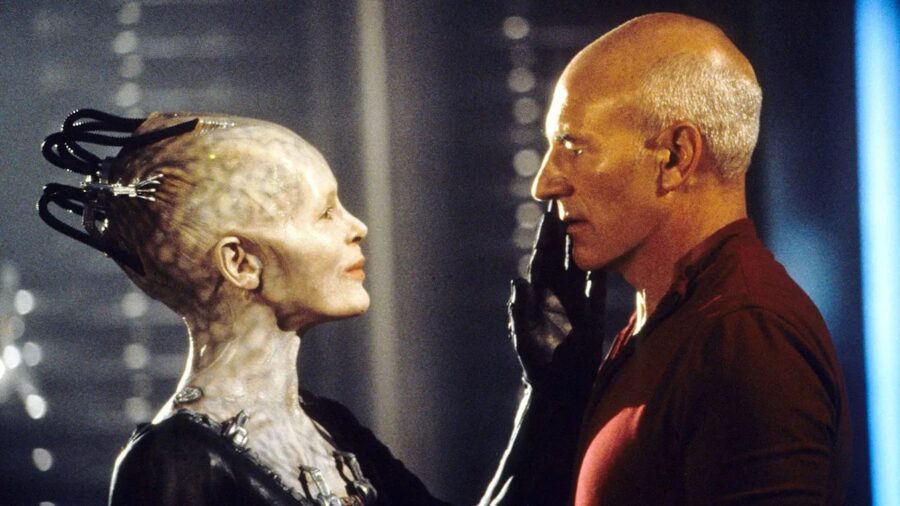
This has led to lingering questions, like how long have Starfleet and the Federation officially known about the Borg? Unofficially, who was keeping tabs on these villains? Were shadowy figures (like Section 31) cross-referencing Cochrane’s tall tales with stories from El-Aurian refugees and Captain Archer’s own account of hostile, cybernetic beings? Right now, all of this is a mystery, one made more frustrating because it involves Star Trek’s most famous villains. Had we gotten this Enterprise episode, it might have cleared that mystery up for fans while making it easier for future writers (say, the Picard writers) to do more with the Borg Queen than have her show up and make evil speeches.
Early on Enterprise was viewed as a major letdown for Star Trek fans. But it started to get really good in its fourth and final season, and the Borg Queen pitch from Judith and Garfield Reeves-Stevens proves that this show still had some great stories to tell. Had we gotten this episode and more like it, Enterprise might have gone on to become one of the franchise’s most successful series. If nothing else, it could have avoided decades of fan squabbles over who and what the Borg Queen is and what she offers to the Collective beyond being (let’s face it) dommy mommy eye candy for drones and fans alike.
Entertainment
Using Claude Fable 5 means your data will be collected. It’s not optional.
Anthropic just released its most powerful public model yet — Claude Fable 5. However, along with the model’s release, the AI giant also made a significant update to its data retention policies.
Fable 5 was released to the public on Tuesday. Fable 5 is a “safe for general use” version of Anthropic’s most powerful model, Mythos, which has been restricted from public use due to its potentially dangerous cybersecurity capabilities. Anthropic created a set of safety guardrails for Fable 5, and its benchmarks blow away much of the competition, per Anthropic.
But it looks like Anthropic has also blown away its data retention policies for Fable 5.
“To ensure we’re responsibly deploying Mythos-class models, we are requiring limited data retention and review as part of our safety work,” reads an update on Anthropic’s official Claude support page. “Prompts submitted to, and outputs generated by, Mythos-class models are retained for 30 days for trust and safety purposes, on every platform where these models are offered.”
The update was first noticed by Jun Park, the CEO of AI training company hillclimb.
Mashable Light Speed
“New policy from Anthropic: if you use Fable/Mythos, they collect your data. No exceptions. Not even for enterprise partners,” Park posted on X.
This Tweet is currently unavailable. It might be loading or has been removed.
This change is significant for Anthropic’s enterprise and API customers, says Jessica Eaves Mathews, a lawyer who specializes in copyright, trademark, and AI law.
In a post on Mathews’ Substack (as highlighted by CyberNews), the lawyer explains how Anthropic already retains user data for 30 days under its free and paid consumer plans. However, Matthews says this change nullifies part of any agreement Anthropic has with its enterprise and API partners.
“Every other Claude model available through the API, including Opus 4.8, Sonnet 4.6, and Haiku 4.5, can operate under Zero Data Retention (ZDR) agreements,” Mathews writes. “Fable 5 cannot. If your organization previously had a ZDR agreement with Anthropic, that agreement does not apply to Fable 5 traffic. This is a policy change that overrides existing enterprise commitments for this specific model class.”
Mathews says that any organization that believed that their data would not be stored by Anthropic should know that there is now a “mandatory exception” for Fable 5 and all future Mythos models.
While Mythos-class models seem to be quite powerful, companies should know about the change in Anthropic’s data retention policies and make adjustments where necessary.
Entertainment
Tons of Fitbits are on sale ahead of Prime Day
Best early Prime Day Fitbit deals at a glance:


Amazon’s Prime Day sales event is right around the corner (I can’t believe it’s that time of year again!), and I’m genuinely shocked by the deals we’re seeing this early in the game.
Usually, Amazon doesn’t put Fitbits on sale until the very last minute, and then they’re gone. (And some years, they don’t go on sale at all.) But right now, we’re seeing all-time lows on select Fitbit models, including the Charge 6.
Here are the best early Prime Day Fitbit deals you can shop right now:
Best deal overall

$99.95
at Amazon
$159.95
Save $60.00
Why we like it
The Fitbit Charge 6 isn’t the newest Fitbit on the market, but it still has (almost) everything you’d need in a smart wearable. (I say almost because the Fitbit Charge 6 doesn’t have an altimeter, but if you’re not a trail runner, this probably isn’t a deal breaker.)
The Charge 6 tracks your calories, steps, sleep, heart rate, and more. It also has built-in GPS, 40+ exercise modes, a seven-day battery life, and includes a three-month Google Health Premium (formerly Fitbit Premium) membership. Once the three months are up, you’ll need to either cancel or renew for $9.99 per month or $99.99 annually.
Mashable Trend Report
Right now, you can get the Fitbit Charge 6 for $99.95 at Amazon. This is the lowest price we’ve tracked on this model since its release in 2023.
Best runner-up deal
Why we like it
If you’re willing to spend a little bit more, the Fitbit Versa 4 is on sale for $149.95. This isn’t the lowest price we’ve seen (it was $104.96 in April 2024), but it’s still a pretty good deal.
Unlike the Charge 6, the Versa 4 has an altimeter and Bluetooth wrist calling. So, if you’re looking for a wearable that acts more like a smartwatch, the Versa 4 might be the better buy. That said, it doesn’t have the more “serious” health sensor that the Charge 6 does (e.g., ECG and EDA).
The Versa 4 also comes with three months of Google Health Premium.
Best budget deal

$79.95
at Walmart
$89.95
Save $10
Why we like it
If you’re just looking for something that’s affordable and efficient, the Fitbit Inspire 3 is your best option at $79.95.
It’s a no-frills fitness tracker that’ll give you the basic features you need to stay on top of your health. It can track your heart rate, steps, and stress levels. (It also offers menstrual health tracking, which is nice.)
You’ll also get 10 full days of battery life and, like the other models mentioned above, three free months of Google Health Premium.
Entertainment
20+ book deals Im sending to the group chat before Prime Day even begins
Table of Contents
The best early Prime Day book deals at a glance:


It’s nearly Amazon Prime Day, which officially runs from June 23 through 26, but if you don’t feel like waiting, there’s already plenty of live deals to shop.
Besides offering three free months of both Kindle Unlimited and Audible to new subscribers, Amazon also has some pretty great discounts on books themselves. I’m not usually one to recommend purchasing physical books via Amazon (support local book stores!), but it’s pretty hard to pass up a 50% price drop on a book you’ve had on your TBR.
Amazon Editors just dropped the 20 best books of 2026 (so far) — find out what made the list
I’m tracking some of the best deals on physical books and e-books at Amazon ahead of the official Prime Day kick off, but remember to check back for more once things start ramping up.
Best early Prime Day hardcover book deal
$14.67
at Amazon
$30
Save $15.33
with on-page coupon
Why we like it
Named one of the best books of 2026 so far by Amazon Book Editors, Crux is an “exhilarating, tender novel about an unlikely friendship forged through a shared love of rock climbing,” according to Amazon Editor Abby Abell. Thanks to an on-page coupon at Amazon, you can add the hardcover version to your home library for less than half its usual cost.
More hardcover book deals
Best early Prime Day paperback book deal
$7.50
at Amazon
$19.95
Save $12.45
Why we like it
A classic trope of two abducted girls, only one returns and one doesn’t, The Girl Who Was Taken is a psychological thriller by Charlie Donlea where nothing is as it seems. Typically around $20, you can pick up the paperback version for only $7.50 at Amazon ahead of Prime Day. That’s just a few cents away from its lowest price ever.
Mashable Deals
More paperback book deals
Best early Prime Day Kindle book deal
$2.99
at Amazon
$18.99
Save $16.00
Why we like it
I highly recommend grabbing this twisty psychological thriller from internationally best-selling author Steve Cavanagh while the Kindle version is only $2.99. Kill For Me Kill For You follows two women seeking revenge against the men who killed their daughters. Over drinks one night, they decide to swap murders, but things don’t go exactly as planned.
More Kindle book deals

Dodgers' Shohei Ohtani continues quest for excellence in clash vs. Pirates
Hot Jac Caglianone, Royals out to halt Rangers' quest for .500


