
Entertainment
New King Arthur Series Ends With Epic Battle, Screaming For A Second Season

By Jennifer Asencio
| Published

A finale for a season of a series has two jobs: to close the season’s story arc while also leaving enough of the larger world’s story open for a possible next season. This is even more important for serial shows like The Pendragon Cycle because the entire season usually has its own plot and circumstances while introducing elements of the larger story. The seasonal arc is supposed to provide closure in case the series doesn’t continue its larger arc with another season.
A Sprawling Setup Hints At A Much Bigger Picture

While the overarching plot of Rise of the Merlin is how he winds up advisor to the One and Future King, Arthur’s parents have only just met, and right now, there are Saxon invaders to take care of. Lots of them. A lot more of them than there are Britons under Aurellius’s banner, and some of his allies are getting scared.
Fortunately, there’s Gorlas to hold things together with his usual candor, while his beautiful daughter Ygerna makes eyes at Uther. All of Briton’s kings must unite to fight this threat, but there are a few in question, and Merlin isn’t back yet. Regardless, ready or not, it’s time for war. Will Merlin bring reinforcements? Will Briton prevail against the Saxons? Will Aurellius become High King?

While all the short-term threads are tied together, this finale didn’t seem like an ending. It left more questions than answers, and a lot of the plotlines that have long-term arcs did not get resolved. This is but a segment of Merlin’s very long life, the part that positions him as the eventual advisor of Uther and his son, Arthur. The Pendragon Cycle is not a contained story in the first place, but the window we are provided is not adequate, and I couldn’t help feeling that the series could have benefited from one more episode. Or, perhaps, a second season, please.
Nevertheless, the immediate threat of Hengist and his hordes of barbarians hangs over the camp during the first half of the episode. Having participated in the Society for Creative Anachronisms, a historical cosplay group for medieval enthusiasts, I felt right at home among the tents, kitchen tables with cooks portioning herbs, squires frantically running from encampment to encampment, and especially the noise.

Dramatic intrigue aside, the camp feels like it leaps out of history, which has been a strength of the show in its later episodes. Did I mention the noise? This camp is a living place, and the din of activity is always present in the background, contributing deeply to its authenticity. This episode hardly has any soundtrack music, and this was a good choice that allowed each scene to speak for itself.
Once the armies face off, though, the episode turns into something else: an amazing spectacle of savage medieval warfare, starting with the eerie effect of the Saxon army’s approach. The lack of soundtrack music is even more effective here. Gritty, chaotic, and violent (hide the kids and the squeamish), this is the best battle in the series. The direction of Jesse V. Johnson really takes the forefront at this point. Once again, authenticity reigns as the camera is deftly maneuvered through the field to follow the various players and their tribulations. Distant shots of the battlefield give a sense of scale that compliment the close frames by adding more urgency to them.
The Epic Battle Buildup

Josiah Nelson’s script shows off both his strengths and his weaknesses. I’ve said before that he’s great at drama, tension, and character development, but that sometimes he lingers too long on both the decision to act and the action itself. In a few places, scenes start to lag, but these are quickly caught before they become tiresome. A lot of time is spent in the build-up to the battle, with the various under-kings squabbling, plotting, and considering retreat. Nelson’s writing is especially good when he’s focused on this kind of intrigue.
The actors seized this opportunity. Riveting performances abound from all the cast, but the spotlight this episode falls to Chick Allan as Gorlas, Nicholas Boulton as Morcant, and Steve Varnom as Custennin.

In pairs, they shine, but when confronted with one another, their performances are mind-blowing. Boulton has been excellent through the entire series at portraying Morcant’s Doubting Thomas attitude toward the youthful king and is especially vibrant with the Saxons on the doorstep. Allan brings his rugged humor to Gorlas’s loyalty to Aurellius, especially on the battlefield. Varnom is at his best, now that Custennin is allowed his full range, especially in battle while wielding a very unusual weapon. But in an episode full of great acting, it’s almost unfair to single anyone out.
A Climax That Needs Closure
The finale of The Pendragon Cycle: Rise of the Merlin seems to have been the focal point of all the production. Hints of it have been dropped along the way: beautiful sets, attention to small details of medieval life, and intense skirmishes that were only a taste of what was to come. This episode brings all that to a resounding crescendo of cinematic visual spectacle. It is almost perfect. Almost.

But the elephant in the room is that it doesn’t provide the closure of a finale. There is still more of Merlin’s story yet untold, too much left undone and unseen. Fans of Arthurian legend will be left with a sense of foreboding that is unfitting for a finale, especially if the show never gets a second season. The single weakness in an otherwise great finale is that Merlin’s story is so dominant over the entire series that it takes precedence over the Saxon invasion, and not enough closure is offered him, which made the finale bittersweet.
Nevertheless, there are so many good things about the finale of The Pendragon Cycle that it’s unfair to hold the fate of future seasons against it. On the contrary, I want to see another season, and the best way to get one is to watch the show and encourage Daily Wire+ to make more.


The Pendragon Cycle: Rise of the Merlin is now streaming in its entirety on Daily Wire+. Check it out and give this Arthurian epic the attention it deserves.
Entertainment
HBO's Harry Potter Series Will Definitely Fail For One Big Reason, And It's Not J.K. Rowling Or Snape

By Jonathan Klotz
| Updated

Harry Potter is coming back. If it were in POG form, everyone might be more excited. Warner Bros. dropped the first trailer for the upcoming HBO Max series, Harry Potter and the Philosopher’s Stone, which has touched off a fresh round of debates over whether or not the series should be boycotted due to J.K. Rowling’s beliefs and who even wanted this series in the first place.
Here’s the trailer…
No matter how you feel about the Boy Who Lived or the rich and famous author who created the most poorly designed sport in literature, it might be some solace to know Warner Bros. is going to fail spectacularly, and it has nothing to do with anyone’s opinions. It’s about money. A lot of money. So much in fact, that it’s impossible enough people will watch the new streaming series to break even, and don’t even think of turning a profit.
The Most Expensive Entertainment Project In History

The 2001 adaptation of Harry Potter and the Philosopher’s Stone made a billion dollars on a budget of $125 million. By way of comparison, the HBO Max series has an estimated budget of $100 million. Per episode.
That’s before the marketing blitz that you won’t be able to get away from, even if you close your eyes while sitting in your tiny room underneath the stairwell. To put this in perspective, Warner Bros. is spending more money on the upcoming streaming series than any studio has ever spent on a single piece of entertainment. Series, movie, The Eras Tour, Dinotopia, doesn’t matter, nothing will come close to the sheer amount of money Warner Bros is setting on fire.

If you watch the initial trailer, it feels like a version of the movie fell out of an alternate universe. Everything looks similar to the original film, but it’s slightly off.
The cast looks like their movie counterparts. The one very notable exception is Snape, who’s also the single worst character in the series to race swap if you worry about things such as why everyone’s suspicious of him for no real reason, or why James Potter bullies him. It’s a baffling choice in a trailer full of baffling choices.
Yer A Remake Harry!

To its credit, the trailer does attempt to answer the question as to why the series is being made. With a single season covering each of the books, finally, the little details that Potterheads have obsessed over for generations will get to leave the page. From the large changes, Headless Nick’s birthday party, to the smaller, calm changes of the later novels, a book-accurate adaptation could only be done as a series.
Though Warner Bros is making it the largest entertainment project since the Romans erected the Colosseum, the first trailer can’t quite shake the nagging feeling that it’s destined to fail. Harry Potter and the Philosopher’s Stone is going to be seen by millions and millions of people around the world, but at a total price tag approaching $4 billion, it seems impossible for it to become a financial success, which, as we all know, is sadly the only type of success that matters to studios.
Harry Potter and the Philosopher’s Stone is coming to HBO Max around Christmas 2026.
Entertainment
The Last NCIS Has One Fatal Flaw
By Robert Scucci
| Published

NCIS is one of those ride-or-die franchises you’ll have a shaky relationship with for the rest of your life if you started watching at a certain age. I remember sitting with my parents watching the flagship series when it first came out, and over the years I’ve kept tabs on its many spinoffs. Now that NCIS: Los Angeles, New Orleans, and Hawai’i have run their course, and the one-off Tony & Ziva miniseries totally screwed the pooch, we’re back to just the flagship series and its prequel, NCIS: Origins.
Honestly, I’m okay with this. The original series still has its charm despite its many personnel changes, and NCIS: Origins allows for some great retconning and callbacks that are obvious enough for diehard fans, but not so granular that newcomers can’t jump in without doing homework. It’s a perfect show if you’re a fan of the franchise, and the best thing that’s been put out in years.

However, there’s one big problem that NCIS: Origins runs into, and it’s something unavoidable: there’s no suspense. Don’t get me wrong, there are plenty of thrills in the heat of the moment when the drama gets dialed up. There are also surprisingly strong action sequences for a series that belongs to a franchise that’s basically a procedural soap opera for boomers who just want to tune into their stories week after week.
One Specific Kind Of Suspense Is Missing
On an episode-to-episode basis, there are plenty of reasons to keep tuning into NCIS: Origins. We get to learn about the early days of Special Agent in Charge Leroy Jethro Gibbs, and how he cut his teeth working for NIS before it became the agency and franchise we all know and love. We see how his 91 rules came to be. We get more backstory on Special Agent Mike Franks, the best character in the series (and it’s not even close), and Kyle Schmid is a dead ringer for the older, somehow more cynical Franks from the original series (Muse Watson).

Even better, comic relief comes in the form of Randy Randolf (Caleb Foote), who, if it weren’t for Franks, would be the standout character. We also get the best kind of wise-cracking forensic nerd banter from Woody (Bobby Moynihan) and Philip (Ely Henry). I could go on, but the point is, NCIS: Origins is a beyond solid series, sans one thing.
There’s no real suspense.
Yes, people get hurt, and dangerous leads get chased, but that’s not the kind of suspense I’m talking about.
The kind of suspense the show is missing, which is par for the course when it comes to prequels, is the kind it could never have in the first place. The show stars Austin Stowell as a young and hungry Gibbs, but it’s still narrated by Mark Harmon. More importantly, we know Gibbs rises through the ranks and then has a 20-year tenure on NCIS. In other words, any time Gibbs finds himself in danger in NCIS: Origins, we know without a sliver of doubt that he’s going to be just fine.

The same can be said for Franks, and the rest of the gang to a certain degree. While I’m speculating here, I think we can guess Lala’s (Mariel Molino) fate as well. She’s never mentioned in the flagship series, yet she’s a constant presence in NCIS: Origins, the series that tells Gibbs’ entire backstory leading up to NCIS. I could be grasping at straws, but I have reason to believe something terrible happens to her that’s too painful to bring up later. The series has done an excellent job retconning the original series, so it’s surprising that they’d come up with a character who could have easily been one of the dozens of agents mentioned in the main series but never actually seen on screen or seen in passing.
In other words, as much as I like her character, I’m not going to get too attached because she’ll probably meet a tragic end at some point.
Fortunately, We Don’t Need This Kind Of Suspense

Thankfully, NCIS: Origins is worth tuning into week after week, not for the suspense, which we’ve established doesn’t exist here for obvious reasons, but because it’s an excellent character study of one of cable’s most iconic, coffee-chugging curmudgeons. We’re currently watching Gibbs’ second marriage, which has yet to fall apart, and I can’t wait to see how that whole thing dissolves, along with his (checks notes) third and fourth marriages.
Lack of pure, adrenaline-pumping thrills aside, showrunners Gina Lucita Monreal and David J. North know what they’re doing with the lore. NCIS: Origins remains a great watch for old-timers and newcomers alike. But if you’re like me and find yourself asking your wife, “Do you think he’s going to make it?” for the thousandth time in an attempt to be funny (she doesn’t find it funny), you’ll be pleased to know that Gibbs does, in fact, make it out alive, and then goes on to star in another 435 episodes.
NCIS: Origins is streaming on Paramount+
Entertainment
Lord Of The Rings Is Now In The Hands Of One Of America's Most Hated Celebrities
By Jennifer Asencio
| Updated

Just when we thought the cancellation of The Late Show with Stephen Colbert meant the end of seeing the comedian’s rhetoric, he’s rising again like Sauron trying to collect the One Ring. But this time, the target of his didactic punditry is nerddom: Colbert is penning a “sequel” to The Lord of the Rings.
One Sequel To Rule Them All
The movie’s working title is The Lord of the Rings: Shadow of the Past and is going into production after the newest entry, The Hunt for Gollum.
Colbert believes he can add to JRR Tolkien’s work with a story that begins 14 years after Frodo leaves for the Grey Wastes. Sam’s daughter goes girl-boss and makes a discovery that leads her “to uncover why the War of the Ring was nearly lost before it began.” That leads to a flashback in which the movie will cover chapters 3-8 of The Fellowship of the Ring, a story that includes exciting prospects like The Barrow Downs.

As if The Hobbit and Rings of Power weren’t damaging enough to Tolkien’s legacy, now we’re getting another shameless cash grab at the expense of the author’s work. Only this time, one of the most divisive and extremely political personalities in Hollywood is writing the script.
Colbert is co-writing the film with his son, Peter McGee, and “franchise veteran” Philippa Boyens. Boyens has long been a part of the Peter Jackson productions; she co-wrote The Lord of the Rings, The Hobbit, and Jackson’s King Kong.
Colbert Really Is A Certified Tolkien Obsessive
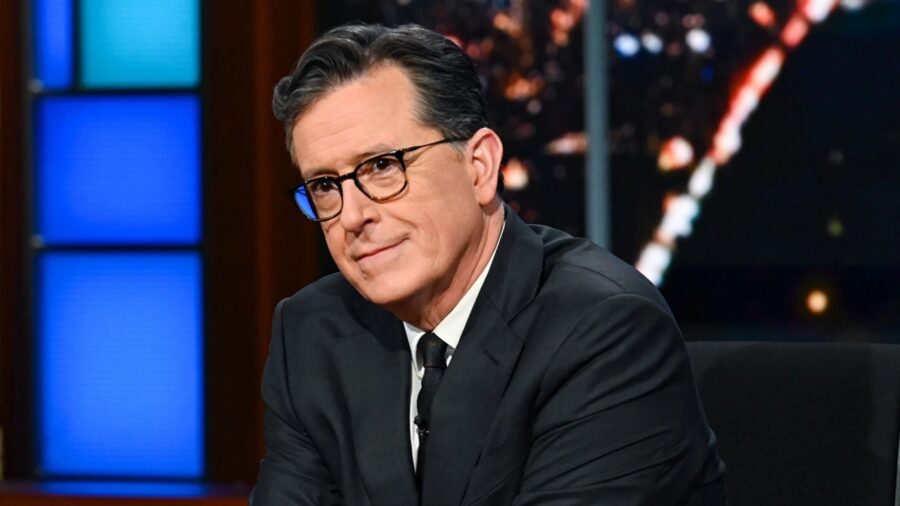
Colbert has been held out as a Tolkien expert since the announcement on March 24, 2026, and that is actually fair, no matter what one thinks of his extreme political views. He has studied the author’s work extensively, to the point where he can speak both Elvish languages, Quenya and Sindarin.
The biggest question on the minds of fans is whether Colbert will be tempted to infuse the story with his personal politics, or if the writing team will try to add extra material that isn’t needed by Tolkien’s story. The Hobbit didn’t work because it added embellishments, such as the romance between Tauriel and Kili. Rings of Power doesn’t work because, on top of adding modern identity politics to the series, it also doesn’t follow the source material, earning the derision of many Tolkien fans.
Boyens has shown that when she sticks to Middle Earth and not regular Earth, she can deliver on Tolkien’s mastery. However, the inclusion of Colbert raises concerns that this movie will stray beyond Tolkien’s boundaries.

In his other job as a talk show host, Colbert has made it a mission to inject his divisive personal politics into his work. That tendency towards personalizing what he does could either strongly enhance a new Lord of the Rings project or turn it into a stain on Tolkien’s legacy by applying themes to the world of the One Ring that Tolkien never intended. Which Colbert will ultimately write the script: the political loudmouth or the Tolkien scholar?

Igor Chernyshov scores late winner as Sharks edge Blue Jackets
Luis Robert Jr. belts three-run HR as Mets down Pirates in 11


