
Entertainment
R-Rated, Punk Rock Horror Thriller Is As Violent As It Is Loud
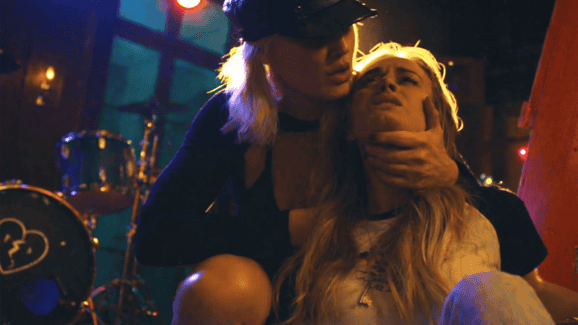
By Robert Scucci
| Published

If you know anybody who’s in a struggling band, or are in one yourself, and you get one of those offers that seems way too good to be true, you should force yourself to be the voice of reason, even if everybody in your orbit will hate you for being so cynical. Opportunities that require you to sign over your rights to your own intellectual property in a 365 deal are never what they’re cracked up to be, and you’ll spend the rest of your life trying to reclaim your art through expensive legal proceedings. Or, if you’re like the struggling punk band Suicide Disease in 2024’s Director’s Cut, you load up the van and drive out to the middle of nowhere because an eccentric videographer has offered to direct your debut music video for free.
In this case, you don’t really have to worry about copyright issues when all is said and done, because all signs suggest you won’t make it through the weekend alive anyway. As much as you’d like to get a cut-rate deal on an otherwise expensive endeavor, you have to think about what the offering party stands to gain from the exchange. You may not want to hear this, but sometimes a contract or written agreement is necessary if you want to protect your livelihood, and sometimes even your life.
A Punk Band With Nothing To Lose

Director’s Cut opens with a struggle that any somewhat serious musician will encounter at some point in their hobby or career. The band Suicide Disease has found their passion project in a state of flux, mostly due to lead vocalist Jay’s (Tyler Ivey) rotten attitude. Jay looks like the kind of guy who writes poems about pain in his Moleskine, but doesn’t have the vocabulary to sound like anything other than an angsty eighth grader. He also looks like he’s spent way more money on tattoos than vocal lessons.
When the rest of the band, John (Greg Poppa), Menace (Brandy Ochoa), and Juan (Louis Rocky Bacigalupo), confront him about the fate of the project, they immediately clash over how they should move forward. Jay wants to write more songs, while the band wants to play more shows. They can’t get better gigs until they have a larger catalog, but they’re too broke to take the current show on the road. That leaves them stuck in local band purgatory for the foreseeable future.

In a desperate move to keep the band together, Jay reveals that he’s received an offer to shoot a music video for free. The man making the offer, known only as Mister Director (Louis Lombardi), has a sizable social media following and a body of past work that suggests he might actually be legit. In a last-ditch effort to keep the band alive, they unanimously decide to haul their gear out to rural Pennsylvania, where Mister Director claims to have access to an abandoned mansion.
Honestly, There Are Way Worse Venues Out There
If you’ve ever spent any time inside a punk venue, you know you risk your life every time you step into the bathroom, and that the stage meant for five people and all of their equipment usually has the same footprint as a twin-sized bed. With that in mind, crashing at an empty mansion doesn’t seem like a bad gig, especially if somebody’s helping you out for free. This assumption is what pushes Director’s Cut into fully unhinged territory.

Almost immediately, Jay feels like something is off and has second thoughts about the whole project, which understandably irritates everyone else in the band since this was his idea in the first place. After exchanging pleasantries with Mister Director and his bruiser of an enforcer, Babs (Lucy Hart), the band commits to the shoot because they truly have nothing left to lose. At least that’s what they think.
Things take a hard left when Mister Director explains that he plans to film each band member individually before editing everything together in post-production. While each member waits their turn, nobody else is allowed on set. By the time the drums and guitars are supposedly finished, it becomes painfully clear that Suicide Disease is going to need some lineup changes if anyone is still breathing by the end of the weekend.

Pushing itself firmly into slasher territory, Director’s Cut gets violent fast, and once it does, there’s no turning back. Mister Director technically has a strong aesthetic vision for the video. Unfortunately for the band, that vision involves everyone staying at the mansion getting murdered in increasingly brutal fashion. Babs is a constant threat whether she’s on screen or lurking just outside the frame. Mister Director is wheelchair bound, so she handles most of the physical work, but the menacing bulge in her pants is what will probably unsettle you the most if I’m being honest.
Be Wary Of The Deals You Make
While Director’s Cut’s storyline is intentionally ridiculous and completely over the top, writer-director Don Capria based the concept on his own experience working as an artist manager for years. He wanted to address the risks young, naive artists take early in their careers when they’re presented with one-sided, exploitative deals. By pushing that idea to its most extreme conclusion, Capria turns Director’s Cut into a cautionary tale about the music industry and how easily it can chew you up if you’re careless about who you trust.


While it’s highly unlikely that you or any local band you know will be lured into a mansion and murdered by a psychotic director, it’s always in your best interest to question any deal that feels off. But if you’re able to hold your own and defend yourself, what happens in Director’s Cut, currently streaming for free on Tubi, isn’t nearly as bad as sitting through a local band showcase on a Tuesday night.
Entertainment
What I Won’t Tell My Friend About Dementia


“My dad got diagnosed on Tuesday, and I’m scared.” My friend’s text comes in the middle of the night.
I sit on the toilet at 3 a.m., considering how to welcome her to the most awful club.
My own mother was diagnosed with dementia a few weeks into COVID, shortly after my husband and I had asked her and my dad to move nearby and help with the kids, drowning as we were in online kindergarten. My mom had been a little “off” for years, and then forgetful, then increasingly paranoid. But she’d always been in love with the grandkids and our family. It was both a devastating surprise of a diagnosis, and not.
Now, years into this experience, the texts come regularly when friends’ parents are diagnosed. Every time I pause. What can I say that will help? What can I share of my experience that isn’t just the pain, the pain, the pain? There are so many things I want to tell her, and so many that I feel I can’t.
I lie awake feeling the chasm between myself now and myself the moment of my mom’s diagnosis, trying to find rocks to stand on in this river — something solid I can share with my friend, something that might steady her as the current pulls.
I’ll tell her what came before the diagnosis, because I know my friend’s loss has already started. The months or years before a diagnosis are their own kind of hell, not knowing what is happening. Questioning one’s own mother — wondering if she’s aging or sick or just being difficult — is a loss of its own, even before doctors are involved.
I’ll tell her about my mom showing up when my daughter was born, paranoid that our house had bed bugs despite no evidence, no bites. I took my newborn to the library when she was two days old so my husband and dad could inspect everything. I felt angry, abandoned, confused — I’d just given birth, but she was the one acting crazy. Now I know she wasn’t crazy, she was sick.
I’ll tell my friend that I hope now she is less lonely. My mom’s diagnosis at least gave a name to the pain I had been feeling of losing someone I loved, and it allowed me to talk about it more openly with friends. While there was so much grief in her diagnosis, there was also a clearer way to understand what my family had been moving through.
Along with the diagnosis came endless, impossible decisions. We spent a long time terrified of moving my mom into a care facility. She was the matriarch of our family, deeply in love with my dad and her garden, and it felt dehumanizing to take her away from what she knew. But she was wandering alone into the snow, waking up in the middle of the night to unplug every single appliance in the house, convinced the computer was going to catch fire. My dad wasn’t sleeping. My siblings and I became just as worried about his health as our mom’s.
There was a precise pain I felt the last time my mom was in my house — knowing it would be the last time, knowing she didn’t know that. She was joyful. We’d had Christmas with all the grandkids, and she and my dad had worn train conductor hats as the kids collected hot chocolate from them, Polar Express style. But she was also having bizarre mood swings and flashes of anger — at one point she tried to put out the fire with a large butcher knife.
The move to a care facility was clearly the right call. The experience reminded me of my kids starting daycare. It felt like a HUGE deal beforehand, then once she was there it was clear she was so happy. I slept better knowing my dad could rest and my mom was chatting with her new friend Martha over puzzles, and happy singing in the afternoon sessions. I fell in love with the people who cared for her, just as I had with my kids’ daycare teachers.
I’ll also tell my friend some small things that helped. When my mom had first shown signs of dementia, we encouraged her to complete a StoryWorth book. We now read her stories to her, and they calm her. My daughter reads them in her own bed every night. Sometimes that makes me cry. When she was still home and starting to wander, we put an AirTag in her shoe. We try to take care of the staff of her facility with the same care they give her — stocking the staff lounge with snacks, writing thank you cards, offering genuine gratitude.
Lying in bed in the middle of the night, I hold onto these practical steps like a life raft, because the emotional truth is harder. I’ll tell my friend that nothing anyone says will feel good. Things I hear regularly — “this has been so hard for so long” and “it’s happening so fast” — make me want to throw things even though (or, really, because) they are true.
But I’ll tell her what did help: friends who showed up without words. Junk food waiting at my parents’ house before a tough visit. Fancy shower products after I mentioned crying in the shower. Their presence in the hardest moments made me feel less alone.
Mostly, when I talk to my friend, I will tell her I am so sorry.
But I will not tell her everything. I will not tell her what’s coming, because if I had known how painful this was going to be, I would have welcomed the bed bugs, the fire, the knife.
I will not tell her about emergency calls to my therapist; the reports we get from my father’s daily visits; my mom currently being on her thirteenth month of hospice. I will not tell her I now understand the word agony.
Instead, I might tell her this: My mom was a woman who loved to help. A theater director and school librarian, she loved nothing more than telling people what to do. In some ways, helping friends now feels like honoring her — trying to make sense and meaning of her story.
When I’m talking to my friend, I also know I will have the exact same feeling that I still have when sitting by my mom’s bedside — there is so much more to say, so much left unsaid. I will want to say to my friend, as I want to say to my mom, she is doing great. The love won’t go away, it never could. Everything else may go, but as the current pulls us both forward, I can tell her this: the love remains.
And of course, I will tell my friend the one thing I cannot truthfully tell my mom, as much as I want to — she will survive this. She will. Most days, I remember I will too.
Kathleen Donahoe is a writer and poet living in Seattle. She has previously written for Cup of Jo about how she stopped drinking. She is writing her first novel and warmly invites you to follow her free Substack newsletter, A Little Laugh.
P.S. Rebecca Handler’s beautiful essay on loving her father through his final years of Alzheimer’s, and a parenting realization that really moved me.
(Photo by Darina Belonogova/Stocksy.)
Entertainment
Big Salad’s Birthday Sale!

This week only, we’re offering 20% off annual subscriptions to Big Salad, our weekly newsletter (and the #1 fashion/beauty publication on Substack). For $4/month, you will get every issue for a year — packed with fun finds, life realizations, and essays on sex, dating, love, marriage, divorce, parenting, and friendship — plus access to our deep archives.
Last Friday, I wrote about a dating realization I had that changed everything (gift link, free for all). The comments were truly incredible, and I felt really moved by the ability to share relationship (and life) highs and lows with women who really get it. We really are all in this together.
Here are a few more issues you may enjoy…
On sex, dating, relationships, and friendship:
The genius advice my therapist gave me when my marriage ended.
What it felt like to have sex for the first time post-divorce.
How do you know if it’s time to get divorced?
Four ways I’ve learned to deepen friendships.
The book that profoundly changed my friend’s sex life.
Reader question: “I want to talk dirty in bed, but I’m nervous.”
Nine habits that are making my 40s my favorite decade.
On fashion and beauty:
How to style a shirt like a Copenhagen girl.
7 things we spotted people wearing in Paris (plus, two magic Paris itineraries).
13 beauty products we always finish.
Do I get botox or filler? Readers asked, and I answered. 🙂
At age 46, I finally figured out my hair.
Gemma’s #1 drugstore beauty find.
Our 13 favorite swimsuits.
And, most of all, amazing life insights from women we love:
Ashley C. Ford on why poverty makes it hard to figure out what you like.
Anne Helen Petersen’s book-filled island cottage.
Three people share how they changed their careers. Then, three more women share!
Brooke Barker’s great conversation starter.
Hunter Harris tells us what movies and shows to watch right now.
Abbey Nova’s jaw-dropping garden makeover.
Natasha Pickowicz wants you to throw yourself a party.
My sister’s parenting hack that I can’t stop thinking about.
Alison Piepmeyer’s amazing wallpaper before-and-after photos.
15 incredible books to read.
Nine ways Kate Baer is coming out to play in her 40s.

Here’s the discount link for 20% off annual subscriptions, and here’s the Big Salad homepage, if you’d like to check it out. We would love to have you, and thank you so much for your support and readership. Joannaxo
P.S. We also offer 50 comped subscriptions per month for those who’d like to read Big Salad but aren’t in a place to pay for it at the moment. Just email newsletter@cupofjo.com to get on the list. Thank you!
Entertainment
The Apple MacBook Air M4 is close to $150 off right now at Amazon — act fast to score this low price
SAVE OVER $100: As of Feb. 10, the Apple MacBook Air M4 is on sale for $849.99 at Amazon. This 15% discount saves you $149.01 off its list price of $999.
$849.99
at Amazon
$999
Save $149.01
Amazon has knocked nearly $150 off the price of the Apple MacBook Air M4. If you’ve been hoping to upgrade your laptop for the year ahead, this is a great time to scoop up this popular model at a cheaper price.
The 2025 13-inch MacBook Air usually comes with a price tag of $999, but it’s currently available for $849.99. In total, this saves you $149.01 off its list price. If you’re in the Apple ecosystem already, it’s a laptop that’s certainly worth picking up on sale.
Mashable Deals
We consider the 2025 13-inch MacBook Air to be the best MacBook for students, thanks to “its greater portability and even cheaper price,” but it’s an option for everyone. Whether you’re using it for work or personal use, the M4 chip offers up speedy and smooth processing power, and with up to 18 hours of battery life, it’ll keep you going throughout the day.
Its Liquid Retina display offers up crisp, colorful visuals. This particular model comes with 16GB of Unified Memory and a 256GB SSD.
Mashable Deals
Don’t miss this excellent deal on the Apple MacBook Air M4 at Amazon.

Union sign F Agustin Anello on permanent transfer
Atlanta Falcons Bet Big on James Pearce Jr. — and Lost


