
Entertainment
Bad Bunny Super Bowl Halftime Show: Will he call out ICE?
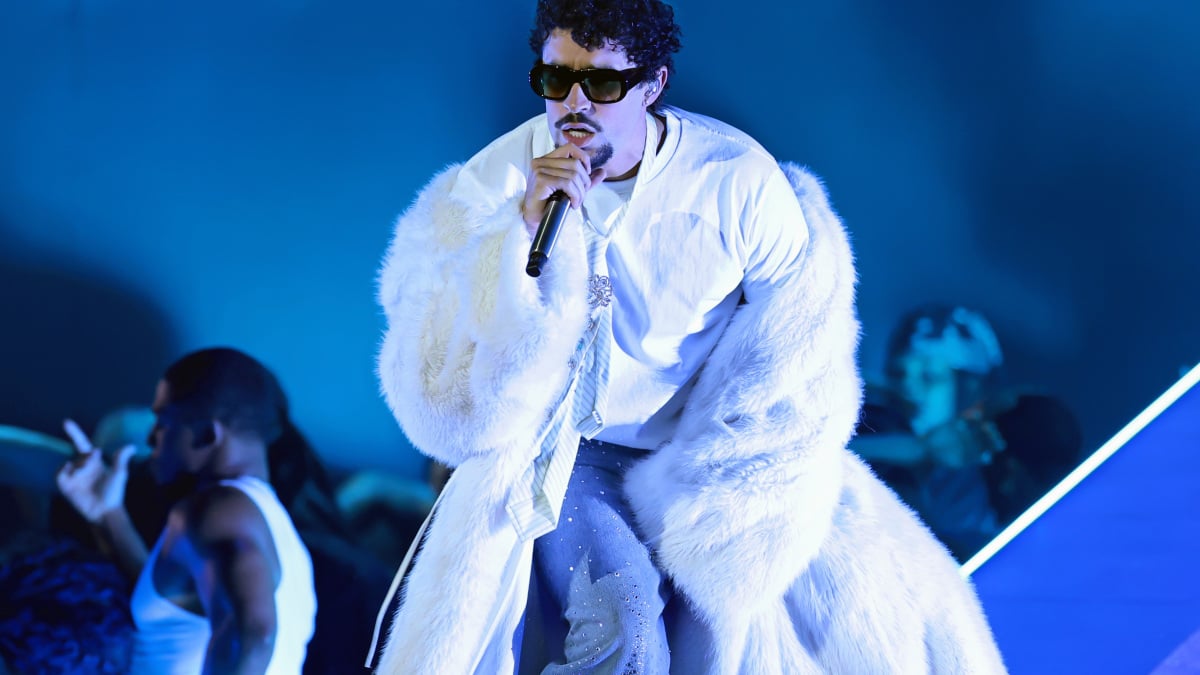
Fresh off his historic Album of the Year win at the 2026 Grammys for DeBÍ TiRAR MáS FOToS, Bad Bunny is set to headline the Super Bowl LX halftime show on Feb. 8 — a performance poised to become yet another culture-shifting moment on the world’s biggest stage.
At the Grammys, the Puerto Rican superstar didn’t shy away from politics, directly calling out U.S. Immigration and Customs Enforcement with a pointed “ICE out” during his acceptance speech for Música Urbana Album. Now, as he prepares for one of the most-watched performances in the world, the question remains: Will Bad Bunny bring that same unapologetic message to the Super Bowl?
Bad Bunny’s history of speaking out against ICE
If Benito does take on ICE at the Super Bowl, it wouldn’t be the first time. In a September 2025 interview with i-D magazine, he said concerns over potential ICE raids and the safety of his Latino and Puerto Rican fans were a key reason he excluded the United States from his 2025–2026 DeBÍ TiRAR MáS FOToS World Tour.
“People from the U.S. could come here to see the show. Latinos and Puerto Ricans of the United States could also travel here, or to any part of the world,” he said. “But there was the issue that … ICE could be outside (my concert venue). And it’s something that we were talking about and very concerned about.”
Instead, the artist staged a historic 31-date residency in Puerto Rico — one intentionally designed to prioritize local fans, keep ticket prices accessible, and inject more than $400 million into the island’s economy. The decision underscored not only his connection to the island but also his ongoing concern for the communities most affected by immigration enforcement.
That awareness surfaced again during the Grammys telecast, when host Trevor Noah joked, “If things keep getting worse in America, can I come live with you in Puerto Rico?” Bad Bunny gently corrected him: “Puerto Rico is part of America.” The moment landed lightly, but its implications were a reminder of Puerto Rico’s complicated political status and the way Latinx communities are often treated as both central to and peripheral within American life.
His criticism of ICE has been consistent. Last June, Bad Bunny shared a video on his Instagram Story condemning federal agents operating in Puerto Rico, urging them to stop harassing people who were simply trying to work. With ICE operations intensifying under the Trump administration, his past comments suggest this activism is not a fleeting statement but a throughline in his career.
Mashable Trend Report
And as a Puerto Rican artist whose music openly celebrates the island, it wouldn’t be surprising if the Super Bowl stage became yet another place where he chooses to make that message heard.
Has Bad Bunny ever criticized President Trump?
While Bad Bunny has rarely named Donald Trump outright, his criticism of the former president — and the policies of his administration — has been clear. In 2024, the artist endorsed Kamala Harris for U.S. president, citing frustration with the Trump administration’s handling of Hurricane Maria and its devastating impact on Puerto Rico. He made the public endorsement in the wake of comedian Tony Hinchcliffe’s racist remarks about Puerto Rico at a Trump rally at Madison Square Garden, where the island was referred to as a “floating island of garbage.”
His commentary has also surfaced through his music. On this past Fourth of July, Bad Bunny released the music video for “NUEVAYoL,” a salsa tribute to the Puerto Rican diaspora in New York.
The visual features the singer perched atop the Statue of Liberty, who wears a Puerto Rican flag across her forehead like a bandanna. In the final moments, a Trump-like voice plays over a radio broadcast, issuing an imagined apology to immigrants. “This country is nothing without the immigrants,” the voice says, naming Mexicans, Dominicans, Puerto Ricans, Colombians, Venezuelans, and Cubans in an unmistakable rebuke of Trump-era immigration rhetoric.
Tensions escalated further after the NFL announced Bad Bunny as the Super Bowl LX halftime performer. U.S. Secretary of Homeland Security Kristi Noem publicly criticized the decision, saying ICE agents would be “all over” the Super Bowl and suggesting the event should be reserved for “law-abiding Americans who love this country.”
The following night, Bad Bunny addressed the backlash during his Saturday Night Live monologue. Speaking first in English, then in Spanish, he framed the moment as a collective victory for Latino communities in the United States, emphasizing their labor and cultural impact. “Our footprints and our contribution in this country,” he said, “no one will ever be able to take that away or erase it.” He closed with a pointed aside in English: “And if you didn’t understand what I just said, you have four months to learn.”
Trump himself responded dismissively when asked about Bad Bunny in October, telling NewsMax he had “never heard of him” and questioning why the NFL selected him as the halftime performer. Just last month, he told the New York Post that he would not attend Super Bowl LX, citing Bad Bunny and opening act Green Day as reasons. “I’m anti-them,” Trump said, “I think it’s a terrible choice. All it does is sow hatred. Terrible.”
We’ll have to wait until Super Bowl Sunday to see if Benito responds.
So, will Bad Bunny mention ICE or Trump at the Super Bowl?
Whether or not Bad Bunny directly addresses politics at Super Bowl LX, the act of bringing Puerto Rican culture and its history to the world’s biggest stage is itself a statement. For Bad Bunny, music and identity have always been inseparable, and this halftime show will surely be no exception.
Entertainment
The best dating apps for serious relationships

Finding love isn’t for the weak. Dating app exhaustion is realer than ever, and while people want to branch out and meet in person, they’re finding it difficult.
One reason is that dating apps are a legitimate way to find a partner, and not just a short-term one. Nearly 44 percent of adults say they use dating apps to find a long-term partner rather than just casual dating or hookups, according to the Pew Research Center. One in 10 partnered adults met their current partner through a dating app, and for younger adults and LGBTQ people, that number rises even higher.
Dating apps aren’t going away, despite fatigue. And it is possible to make them work for you if you want to find your special someone.
Hookup apps for everyone
AdultFriendFinder
—
readers’ pick for casual connections
Hinge
—
popular choice for regular meetups
Are dating apps worth it?
Even using the “right” app for you may still bring moments of uncertainty and frustration (you’re dating, after all), but finding the app with features that most closely align with your dating style and the type of partnership you’re looking for can still make online dating worth it.
If you’ve been using apps for a while and are experiencing serious burnout, it’s always fair to take some time off and come back to them when you feel ready. Our guide will be here for you! Even the best app can feel exceptionally tedious when you simply don’t have the energy.
Which dating app is best for serious relationships?
There are so many dating apps, but not all of them are created equal when it comes to finding a serious, committed relationship.
Some free dating apps are better suited for casual flings or hookups (e.g., Tinder, Grindr, etc.), while others have matching algorithms and profile features specifically designed to help users find meaningful connections (e.g., eharmony, OkCupid, Hinge, and Coffee Meets Bagel).
The good news is that we’ve done the research (and hands-on testing) to figure out which apps work best for long-term relationships, and Match Group isn’t the only player in the game. Plus, all of these platforms are available via Google Play and the App Store, so having an Android or iPhone won’t limit your options. Some old-school dating sites still maintain desktop versions.
To find your match, here are the best dating apps for serious relationships in 2026:
Entertainment
Forget the workarounds — get real Office apps for your Mac for just $50
TL;DR: Get the full Microsoft Office suite on your Mac for a one-time $49.97 — no other fees, no renewals, just lifetime access.
Free productivity apps sounded like a good idea until you hit the roadblocks. Formatting breaks, missing features, and compatibility issues tend to show up right when you need things to work smoothly. That’s why a full version of Microsoft Office still stands out — especially when it’s available as a one-time purchase instead of another monthly bill.
For a limited time, you can get a lifetime license to Microsoft Office Home & Business 2021 for Mac for just $49.97 (reg. $219). It’s a straightforward upgrade that gives you the tools you probably already know — just without the ongoing cost.
Mashable Deals
What you get with Office 2021 for Mac:
-
Word, Excel, PowerPoint, Outlook, Teams, and OneNote: the core apps for writing, data, presentations, email, and collaboration
-
One-time purchase, lifetime access: no subscription fees
-
Built for Mac users: clean, familiar interface optimized for macOS
-
Reliable file compatibility: share and open files without formatting headaches
-
Instant delivery: get your license key and download right away
If you’ve been piecing together your workflow with free tools, this is a simple way to upgrade without overthinking it.
Mashable Deals
Get lifetime access to Microsoft Office Home& Business 2021 for a one-time $49.97 (reg. $219).
StackSocial prices subject to change.
Entertainment
The quirky stuff NASA packed in the Orion spaceship for Artemis II
Over a half-century ago, NASA only spent three years landing astronauts on the moon before the nation lost interest in continuing the program.
That meant the U.S. space agency didn’t get to launch at least three more planned Apollo missions that would have explored new regions of the lunar surface.
But NASA never forgot — demonstrated by a little artifact the agency tucked inside the Orion spacecraft: An American flag that would have flown on Apollo 18 in the early 1970s.
“The flag serves as a powerful emblem of America’s renewed commitment to human exploration of the moon,” NASA said, “while honoring the legacy of the Apollo pioneers who first blazed the trail.”
NASA’s Artemis II mission, which blasted off April 1, is a crowded flight, carrying four astronauts in a spacecraft the size of two minivans. While the crew — Commander Reid Wiseman, Victor Glover, Christina Koch, and Jeremy Hansen — didn’t have to leave their carry-ons on the Cape Canaveral, Florida, launchpad, their “home” for the 10-day flight around the moon is certainly packed to the gills. Still, NASA had room to stow away a few precious mementos and other odds and ends for the journey.
The “official flight kit,” established in federal law, allows NASA, commercial partners, and international entities to use these items later as awards, gifts, or museum exhibits. But for them to get those items onboard, each supplier has to ask NASA for written permission.
The Artemis II flight kit is considerably smaller than the one that flew on the uncrewed Artemis I mission in 2022, which contained about 120 pounds of weird stuff. On this journey, the capsule was maxed out with systems and cargo to keep four adults alive. A toilet, compact rowing machine, food, and other life-support equipment, as well as the astronauts themselves, had to take priority.
This Tweet is currently unavailable. It might be loading or has been removed.
As usual, Artemis II’s kit includes a lot of flags, mission patches, and pins, most of which will go to employees and contractors who helped support the project. But here are some of the more unusual and symbolic items that made the cut:
Pieces of the Space Launch System
When a rocket is about to thrust you into space at 18,000 mph, the last thing you as an astronaut want to hear is that some of its parts are actually sitting right next to you inside the capsule.
But don’t worry. These are shavings from the Space Launch System‘s core stage, likely little aluminum bits recovered from the welding and machining process. After the first eight minutes of the flight, the core stage shut down its engines and detached, breaking apart over the Pacific Ocean.
Mashable Light Speed

At 212 feet tall, the core stage of the Space Launch System holds more than 733,000 gallons of fuel to feed four engines at its base.
Credit: NASA
Bags of dirt
Yes, mission planners made room for 10 bags of dirt — but not just any dirt. Special dirt. These bags contain soil collected from trees whose seeds flew on Artemis I. After that flight, they were planted on Earth. Now some of the soil that helped them grow is making the lunar trip, tracing a full circle from space to Earth and back again.
On Apollo 14, NASA brought seeds to learn about the effects of deep space on plants. Unfortunately, the can containing them broke, with the seeds getting all mixed up. No longer viable for research, the seeds became part of a new program. Not wanting to waste them, NASA delivered the seeds to the U.S. Forest Services. When hundreds began sprouting, they earned the nickname of “moon trees.”
NASA didn’t pack any tree seeds this time, but the Canadian Space Agency did, continuing the tradition. As a member of the Artemis II crew, Canadian astronaut Hansen is the first non-American on a deep space flight.
Other seeds, including a packet of zinnias and chili peppers, are also on board.

The Wrights pioneered the first powered airplane flight at Kitty Hawk, North Carolina, on Dec. 17, 1903.
Credit: The Estate of Orville Wright / Smithsonian
Wright Brothers’ fabric swatch
A one-inch square of fabric from the Wright brothers’ Flyer is inside Orion right now. The swatch is meant to commemorate the birth of flight. The scrap is on loan from the Smithsonian’s National Air and Space Museum, along with another little piece that previously flew on the Space Shuttle Discovery in 1985. After the spacecraft splashes down, the artifacts will return to the museum.
As another nod to the history of flight, the kit holds a photo negative from Ranger 7, the 1964 probe that became the first U.S. mission to successfully touch the lunar surface.
Lab-grown astronaut tissue samples
Separate from the flight kit, the mission is carrying a unique science experiment, known as A Virtual Astronaut Tissue Analog Response, or AVATAR. The test involves live tissue from each of the four astronauts on thumb-drive-size chips, stored in a temperature-controlled box.
Before the launch, doctors drew blood from each crew member and grew cells from those samples to load on the chips. The samples mimic bone marrow, a crucial part of the immune system.
After the mission, scientists will study how gene activity changes within individual cells, comparing flight samples with copies on Earth. The work aims to reveal how deep-space radiation and microgravity affect blood cell development. And it will also serve as a test case for whether these chips can predict health outcomes. In the future, the research may help NASA build personalized health kits for astronauts.

Lucas Ye, 8, won a contest to design a zero-gravity indicator for the Artemis II moon mission.
Credit: Freelancer / NASA
A stuffie with a story
NASA didn’t assign Snoopy to this moon mission — the beagle flew previously on Artemis I — but another cuddly plush toy is filling in. Though not a part of the official flight kit, the round mascot, selected by the astronauts from more than 2,600 contest entries, has an important role. It’s what’s known as a zero-G indicator, letting mission control know when the spacecraft has reached microgravity.
How? It floats.
A second grader from California, Lucas Ye, designed the little stuffie, who looks like the moon wearing an Earth cap. It represents the famous Earthrise image taken during Apollo 8, when humans first saw the planet hovering above the moon’s horizon. Zipped inside is an SD card of names from people rooting for the mission’s success.
Right now, it doesn’t look as though there’s a way to buy Rise, as NASA apparently hasn’t licensed it. But there may be some pent-up demand for the cutie: The official Kennedy Space Center gift shop has temporarily stopped selling most Artemis-related merchandise due to “an unprecedented surge” in orders.
“We sincerely appreciate your excitement and support,” the shop said in a notice on its website, “and kindly ask for your patience as fulfillment times may be longer than usual.”

Padres, Red Sox chasing first series win of season
On a roll, Yankees to send Max Fried up against Marlins


