
Tech
Meet Gizmo: A TikTok for interactive, vibe-coded mini apps
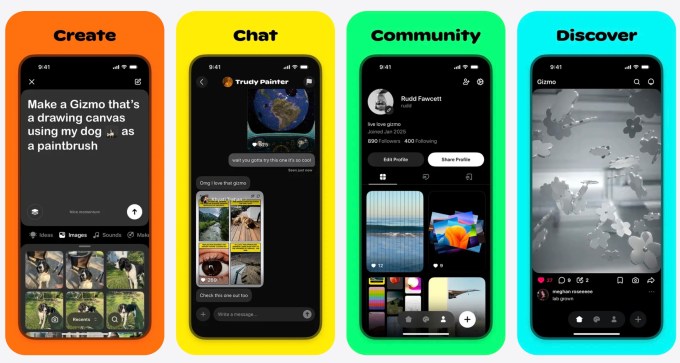
Gizmo, a TikTok-like app for vibe-coded mini applications, is offering a new way to create interactive media. The relatively new mobile app from the startup Atma Sciences lets anyone create experiences using text, photos, sound, and touch, which are then displayed in a vertical feed, similar to TikTok or Reels. But unlike traditional short-form video apps, you don’t just watch and scroll in Gizmo — you play.
Depending on the type of “Gizmo” you encounter, you might poke the screen, swipe, tap, draw, drag, and more to interact with the mini app. These Gizmos aren’t just games but are more like digital toys — things that could include interactive puzzles, memes, art, animation, or anything else a creator can dream up.

The result is an engaging, playful feed, where you can like and comment on the tiny creations and even remix existing Gizmos to create your own version, if you choose.
What’s more, you don’t need to know how to code or even vibe code to get started. Instead, you can simply type out an AI prompt to explain your idea using natural language.
The app then leverages AI coding technology to turn your idea into an interactive experience by generating the code that makes it work. As part of this process, Gizmo will also render your idea visually to ensure that each app functions properly and runs smoothly. Apps are also vetted using AI and human moderation to ensure user safety, a company FAQ notes.
Gizmo hails from a New York-based startup called Atma Sciences, co-founded by Rudd Fawcett and Brandon Francis, along with CEO Josh Siegel and CTO Daniel Amitay. The company last year raised a $5.49 million seed round from First Round Capital and others, according to data from PitchBook. On the company’s website (which is also silly and interactive), the team explains their focus is on combining “powerful technology with simple, elegant foundations,” starting with their creativity app, Gizmo.
None of the company’s founders responded to requests for an interview when TechCrunch reached out through multiple emails, requests to investors, and via LinkedIn. We were told by one investor that the team isn’t yet ready to do press. (Sorry!)
Techcrunch event
Boston, MA
|
June 23, 2026
TechCrunch was drawn to Gizmo because of the app’s potential for growth and its unique approach to the vibe-coding space (and a rare recommendation from my teen). The company is envisioning a world where anyone can create apps for fun, not just for a purpose, as with other vibe-coding app platforms for micro apps, like Anything, and others.
Despite being relatively new, Gizmo’s feed isn’t repetitive. It’s filled with creative mini apps, leading to an experience that feels somewhat like a mash-up between TikTok and the interactive 3D-space designer, Rooms. But while Rooms introduced the programming language Lua to those who wanted more advanced controls over their creations, Gizmo keeps things prompt-based and simple.
The app is incredibly easy to use. You simply type out your prompt and then see how it turns out, and then modify as needed. In one test, the AI quickly coded a mini quiz, but we had to instruct it to edit the title, which was cut off at the top of the screen.
The resulting creation can be shared to the app’s feed, messaged to a friend, or posted to social media using a unique URL.
According to data from market intelligence firm Appfigures, Gizmo has roughly 600,000 installs, with around half coming from the U.S., after being introduced with little fanfare less than six months ago. Around 235,000 of its downloads came in December alone, representing 39% of its total count.
Gizmo’s growth from October to December was 312%, with December installs up 50% month-over-month and November installs up 180% from October.
Tech
Mirage raises $75M to continue building models for its AI video editing app Captions

Mirage, the maker of video-editing app Captions, has raised $75 million in growth financing from General Catalyst’s Customer Value Fund (CVF).
Over the past year, the startup has made significant changes both to its product and corporate identity. The startup rebranded from Captions to Mirage to position itself as an AI lab that produces different models and also caters to industries like advertising and marketing. It has also trained a model specifically for pacing, framing, and attention dynamics in short videos.
The company also switched to a freemium model in January 2025 to better compete with apps like ByteDance’s CapCut and Meta’s Edits, which was released later in the year. It now offers a video-creation suite as well, with some of the features from Captions, that lets companies create and distribute videos in bulk.
Mirage’s co-founder and CEO Gaurav Misra said that the company aims to create more models. However, he didn’t specify what its next set of models would do, only saying that they would be focused on “assembly intelligence” — basically putting together a video using different sources and components.
Speaking about Mirage’s new audio model, which it claims can preserve accents in generated videos, Misra said, “The reason for the audio model was that we noticed that there was a gap in accents because a lot of our users are international. Accents are just very important. There was my own dad’s example. He was trying to use the app, and he would say a word in an Indian accent, and it would always make it sound like he’s talking in an American accent.”
According to data from analytics firm Appfigures, Captions has been downloaded over 3.2 million times in the last 365 days and has brought in $28.4 million in in-app revenue. Misra said the platform has been used to create more than 200 million videos so far, and that it has attracted an international user base, with only 25% of its revenue coming from the U.S.
Currently, Mirage’s marketing suite is available on the web, and Captions largely offers a mobile-first editing suite. The company aims to merge these two platforms to better target small businesses that may be looking to create marketing videos.
Techcrunch event
San Francisco, CA
|
October 13-15, 2026
Pranav Singhvi, managing director of General Catalyst’s CVF fund, said Mirage has great product-market fit.
“Mirage’s business equation is extremely figured out. They know exactly how to spend that dollar and generate a very attractive ROI. If you think about the market they’re going after, it’s in a sense an infinite total addressable market. You can start out in the creator world, the influencer world, and then use that as a mechanism to sell to enterprises as well,” Singhvi told TechCrunch.
There are tons of companies building AI video-generation pipelines for marketing. Canva has introduced several tools around marketing creation and tracking, while platforms like D-ID, HeyGen, Webflow, and Avataar have been releasing new models and features.
However, Singhvi seems confident about Mirage’s positioning and unit economics. “Regardless of what the other tools are out there, Mirage is clearly ahead of the pack from a unit economics standpoint. Ultimately, it’s all a reflection of their product,” he said.
Mirage aims to use the fresh capital to fuel growth, and expand in high-growth Asian markets.
Tech
Spotify’s new SongDNA feature maps how your favorite songs are connected
Spotify announced on Tuesday the global rollout of a new feature, SongDNA, that lets listeners more deeply explore their favorite music.
Now available to Premium subscribers on iOS and Android, the feature provides an interactive experience that lets users trace other components of a song beyond the singer, songwriter, or musician. With SongDNA, listeners could explore other connections, like who may have covered that song, plus other information like samples, interpolations, or what other projects the song’s collaborators have also been involved in.
The idea is something of an expansion to the existing “About the Song” feature, allowing Spotify’s customers to learn more about the writers, producers, and collaborators behind their favorite music. This could lead users to see how artists are connected to and influenced by one another’s work. For those in the music industry itself, the feature could help them find new collaborators, producers, engineers, and others they may want to work with.
It also offers those in the background of music production more visibility and credibility than they’ve previously had in the streaming age.

TechCrunch reported in October that Spotify was developing the SongDNA feature as a way to help users discover music through a song’s credits, after references to the feature were spotted in the app’s code by reverse engineer Jane Manchun Wong. The following month, the company officially confirmed its plans to launch SongDNA in early 2026.
In part, SongDNA has been built on top of data from the online community-built music database WhoSampled, which Spotify acquired last year. The feature also competes with TIDAL’s interactive credits, which similarly focus on the contributors behind the songs you stream.
“By bringing collaborators, samples, and covers together in one place, we’re making it easier for fans to discover new music and see how songs connect and come to life—while giving songwriters, producers, and rightsholders meaningful recognition for the role they play in creating it,” said Jacqueline Ankner, Spotify’s head of Songwriter & Publisher Partnerships, in a statement.
The feature is rolling out now in beta to Premium users globally across iOS and Android devices, with plans for the rollout to be complete sometime in April.
Tech
Snapchat’s new ‘AI Clips’ Lens format turns photos into five-second videos
Snapchat announced on Tuesday that it’s launching AI Clips in Lens Studio, its platform that lets creators design and publish AR and AI effects called Lenses. The new Clips are an AI-powered Lens format that transforms a single photo into a five-second video.
Unlike open-ended text-to-video tools, AI Clips are designed as a closed-prompt experience, where Lens creators design the Lens, and users can tap it to generate a video from their own photos.
For example, a Lens creator could design a Lens that allows users to generate a video of themselves walking down a red carpet using their own photo.
Snapchat says both experienced and new developers can use the new Lens format to turn a single prompt into a published Lens in minutes without the need for external tools.
AI Clips are available to Snapchat users who are subscribed to that platform’s Lens+ offering, which costs $8.99 per month. As its name suggests, Lens+ gives users access to exclusive Lenses and AR experiences, along with the features available as part of the standard Snapchat+ subscription.

“For the first time, developers can build and publish photo-to-video AI directly to Snapchat from the GenAI Suite in Lens Studio,” Snapchat wrote in a blog post. “There’s currently nothing else on the market that combines closed-prompt AI video generation with direct photo input, real distribution, and monetization.”
Lens creators enrolled in Lens+ Payouts, Snapchat’s monetization program that allows developers to earn money from their Lenses, can earn revenue from the AI Clips they create.
Snapchat isn’t the only platform focused on letting users create AI clips from their own photos, as YouTube announced last week that it was rolling out “Reimagine,” a new feature that lets users transform a single frame from an existing YouTube Short into an eight-second clip using their own photo.
The launch of AI Clips comes the same day that Snapchat announced that users created nearly two trillion Snaps, or 63,000 Snaps per second, in 2025.

The best early Big Spring Sale deals at Amazon include record-low prices on portable power stations
Ads may be coming to Apple Maps as soon as this summer, report says


