
Tech
OpenAI launches new macOS app for agentic coding
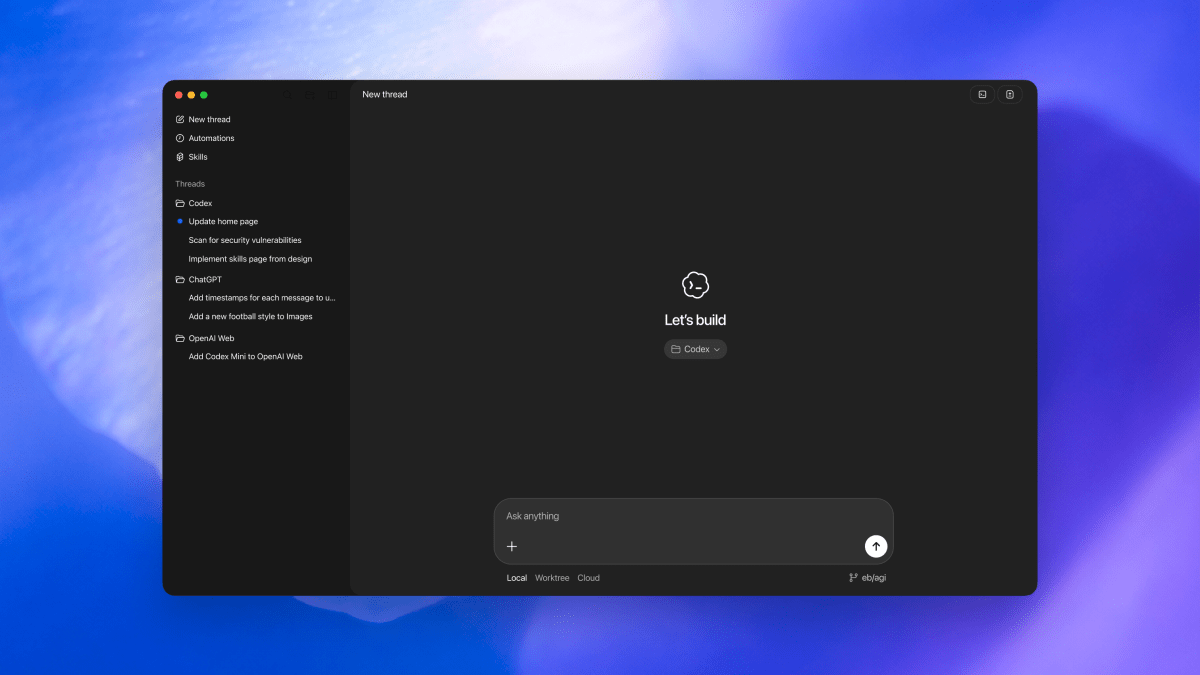
AI is already having a seismic impact on how software is written, with much of the grunt work of programming now performed by swarms of agents and subagents. But as developers experiment with new interfaces and form factors for human-AI collaboration, it’s become hard for even the most advanced AI labs to keep up.
The current trend is for agentic software development — systems where AI agents can work independently on coding tasks — epitomized by the Claude Code and Cowork apps. In the meantime, OpenAI has been gradually building out its Codex tool, which launched as a command line tool last April and expanded to a web interface one month later.
Now OpenAI is taking a major step toward catching up. On Monday, the company launched a new macOS app for Codex, integrating many of the agentic practices that have become popular in the past year. The new app is designed to work with multiple agents in parallel, integrating agent skills and other state-of-the-art workflows. The launch also comes less than two months after the launch of GPT-5.2-Codex, OpenAI’s most powerful coding model, which the company hopes will be enough to tempt over Claude Code users.
“If you really want to do sophisticated work on something complex, 5.2 is the strongest model by far,” CEO Sam Altman told reporters on a press call. “However, it’s been harder to use, so taking that level of model capability and putting it in a more flexible interface, we think is going to matter quite a bit.”
While Altman’s confidence in GPT-5.2 is understandable, coding benchmarks tell a more complicated story. GPT-5.2 does hold the top spot on TerminalBench (a test measuring how well AI handles command-line programming tasks), at least as of press time. But agents from Gemini 3 and Claude Opus have logged roughly equivalent scores — lower, but within the margin of error of the benchmark. Results from SWE-bench, another coding benchmark that tests AI’s ability to fix real-world software bugs, are similar, showing no clear advantage for GPT-5.2. However, agentic use cases have been difficult to benchmark effectively, and state-of-the-art models can vary significantly in user experience.
The Codex app also comes with a range of new features that OpenAI says will help it achieve parity or, in some cases, outpace the various Claude apps. The Codex app will allow for automations that can be set to run in the background on an automatic schedule, with results placed in a queue to be reviewed when the user returns. Users can also select different personalities for the agent — from pragmatic to empathetic — depending on their working style.
But for the company, the biggest selling point is the sheer speed of development that’s made possible by AI. “You can use this from a clean sheet of paper, brand new, to make a really quite sophisticated piece of software in a few hours,” Altman said. “As fast as I can type in new ideas, that is the limit of what can get built.”
Techcrunch event
Boston, MA
|
June 23, 2026
Tech
David Sacks is done as AI czar — here’s what he’s doing instead

David Sacks has used up his days as Donald Trump’s AI and crypto czar.
Speaking with Bloomberg on Thursday, the longtime entrepreneur, investor, and podcaster confirmed that his non-consecutive 130-day stint as a special government employee is over and that he’s moving on to co-chair the President’s Council of Advisors on Science and Technology (PCAST) alongside senior White House technology adviser Michael Kratsios.
“I think moving forward as co-chair of PCAST, I can now make recommendations on not just AI but an expanded range of technology topics,” he told Bloomberg via a video interview. “So yes, this is how I’ll be involved moving forward.”
What that means in practice is Sacks will be much further from the power center in Washington than since the outset of this second Trump administration. As AI czar, Sacks had a direct line to Trump and a hand in shaping policy. PCAST is a federal advisory body, so while it studies issues, produces reports, and sends recommendations up the chain, it doesn’t make policy.
The council has existed in some form since FDR, though Sacks made a point to Bloomberg of noting that this particular iteration has “the most star power of any group like this” ever assembled, and it’s hard to argue he’s wrong. The initial 15 members include Nvidia’s Jensen Huang, Meta’s Mark Zuckerberg, Oracle’s Larry Ellison, Google co-founder Sergey Brin, Marc Andreessen, AMD’s Lisa Su, and Michael Dell, among others. (That’s a lot of billionaires.)
Sacks told Bloomberg the council will take up AI, advanced semiconductors, quantum computing, and nuclear power, and that near-term attention will go toward pushing Trump’s national AI framework, released just last week. The framework is aimed at replacing what Sacks described to Bloomberg as a mess of conflicting state-level rules. “You’ve got 50 different states regulating this in 50 different ways,” he said, “and it’s creating a patchwork of regulation that’s difficult for our innovators to comply with.”
What Sacks didn’t address head-on was why the transition is happening now and whether his recent comments were a factor. Earlier this month, on the popular “All In” podcast that he co-hosts, Sacks publicly urged the administration to find an exit from the U.S.-backed war with Iran, walking through a set of worsening scenarios — attacks on oil infrastructure in neighboring countries, the destruction of desalination plants, the possibility of nuclear use by Israel — and calling for a polite way out. Trump responded by telling reporters that Sacks hadn’t spoken to him about the war. (The U.S.-Israel war on Iran has now been going on for approximately 27 days.)
Techcrunch event
San Francisco, CA
|
October 13-15, 2026
Asked about the podcast episode on Thursday by Bloomberg, Sacks figuratively threw his hands in the air: “I’m not on the foreign policy team or the national security team,” he said, adding that his podcast comments represented his personal view, not an official one.
For all the marquee names Sacks is bringing to PCAST, it’s worth reflecting on what the council has historically been, which is an advisory body with some influence in some administrations and almost none in others.
President Obama’s version was seemingly the most productive on record, churning out 36 reports over eight years — two of which led to concrete policy changes, including an FDA rule that opened the market for over-the-counter hearing aids.
President Trump’s first-term council, by contrast, took nearly three years just to name its first members, produced a handful of reports, and made no particular mark, while President Biden’s council skewed heavily academic — Nobel laureates, MacArthur fellows, National Academy members — and issued a modest number of reports before the administration ended.
The current PCAST is a completely different animal, built almost entirely from the executive suites of the companies shaping the technology it will advise on.
Now, Sacks is again one of those unencumbered executives, free to resume his life as an investor and entrepreneur. A spokesperson for Craft Ventures, the firm Sacks co-founded and where he remains a partner, has not yet responded to related questions about next steps; TechCrunch reported last year on the ethics waivers Sacks obtained to maintain financial stakes in AI and crypto companies while shaping federal policy in both areas — an arrangement that drew sharp criticism from ethics experts and lawmakers.
Tech
OpenAI shuts down Sora while Meta gets shut out in court
When an 82-year-old Kentucky woman was offered $26 million from an AI company that wanted to build a data center on her land, she said no. Sure, that same company can try to rezone 2,000 acres nearby anyway, but as AI infrastructure stretches further into the real world, the real world is starting to push back.
That tension is everywhere this week, from OpenAI shutting down its Sora app to courts finally starting to hold social platforms like Meta accountable. On this episode of TechCrunch’s Equity podcast, Kirsten Korosec, Anthony Ha, and Sean O’Kane dig into what it looks like when the AI hype cycle meets reality.
Subscribe to Equity on YouTube, Apple Podcasts, Overcast, Spotify and all the casts. You also can follow Equity on X and Threads, at @EquityPod.
Tech
Apple says no one using Lockdown Mode has been hacked with spyware
Almost four years after launching a security feature called Lockdown Mode, Apple says it has yet to see a case where someone’s device was hacked with these additional security protections switched on.
“We are not aware of any successful mercenary spyware attacks against a Lockdown Mode-enabled Apple device,” Apple spokesperson Sarah O’Rourke told TechCrunch on Friday.
It’s the tech giant’s most recent affirmation that Apple devices with Lockdown Mode can withstand government spyware attacks, after first making the claim a year after the security feature’s debut.
Apple in 2022 announced Lockdown Mode, an opt-in series of security protections that switches off certain features in iPhones and other Apple devices that are commonly exploited to hack targets with spyware. Apple specifically released this security mode to help at-risk customers defend themselves from the threats posed by government spyware made by companies like Intellexa, NSO Group, and Paragon Solutions.
In recent years, Apple has conceded that its customers can be hacked by spyware and has been more proactive about notifying customers who have been targeted.
Apple has sent numerous batches of notifications to users in over 150 countries, alerting them that they may have been hacked with spyware, which shows how much visibility the company now has on these types of attacks. Apple has never said how many users it has notified, but it’s likely fair to assume there have been dozens, if not more.

Donncha Ó Cearbhaill, the head of the security lab at Amnesty International, where he has investigated dozens of spyware attacks, said that he and his colleagues “have not seen any evidence of an iPhone being successfully compromised by mercenary spyware where Lockdown Mode was enabled at the time of the attack.”
Digital rights organizations like Amnesty International and the University of Toronto’s Citizen Lab have documented several successful attacks on iPhone users, none of which have mentioned a bypass of Lockdown Mode. In at least two cases, Citizen Lab researchers publicly said they had seen Lockdown Mode actively block spyware attacks, one carried out with NSO’s Pegasus, the other with Predator spyware, made by a company now part of Intellexa.
In at least one documented case of a spyware attack targeting iPhones, security researchers at Google said the spyware would bail out of trying to infect the victim if it detects Lockdown Mode, likely as a way to evade detection.
Patrick Wardle, an Apple cybersecurity expert and critic, says that Lockdown Mode is an important feature that makes it more difficult for spyware makers to attack Apple users.
“I think it’s safe to say, Lockdown Mode is one of the most aggressive consumer-facing hardening features ever shipped,” he told TechCrunch.
Contact Us
Do you have more information about spyware attacks, or spyware makers? From a non-work device, you can contact Lorenzo Franceschi-Bicchierai securely on Signal at +1 917 257 1382, or via Telegram, Keybase and Wire @lorenzofb, or by email.
Wardle explained that by “shrinking the attack surface,” Lockdown Mode eliminates many techniques normally used to exploit the iPhone, and forces spyware makers to use more complex and expensive techniques to develop.
“It kills entire delivery mechanisms/exploit classes,” he added, “as it blocks most message attachment types, restricts WebKit features. This is really a huge reduction in remotely reachable attack surface, especially for zero-click exploit chains,” referring to hacks that can target people over the internet without any interaction from the victim.
It’s possible that Lockdown Mode has been bypassed, and neither Apple nor independent investigators have caught the attack. But given that Apple is typically publicly tight-lipped at the best of times, its latest statement marks a significant milestone for Lockdown Mode.
I have used Lockdown Mode for years, and I barely think about it — except when it pops up notifications that can be occasionally confusing. Some features that have been switched off require you to take an extra step, such as copying and pasting links from text messages to your browser. That’s why I, and several digital security experts, recommend anyone worried about being targeted by spyware or digital attacks to switch on Lockdown Mode.

Three College Basketball Teams To Avoid in This Year’s Elite Eight
Did the World Baseball Classic Hurt MLB Starting Pitchers?


