
Entertainment
Starfleet Academy Mangled Star Trek's Most Important Quote About Freedom, Just Like ChatGPT Would Have
By Chris Snellgrove
| Published

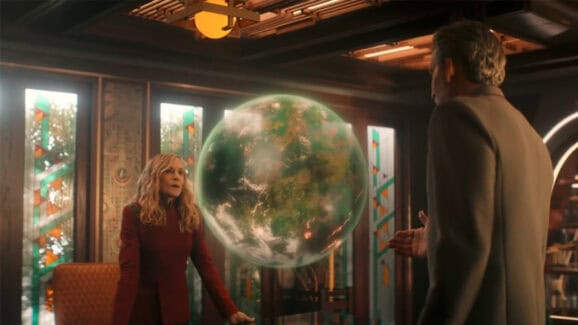
The second scene of Starfleet Academy’s latest episode attempted to honor Star Trek: The Next Generation by having the holographic Doctor quote Aaron Satie, the famous in-universe judge that Picard quoted during “The Drumhead.” Presumably, this bit of nostalgia was meant to honor the Golden Age of Star Trek, thus reassuring skeptical fans that this wildly different spinoff hasn’t forgotten its creative roots.
Unfortunately, they failed. Not only does the Doctor omit a huge chunk of the quote, but he later insults a student in a way that shows he doesn’t actually believe any of the words he’s saying.

First, some context: in the TNG episode “The Drumhead,” an admiral is brought onboard to help the Enterprise investigate whether an explosion was the result of sabotage. She is the daughter of a famous Starfleet judge, and she is so determined to follow in her famous father’s footsteps that she is suspicious of everyone, eventually going so far as to publicly put Captain Picard on the stand for questioning. There, Picard shames and humbles her by quoting her father (Judge Aaron Satie), claiming these are “some words I’ve known since I was a schoolboy.”
Star Trek Is Playing Its Greatest Hits

The words in question are as follows:
“With the first link, the chain is forged. The first speech censured, the first thought forbidden, the first freedom denied, chains us all irrevocably.” – Picard in Star Trek: The Next Generation
Picard went on to note that Judge Satie’s words functioned “as wisdom and warning” because “the first time any man’s freedom is trodden on, we are all damaged.” He was basically calling out Admiral Satie for turning an unnecessary investigation (it turns out the explosion was an accident) into a drumhead trial where she could needlessly try to punish innocent people, including a young ensign who turned out to secretly have Romulan parentage.

In the most recent episode of Starfleet Academy, the Doctor is in charge of hosting a debate competition named after the late, great Judge Aaron Satie, and he quotes the same words to his students that Picard once quoted to Satie’s own daughter. There’s just one problem: he omits a large part of the quote. In the episode as originally released on Paramount+, he goes from saying the word “forbidden” to the word “us,” leaving out the phrase “the first freedom denied” and the word “chains.”
“With the first link, the chain is forged. The first speech censured, the first thought forbidden, us all.” – The Doctor on Starfleet Academy
Most Starfleet Academy fans who noticed this error assumed that it was a sound editing error, mostly because it seems like there was a pause where the word “chains” could be said before the word “us.” Such an editing mistake would be a major screw-up on the producers’ fault because it ruins what is supposed to be this big, fan service nod to Star Trek: The Next Generation. Plus, with how expensive NuTrek is (Discovery and Strange New Worlds episodes each cost between $7-$10 million to produce), it’s wild to think such a blatant sound error got past the editors of Paramount+’s biggest new show.
Pushing The Buttons On Every Older Trek Fan

Of course, even if the error was just omitting the word “chains,” that means the Doctor still screwed up the quote. Even if he had said “chains,” he would have still left out another part of the quote: “the first freedom denied.” That may sound like nitpicking, but why would the Starfleet Academy writers go out of their way to quote one of the most famous lines and scenes in Star Trek: The Next Generation if they are just going to screw it up?
Judging from the rest of the scene, however, I may be giving those writers too much credit. At one point, to shock the class (and, presumably, the audience), the Doctor declares that “speech and debate is not for the chickensh*t,” causing a bespectacled student (seriously, why do so many people in the 32nd century still wear glasses?) to ask if the haughty hologram is allowed to talk like that.
Do The Writers Need Their Vision Checked?

At this, the Doctor wheels on the poor kid, telling him that “I have existed longer than your entire lineage… I have earned the right to speak as I see fit. One day, you too may earn that same privilege.” When the cadet groans, the Doctor wraps up their sidebar conversation by saying, “But alas, that day is not today.”
It’s meant to be a funny moment, par for the course in a show that can never go very long without dropping a clunky punchline. But in trying to make the audience laugh (and justify the Doctor’s weirdly archaic vulgarity), the Starfleet Academy writers reveal that they don’t understand (or maybe just don’t care) anything about the iconic words he was just quoting.
You see, the quote emphasizes how societies lose their essential freedoms when “the first speech” is “censured” and how this is “the first link” in a chain that binds us all. But in trying to make an example of the cadet who asked about his vulgar language, the Doctor tells him that speaking however one “sees fit” is a right the Doctor “earned” through old age. It’s a “privilege” that the young man “may earn” only with the passage of time.
The Doctor Took The Hippocratic Oath

So, what is it, Doc? Do you believe, as Judge Satie said, that all speech should be protected because as soon as we prevent someone from speaking their mind, we collectively imprison everyone’s thoughts and feelings? Or do you believe that only older people get to speak their mind and that these young whipper snappers need to shut up and earn the right to speak as they see fit?
Again, this may seem like nitpicking, but this scene is practically a microcosm of everything wrong with Starfleet Academy. It sabotages a beloved legacy character (The Doctor) by turning him into a foul-mouthed hypocrite who can’t keep up with what he said only moments ago. This all happened because the writers screwed up an homage to Star Trek: The Next Generation, completely ruining an iconic quote while demonstrating their ignorance as to what it even means.
As a fan of the franchise since the ‘80s (yes, Next Generation was my first series), I really want to like Starfleet Academy, and I guess I should be grateful the writers are trying so hard to jam in references from that era of the franchise. But what’s the point if they are going to screw up an important quote like this from beginning to end? Sorry, Paramount: this is a Star Trek show in name only, and older fans are beyond sick of you trying to sell us a generic sci-fi comedy that only makes gestures towards better series that the writers (if there are any) can never (and apparently will never) truly understand.
Entertainment
How Stargate SG-1 Used A Classic Trope To Emotionally Wreck Its Fans

By Jonathan Klotz
| Published

Garfield and Friends said it best: “Oh no, we’ve resorted to an evil twin storyline.” Star Trek: The Original Series did it the best with Mirror Universe Spock, and ever since, it’s been a lazy excuse for every series to use when they run out of ideas. The exception is Stargate SG-1’s sixth episode, “Cold Lazarus,” which plays with the trope by making the twin less evil and more confused.
When fans say they skip this episode when rewatching, it’s not because it’s a lazy, poorly written episode. In fact, it’s the opposite. The ending of “Cold Lazarus” is a pivotal character moment for Jack O’Neill (Richard Dean Anderson) and a gut punch to the audience.
Stargate SG-1’s First Evil Twin

“Cold Lazarus” opens with the SG-1 team on a planet that doesn’t look like Vancouver (it was a giant pile of sulfur at the port of Vancouver). The desert landscape is dotted with shattered blue crystals that look like the remnants of a civilization until we see a crystal eye-view of O’Neill, a mysterious light knocks him out, and all of a sudden, a second O’Neill is looking down at the first. Turns out, the crystals are the civilization.
Fake O’Neill is trying to figure out who O’Neill is and what SGC is all about. When he pulls out photos of his family, it takes Samantha Carter (Amanda Tapping) by surprise. O’Neill’s never mentioned his wife, Sara, or his son, Charlie. Confused, the Fake O’Neill goes to the home, where Sara is disgusted he’d come by and thinks it’s a sick joke that he’s asking about Charlie. If you’re wondering if you missed a key part of O’Neill’s backstory, don’t worry, this is the first time that either Sara or Charlie is mentioned, and tragically, we soon learn why.
No One Ever Dies

Charlie shot himself with O’Neill’s gun. Fake O’Neill starts to piece this together when he goes into Charlie’s old room and breaks down, prompting Sara and him to finally have the conversation about their shared grief. Back in SGC, the crystal’s nature is revealed to be an energy alien calling itself Unity, which accidentally killed a Jaffa, and the Goa’uld shattered them in retribution. That’s when O’Neill stumbles back through the Stargate, and the team realizes the mistake they made.
The Fake O’Neill is soon captured at a local hospital, suffering from Earth’s radiation, where he explains that he sensed O’Neill’s pain after he took his form and wanted to help ease the suffering, as nothing ever truly dies to Unity. To prove its point, Unity transforms into Charlie, giving O’Neill and Sara one last chance to see their child. Fans who haven’t lost a child can understand the emotion, but for fans who have, this scene is emotional torture, in the best way possible.

Jack knows this isn’t Charlie, but he talks to him like he is, and then they walk together through the Stargate back to Unity’s planet. It’s a beautiful moment that explains so much about O’Neill’s throwing himself into work and how even his friendships remain professional. “Cold Lazarus” may have started out with the “evil twin” trope in full effect, but the ending is proof that even early during its run, Stargate SG-1 was going to be the greatest.
Entertainment
Star Trek’s Scariest Episode Secretly Answered Fans’ Oldest Complaint
By Chris Snellgrove
| Published

Star Trek is a long-running franchise filled with tropes, some of them more annoying than others. For many fans, the dumbest trope that keeps popping up is when there’s only one ship that can save Earth from one catastrophe or another. It always begs the question: why isn’t the seat of the United Federation of Planets better protected? It certainly feels like such an important planet would have its own fleet for protection rather than relying on a long-range vessel like the Enterprise to warp in and save the day.
However, it seems that Star Trek’s scariest episode might have secretly answered fans’ oldest complaint about the franchise. Over on Reddit, user u/Wallname_Liability presented a compelling theory: that in the Star Trek: The Next Generation two-parter “The Best of Both Worlds,” the collection of Starfleet vessels lost fighting the Borg at Wolf 359 was the home fleet. This theory would help explain that Earth was typically better-defended than we might imagine and why there were fewer ships to protect the planet in later movies and shows.
My Borg Friend’s Back (And There’s Gonna Be Trouble)

In Star Trek: The Next Generation, most of the adventures take place in deep space because the intrepid crew has an ongoing mission to explore strange new worlds, seek out new life and new civilizations, and (come on, you know you’re already saying it out loud) boldly go where no one has gone before. But in “The Best of Both Worlds,” a Borg Cube starts heading directly for Earth. The Enterprise crew tries to develop a weapon that can defeat this implacable foe, one who seems nearly unstoppable after they assimilate Captain Picard. Meanwhile, a fleet of Starfleet ships assembles at Wolf 359 for one last stand against the Borg.
Unfortunately, that entire fleet is wiped out. The Borg makes it to Earth, but the Enterprise manages to stop these bionic baddies after rescuing Captain Picard. Data exploits Picard’s connection to the Collective and puts the cube to “sleep,” and it explodes soon after that. Picard and his crew get a mostly happy ending, but the same can’t be said for the crew of the ships that fought at Wolf 359. All vessels were lost, and only a handful of people survived, including Benjamin Sisko and Liam Shaw.
Resistance Was Futile

According to this Redditor’s theory, the fleet that assembled at Wolf 359 was the home fleet assigned to (among other things) protect Earth. Some of the ships were likely already at Earth (possibly undergoing repairs or retrofits), and others might have been located near some of humanity’s older colonies. But everyone would have had to have been close enough to Earth to quickly warp to Wolf 359, a real star system that is only eight light-years from humanity’s home planet.
Why is the idea that this was the home fleet so important? In various Star Trek episodes and films, there has often only been one ship (usually the Enterprise) close enough to save Earth. In Star Trek: Generations, for example, the Enterprise-B is on a shakedown cruise, but it’s the only ship close enough to save the El-Aurian refugees from the threat of the Nexus. In Star Trek: The Motion Picture, only the Enterprise can intercept V’ger. In Nemesis, the Enterprise is the only Starfleet ship capable of preventing Shinzon from killing everyone on Earth, and so on.
The Best Of Trope Worlds

This trope can get frustrating when you start comparing Starfleet to, say, the United States Navy. How insane would it be if the whole country had to keep relying on a single ship to save us from major existential threats? Star Trek asks us to repeatedly believe that there’s only one ship within spitting distance of the entire solar system that can take care of the crisis du jour. It’s completely unbelievable, but this Wolf 359 home fleet theory helps make these frustrating moments make more sense.
It’s entirely possible that, in the time of Star Trek: The Original Series and its spinoff movies, there wasn’t a home fleet. Starfleet was a lot smaller back then. Remember, the original Enterprise was one of only 12 Constitution-class vessels. However, both The Motion Picture and The Voyage Home had Earth being attacked by seemingly unstoppable alien forces. In each case, the only man who could stop things was James T. Kirk, but Starfleet must have known he wouldn’t be around forever. Therefore, sometime before The Next Generation premiered, they developed a home fleet that could protect the Earth from overpowered alien attackers.
The Worst Massacre In Starfleet History

Or so they thought. The Borg wiped the floor with the fleet at Wolf 359, which helps to explain why the admiralty needed to assemble an ersatz fleet in First Contact. They were still rebuilding from earlier losses, and most spare vessels were probably being ordered to areas of interest as the Dominion War loomed near. Speaking of which, that war is the most likely reason that the Enterprise was the only ship that could help in Nemesis. The movie took place four years after the Dominion War ended, and once more, Starfleet would have needed time to fully rebuild its fleet.
Obviously, these are only theories, but they are compelling ones. It makes sense that Starfleet would have learned its lessons from V’ger and the Alien Probe and developed a home fleet, only for it to be destroyed by the Borg at Wolf 359. Afterward, the next big Borg attack and the Dominion War destroyed many vessels, all while requiring the existing fleet to stretch that much thinner. Fortunately, Earth was in good hands. No matter how bad the war with the Dominion got, Captain Sisko and Admiral Ross ensured that there was always a fleet or two close enough to protect paradise, even from those pesky Breen.
Entertainment
Ben Stiller Makes The Same Screwball Comedy For The Fourth Time In New Trailer
By TeeJay Small
| Published

Paramount Pictures dropped an announcement trailer for their upcoming film, Focker In-Law, last week, and it immediately caught my attention. As you can probably tell from the title alone, the film is the fourth installment in the Meet The Parents film series, which originally kicked off in 2000. While I loved the original film and enjoyed parts of the 2004 sequel, I can’t help but feel frustrated that we’re getting the exact same movie for the fourth time. From the trailer, it looks like Focker In-Law promises to add some comedic beats from Ariana Grande, but little else.
A Strong Start And Slow Decline
In case you’re not hip to the franchise, the original Meet the Parents tells a very straightforward comedic story of an obnoxious, anxious man named Gaylord Focker (Ben Stiller), as he encounters his girlfriend’s family for the very first time. Focker wants to take this opportunity to get the family’s blessing to propose, but he’s mired by a series of misunderstandings and social faux pas at every turn. To make matters worse, Focker must contend with his girlfriend’s domineering ex-CIA father, Jack (Robert De Niro).
The second film, Meet The Fockers, introduces some fresh talent, flips the script on Jack a little bit by taking him out of his comfort zone, and ratchets up the tension as the happy couple navigate their upcoming wedding and a premarital pregnancy. It’s sort of unnecessary, but it’s a harmless way to squeeze more laughs out of a pretty simple premise. Then, in 2010, we got Little Fockers, which produced absolutely no memorable moments whatsoever. Seriously, Ben Stiller even took to X this week to say “I stand by the first two” installments in the franchise, ignoring the third film entirely.
The Same Old Jokes For A New Generation

Now, it looks like we’re due for the same material a fourth time with Focker In-Law. Greg Focker is still an awkward, bumbling mess, while the aging Jack flexes his people skills and dunks on his son-in-law for having a stupid last name. Meanwhile, a new generation of Focker men have emerged, with Greg’s son Henry (Skyler Gisondo) planning to propose to his girlfriend, Olivia Jones (Ariana Grande). From the trailer, it looks like Grande plays an FBI hostage negotiator, who wishes to pry Focker Jr. away from his emotionally topsy-turvy family in favor of a life of relative normalcy.
Will I watch this movie as soon as it comes out? Almost certainly. But will I have any memory of seeing it within hours of leaving the theater? I’ve got my doubts. The truth is, Focker In-Law could have been an opportunity to completely reshape the characters in fun and exciting ways. We could have had Greg really come into his own with age, assuming a more confident and bullish attitude. We could have even seen him and Jack get on the same page for once, and work together to test Ariana Grande’s worthiness to enter the coveted “circle of trust.”

Instead, it seems like we’re due for another 90 minutes of Robert De Niro rolling his eyes at Ben Stiller, and conflicts driven by characters who refuse to sit down and explain themselves in plain English. The trailer reveals that even minor side characters from the other film are returning to do their same schtick. I’m not mad about Focker In-Law basically recycling the Meet The Parents script for the fourth time, but I am a bit disappointed, since I know for a fact that Stiller, De Niro, and the others are capable of putting out something much stronger.
In fairness, this is all a reaction to a single trailer. There’s an extremely minute chance that Focker In-Law subverts all my expectations, and delivers a new comedy classic that can hold its own. There’s a similarly likely chance that the earth is obliterated by a meteor before the film hits theaters, but I won’t be holding my breath either way. If this film is what Ben Stiller needs to finance a third season of Severance, then I’m content to buy 50 tickets and give Focker In-Law the best damn opening weekend I can.

Mariners' stadium reminds A's of their goal: AL West title
Jose Soriano on a mission to jolt Jays, end Angels' losing streak


