
Tech
Physical Intelligence, Stripe veteran Lachy Groom’s latest bet, is building Silicon Valley’s buzziest robot brains
From the street, the only indication I’ve found Physical Intelligence’s headquarters in San Francisco is a pi symbol that’s a slightly different color than the rest of the door. When I walk in, I’m immediately confronted with activity. There’s no reception desk, no gleaming logo in fluorescent lights.
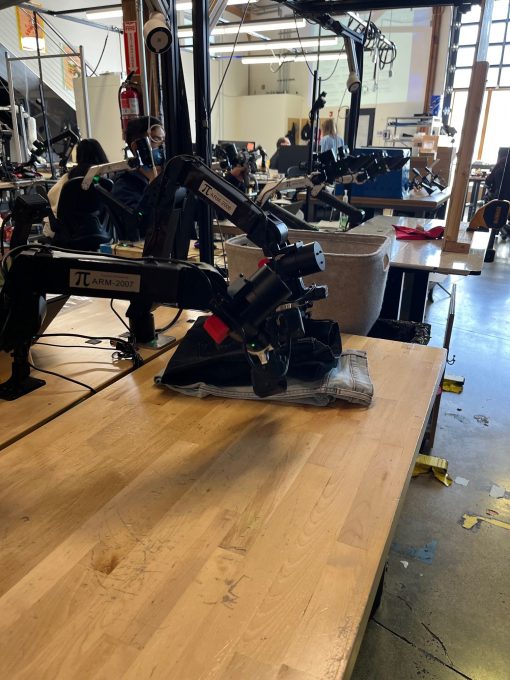
Inside, the space is a giant concrete box made slightly less austere by a haphazard sprawl of long blonde-wood tables. Some are clearly meant for lunch, dotted with Girl Scout cookie boxes, jars of Vegemite (someone here is Australian), and small wire baskets stuffed with one too many condiments. The rest of the tables tell a different story entirely. Many more of them are laden with monitors, spare robotics parts, tangles of black wire, and fully assembled robotic arms in various states of attempting to master the mundane.
During my visit, one arm is folding a pair of black pants, or trying to. It’s not going well. Another is attempting to turn a shirt inside out with the kind of determination that suggests it will eventually succeed, just not today. A third – this one seems to have found its calling – is quickly peeling a zucchini, after which it is supposed to deposit the shavings into a separate container. The shavings are going well, at least.
“Think of it like ChatGPT, but for robots,” Sergey Levine tells me, gesturing toward the motorized ballet unfolding across the room. Levine, an associate professor at UC Berkeley and one of Physical Intelligence’s cofounders, has the amiable, bespectacled demeanor of someone who has spent considerable time explaining complex concepts to people who don’t immediately grasp them.

What I’m watching, he explains, is the testing phase of a continuous loop: data gets collected on robot stations here and at other locations — warehouses, homes, wherever the team can set up shop — and that data trains general-purpose robotic foundation models. When researchers train a new model, it comes back to stations like these for evaluation. The pants-folder is someone’s experiment. So is the shirt-turner. The zucchini-peeler might be testing whether the model can generalize across different vegetables, learning the fundamental motions of peeling well enough to handle an apple or a potato it’s never encountered.
The company operates test kitchens in this building and elsewhere, including people’s homes, Levine says, using off-the-shelf hardware to expose the robots to different environments and challenges. There’s a sophisticated espresso machine nearby, and I assume it’s for the staff until Levine clarifies that no, it’s there for the robots to learn. Any foamed lattes are data, not a perk for the dozens of engineers on the scene who are mostly peering into their computers or hovering over their mechanized experiments.
The hardware itself is deliberately unglamorous. These arms sell for about $3,500, and that’s with what Levine describes as “an enormous markup” from the vendor. If they manufactured them in-house, the material cost would drop below $1,000. A few years ago, he says, a roboticist would have been shocked these things could do anything at all. But that’s the point – good intelligence compensates for bad hardware.
Techcrunch event
Boston, MA
|
June 23, 2026
As Levine excuses himself, I’m approached by Lachy Groom, moving through the space with the purposefulness of someone who has half a dozen things happening at once. At 31, Groom still has the fresh-faced quality of Silicon Valley’s boy wonders, a designation he earned early, having sold his first company nine months after starting it at age 13 in his native Australia (this explains the Vegemite).
When I first approached him earlier, as he welcomed a small gaggle of sweatshirt-wearing visitors into the building, his response to my request for time with him was immediate: “Absolutely not, I’ve got meetings.” Now he has ten minutes, maybe.
He found what he was looking for when he started following the academic work coming out of the labs of Levine and Chelsea Finn, a former Berkeley PhD student of Levine’s who now runs her own lab at Stanford focused on robotic learning. Their names kept appearing in everything interesting happening in robotics. When he heard rumors they might be starting something, he tracked down Karol Hausman, a Google DeepMind researcher who also taught at Stanford and who Groom had learned was involved. “It was just one of those meetings where you walk out and it’s like, This is it.”
Groom never intended to become a full-time investor, he tells me, even though some might wonder why not given his track record. After leaving Stripe, where he was an early employee, he spent roughly five years as an angel investor, making early bets on companies like Figma, Notion, Ramp, and Lattice while searching for the right company to start or join himself. His first robotics investment, Standard Bots, came in 2021 and reintroduced him to a field he’d loved as a kid building Lego Mindstorms. As he jokes, he was “on vacation much more as an investor.” But investing was just a way to stay active and meet people, not the endgame. “I was looking for five years for the company to go start post-Stripe,” he says. “Good ideas at a good time with a good team – [that’s] extremely rare. It’s all execution, but you can execute like hell on a bad idea, and it’s still a bad idea.”

The two-year-old company has now raised over $1 billion, and when I ask about its runway, he’s quick to clarify it doesn’t actually burn that much. Most of its spending goes toward compute. A moment later, he acknowledges that under the right terms, with the right partners, he’d raise more. “There’s no limit to how much money we can really put to work,” he says. “There’s always more compute you can throw at the problem.”
What makes this arrangement particularly unusual is what Groom doesn’t give his backers: a timeline for turning Physical Intelligence into a money-making endeavor. “I don’t give investors answers on commercialization,” he says of backers that include Khosla Ventures, Sequoia Capital and Thrive Capital among others that have valued the company at $5.6 billion. “That’s sort of a weird thing, that people tolerate that.” But tolerate it they do, and they may not always, which is why it behooves the company to be well-capitalized now. Not because it needs to be, but because it enables the team to make long-term decisions without compromise.
Quan Vuong, another cofounder who came from Google DeepMind, explains that the strategy revolves around cross-embodiment learning and diverse data sources. If someone builds a new hardware platform tomorrow, they won’t need to start data collection from scratch – they can transfer all the knowledge the model already has. “The marginal cost of onboarding autonomy to a new robot platform, whatever that platform might be, it’s just a lot lower,” he says.
The company is already working with a small number of companies in different verticals – logistics, grocery, a chocolate maker across the street – to test whether their systems are good enough for real-world automation. Vuong claims that in some cases, they already are. With their “any platform, any task” approach, the surface area for success is large enough to start checking off tasks that are ready for automation today.
Physical Intelligence isn’t alone in chasing this vision. The race to build general-purpose robotic intelligence – the foundation on which more specialized applications can be built, much like the LLM models that captivated the world three years ago – is heating up. Pittsburgh-based Skild AI, founded in 2023, just this month raised $1.4 billion at a $14 billion valuation and is taking a notably different approach. While Physical Intelligence remains focused on pure research, Skild AI has already deployed its “omni-bodied” Skild Brain commercially, saying it generated $30 million in revenue in just a few months last year across security, warehouses, and manufacturing.

Skild has even taken public shots at competitors, arguing on its blog that most “robotics foundation models” are just vision-language models “in disguise” that lack “true physical common sense” because they rely too heavily on internet-scale pretraining rather than physics-based simulation and real robotics data.
It’s a pretty sharp philosophical divide. Skild AI is betting that commercial deployment creates a data flywheel that improves the model with each real-world use case. Physical Intelligence is betting that resisting the pull of near-term commercialization will enable it to produce superior general intelligence. Who’s ‘more right’ will take years to resolve.
In the meantime, Physical Intelligence operates with what Groom describes as unusual clarity. “It’s such a pure company. A researcher has a need, we go and collect data to support that need – or new hardware or whatever it is – and then we do it. It’s not externally driven.” The company had a 5-to-10-year roadmap of what the team thought would be possible. By month 18, they’d blown through it, he says.
The company has about 80 employees and plans to grow, though Groom says hopefully “as slowly as possible.” What’s the most challenging, he says, is hardware. “Hardware is just really hard. Everything we do is so much harder than a software company.” Hardware breaks. It arrives slowly, delaying tests. Safety considerations complicate everything.
As Groom springs up to rush to his next commitment, I’m left watching the robots continue their practice. The pants are still not quite folded. The shirt remains stubbornly right-side-out. The zucchini shavings are piling up nicely.
There are obvious questions, including my own, about whether anyone actually wants a robot in their kitchen peeling vegetables, about safety, about dogs going crazy at mechanical intruders in their homes, about whether all of the time and money being invested here solves big enough problems or creates new ones. Meanwhile, outsiders question the company’s progress, whether its vision is achievable, and if betting on general intelligence rather than specific applications makes sense.
If Groom has any doubts, he doesn’t show it. He’s working with people who’ve been working on this problem for decades and who believe the timing is finally right, which is all he needs to know.
Besides, Silicon Valley has been backing people like Groom and giving them a lot of rope since the beginning of the industry, knowing there’s a good chance that even without a clear path to commercialization, even without a timeline, even without certainty about what the market will look like when they get there, they’ll figure it out. It doesn’t always work out, but when it does, it tends to justify a lot of the times it didn’t.
Tech
Blue Origin successfully re-uses a New Glenn rocket for the first time ever

Blue Origin has successfully reused one of its New Glenn rockets for the first time ever, marking a major milestone for the heavy-launch system as Jeff Bezos’ space company looks to compete with Elon Musk’s SpaceX.
But the overall mission’s success may be in question. Roughly two hours after the launch, Blue Origin revealed that the communications satellite that New Glenn carried to space for AST SpaceMobile wound up in an “off-nominal orbit,” meaning something may have gone wrong with the rocket’s upper stage. In other words, it appears the company missed the mark.
“We have confirmed payload separation. AST SpaceMobile has confirmed the satellite has powered on,” the company wrote on X. “We are currently assessing and will update when we have more detailed information.”
AST later said Blue Origin’s rocket placed its satellite into an orbit that was “lower than planned,” so the satellite will have to be de-orbited.
According to a timeline provided by Blue Origin prior to the launch, the upper stage of New Glenn should have performed a second burn roughly one hour after the rocket lifted off from Cape Canaveral, Florida. It’s unclear if that second burn ever happened, or if there were other problems with it, before the AST satellite was deployed.
The company accomplished the re-use feat Sunday on just the third-ever launch of New Glenn, and a little more than one year after the first flight of the new rocket system, which has been in development for more than a decade.
Making New Glenn reusable is crucial to its economics. SpaceX’s ability to re-fly Falcon 9 rocket boosters is one of the main reasons why it has come to dominate the global orbital launch market.
Techcrunch event
San Francisco, CA
|
October 13-15, 2026
While Blue Origin has already sent a commercial payload to space with New Glenn — Sunday was the second-such mission — the company wants to use the rocket for NASA moon missions, and to help both it and Amazon build space-based satellite networks. Blue Origin is currently finishing getting its first robotic moon lander ready for an attempted launch later this year.
The booster that Blue Origin re-flew on Sunday was the same one the company used in the second New Glenn mission in November. During that mission, the New Glenn booster helped put two robotic NASA spacecraft into space for a mission to Mars, before returning to a drone ship in the ocean. On Sunday, Blue Origin recovered the rocket booster a second time on a drone ship roughly 10 minutes after takeoff.
Any trouble deploying AST’s satellite could present a risk to Blue Origin’s near-term plans for New Glenn. Blue Origin has a deal with the communications company to send multiple satellites to orbit over the next few years as it works to build out its own space-based cellular broadband network.
This story has been updated with new information from Blue Origin and AST SpaceMobile.
Tech
Cracks are starting to form on fusion energy’s funding boom
It happens in every emerging industry: founders and investors push toward a common goal, until the money starts to roll in and that shared vision begins to diverge.
Cracks are emerging in the fusion power world, which I saw firsthand at The Economist’s Fusion Fest in London last week. It didn’t dampen the overall buoyant mood, lifted by fusion startups’ fundraising haul of $1.6 billion in the last 12 months. But people had differing opinions on two key questions: When should fusion startups go public? And are side businesses a distraction?
Going public was at the top of everyone’s minds. In the last four months, TAE Technologies and General Fusion have announced plans to merge with publicly traded companies. Both stand to receive hundreds of millions of dollars to keep their R&D efforts alive, and investors, some of whom have kept the faith for 20 years, finally see an opportunity to cash out.
Not everyone is in agreement. Most of those who I spoke to were worried these companies were going public far too early and that they hadn’t achieved key milestones that many view as vital in judging the progress of a fusion company.
First, a recap: TAE announced its merger with Trump Media & Technology Group in December. Though the deal isn’t yet completed, the fusion side of the business has already received $200 million of a potential $300 million in cash from the deal, giving it some runway to continue planning its power plant. (The remainder will reportedly land in its bank account once it files the S-4 form with the U.S. Securities and Exchange Commission.)
General Fusion said in January that it would go public via a reverse merger with a special purpose acquisition company. The deal could net the company $335 million and value the combined entity at $1 billion.
Both companies could use the cash.
Techcrunch event
San Francisco, CA
|
October 13-15, 2026
Before the merger announcement, General Fusion was struggling to raise funds, and around this time last year it laid off 25% of its staff as CEO Greg Twinney posted a public letter pleading for investment. It received a brief reprieve in August when investors threw it a $22 million lifeline, but that sort of money doesn’t last long in the fusion world, where equipment, experiments, and employees don’t come cheap.
TAE’s position wasn’t quite as dire, but it still required some funds. Pre-merger, the company raised nearly $2 billion, which sounds like a lot, but keep in mind the company is nearly 30 years old. What’s more, its valuation pre-merger was $2 billion, according to PitchBook. Investors were breaking even at best.
Neither company has hit scientific breakeven, a key milestone that shows a reactor design has power plant potential. Many observers doubt they’ll hit that mark before other privately held startups do. One executive told me, if they were in those shoes, they’re not sure how they would fill time on quarterly earnings calls if the companies didn’t hit scientific breakeven soon.
If TAE or General Fusion doesn’t deliver results, several people feared the public markets would sour on the entire fusion industry.
Now, not all may be lost. TAE has already started marketing other products, including power electronics and radiation therapy for cancer. That could give the company some near-term revenue to placate shareholders. General Fusion, though, hasn’t revealed any such plans.
And therein lies another divide: fusion companies remain split on whether they should pursue revenue now or wait until they have a working power plant.
Some companies are embracing the opportunity to make money along the way. Not a bad strategy! Fusion is a long game, so why not improve your odds? Both Commonwealth Fusion Systems and Tokamak Energy have said they’ll be selling magnets. TAE and Shine Technologies are both in nuclear medicine.
Other startups are worried that side hustles could become a distraction. Inertia Enterprises, for example, told me that they’re laser-focused on their power plant. That jibes with what another investor told me months ago: — they were worried that fusion startups could get distracted by profitable, but tangential businesses and fall off the lead.
There wasn’t consensus on the right time to go public either. I heard a few proposed milestones. Some believe startups should first reach that scientific breakeven milestone, in which a fusion reaction generates more energy than it needs to ignite. No startup has achieved that yet. The other possibilities are facility breakeven — when the reactor makes more energy than the entire site needs to operate — and commercial viability — when a reactor makes enough electrons to sell a meaningful amount to the grid.
We may have an answer to that question sooner than later. Commonwealth Fusion Systems expects it will hit scientific breakeven sometime next year, and some think the company might use that as an opportunity to go public.
Tech
TechCrunch Mobility: Uber enters its assetmaxxing era
Welcome back to TechCrunch Mobility, your hub for the future of transportation and now, more than ever, how AI is playing a part. To get this in your inbox, sign up here for free — just click TechCrunch Mobility!
A few weeks ago, I wrote about how Uber seemed to be everywhere, all at once in the emerging autonomous vehicle technology sector. The Financial Times has now put a number on it. The FT calculated that Uber has committed more than $10 billion to buying autonomous vehicles and taking equity stakes in the companies developing the tech, according to public records and discussions with folks behind the scenes. About $2.5 billion of that is in direct investments, with the remaining $7.5 billion to be spent on buying robotaxis over the next few years, the outlet reported.
We’ve reported on Uber’s numerous investments and deals with autonomous vehicle companies across drones, robotaxis, and freight. Some of its investments include WeRide, Lucid and Nuro, Rivian, and Wayve.
This rather large number (and particularly that $7.5 billion) got me thinking about another transformative era in Uber’s history and how it has visited these asset-heavy shores before. Uber might have started with a plan to be asset light, but for a brief period it did quite the opposite.
Uber went on a moonshot spree between 2015 and 2018. It launched electric air taxi developer Uber Elevate and the in-house autonomous vehicle unit Uber ATG, which would be boosted by its acquisition of Otto in 2016. It also snapped up micromobility startup Jump in 2018.
And then in 2020, Uber pulled the asset-heavy rip cord, ostensibly leaving all of those moonshots behind. Uber sold Uber ATG to Aurora, Jump to Lime, and Elevate to Joby Aviation. But it didn’t completely divest; it kept equity stakes in all of them.
Uber is now entering into a new and different asset-heavy era. It’s not plunking down millions, or even billions, to develop the technology in-house, although I’m sure folks there would be quick to pipe up that there is always R&D happening over at Uber. Instead, it appears to be focused on owning (or perhaps leasing) the physical assets.
Techcrunch event
San Francisco, CA
|
October 13-15, 2026
That could mean interesting line items on Uber’s balance sheet in the future.
Owning fleets of robotaxis built by other companies might not have been the original vision of Uber, or its former CEO Travis Kalanick, who has said the company made a mistake when it abandoned its AV development program. But this new approach could still get it to the same end point.
A little bird

Earlier this month, I interviewed Eclipse partner Jiten Behl about the venture firm’s new $1.3 billion fund and where that money might be headed. The firm, as I wrote, intends to incubate more startups (e.g., it was behind the Rivian spinout Also). Behl wouldn’t give me details, only stating, “We’re definitely working on a couple of really cool ideas.” He also said Eclipse is particularly interested in startups that work across enterprises.
Thanks to one little bird and some document diving by senior reporter Sean O’Kane, it looks like a seed round announcement is imminent for a San Francisco-based startup working on an autonomous hauler that I’ve been told doesn’t have a driver cab. This sounds similar to what Einride has built, but since we haven’t seen it, we’ll have to wait.
The company’s roster isn’t big, but it is chock-full of Silicon Valley tech elite, including a founder who was at Uber ATG, Pronto, and Waabi. Stay tuned for more.
Got a tip for us? Email Kirsten Korosec at kirsten.korosec@techcrunch.com or my Signal at kkorosec.07, or email Sean O’Kane at sean.okane@techcrunch.com.
Deals!

Slate is back with more capital as it prepares to put its first affordable pickup trucks into production by the end of 2026.
The electric vehicle startup, which got its start with backing from Jeff Bezos, raised another $650 million in a Series C funding round led by TWG Global. Keep your eye on TWG. This is the firm run by Guggenheim Partners chief executive (and Los Angeles Dodgers owner) Mark Walter and investor Thomas Tull.
Slate has raised about $1.4 billion to date, and its previous investors include General Catalyst, Jeff Bezos’ family office, VC firm Slauson & Co., and former Amazon executive Diego Piacentini, as TechCrunch first reported last year.
Other deals that got my attention …
Glydways, a San Francisco-based startup developing personal autonomous pods designed to operate on dedicated 2-meter-wide lanes in cities, raised $170 million in a Series C funding round co-led by Suzuki Motor Corporation, ACS Group, and Khosla Ventures. Existing investors Mitsui Chemicals and Gates Frontier and new investor Obayashi Corporation also participated. But wait, there’s more.
GM and Ford are reportedly talking to the Pentagon about whether the auto industry can help the military revamp its procurement program and find cheaper, faster ways to buy vehicles, munitions, or other hardware, the New York Times reported, citing anonymous sources.
Loop, a San Francisco-based startup, raised $95 million in a Series C funding round led by Valor Equity Partners and the Valor Atreides AI Fund, and includes investments from 8VC, Founders Fund, Index Ventures, and J.P. Morgan’s late-stage fund, Growth Equity Partners.
Monarch Tractor, the startup developing electric, autonomous tractors, has moved on to (ahem) a different pasture. The startup’s assets have been acquired by Caterpillar after struggling to pivot to a software services business.
Uber is increasing its stake in Delivery Hero by 4.5%, the Financial Times reported. Uber agreed to buy about 270 million euros in shares from Prosus, the Dutch investment group and Delivery Hero’s largest shareholder.
Notable reads and other tidbits

Doug Field, the high-profile executive who shaped Ford’s electric vehicle and technology strategies over the past five years, is leaving. Notably, Ford is shaking up the organization as well, creating a “product creation and industrialization” team to be led by COO Kumar Galhotra. Any guesses where Field is headed next? Perhaps he’ll return to Silicon Valley.
Lightship, the all-electric RV startup, is expanding its Colorado-based factory by another 44,000 square feet, which will allow it to quadruple its manufacturing capacity.
Rivian and battery recycling and materials startup Redwood Materials partnered years ago. We’re now seeing the fruits of that relationship. Redwood is installing battery energy storage at Rivian’s factory in Illinois. The catch? Redwood is using 100 second-life Rivian battery packs, which will provide 10 megawatt-hours (MWh) of dispatchable energy to reduce cost and grid load during peak demand periods.
Tesla created a new self-driving app that makes it easier for owners to subscribe to its Full Self-Driving software and see statistics on how — and how often — they use it. This may not be huge news, but it did catch my eye because of the gamified qualities of these new stats.
Waymo, as per usual, has a few news items this week. The Alphabet-owned company started testing its autonomous vehicles on public roads in London. It also removed its waitlist in Miami and Orlando to scale its robotaxi services in the two cities.
One more thing …
This newsletter isn’t my only project that is leaning more heavily into robotics. My podcast, the Autonocast, is too, as the worlds of autonomous vehicles, AI, and robotics mash together. Check out this interview with Foxglove founder Adrian MacNeil, who previously worked at Cruise.

Reds RHP Brady Singer 'good' to go against Twins
Skidding Mets make pitching change ahead of series finale vs. Cubs


