
Tech
Cohere claims its new Aya Vision AI model is best-in-class
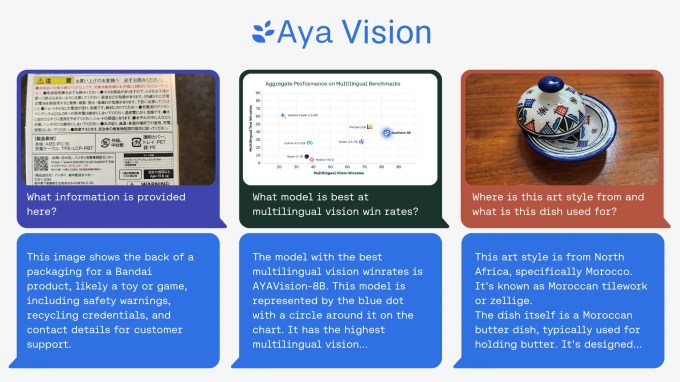
Cohere for AI, AI startup Cohere’s nonprofit research lab, this week released a multimodal “open” AI model, Aya Vision, the lab claimed is best-in-class.
Aya Vision can perform tasks like writing image captions, answering questions about photos, translating text, and generating summaries in 23 major languages. Cohere, which is also making Aya Vision available for free through WhatsApp, called it “a significant step towards making technical breakthroughs accessible to researchers worldwide.”
“While AI has made significant progress, there is still a big gap in how well models perform across different languages — one that becomes even more noticeable in multimodal tasks that involve both text and images,” Cohere wrote in a blog post. “Aya Vision aims to explicitly help close that gap.”
Aya Vision comes in a couple of flavors: Aya Vision 32B and Aya Vision 8B. The more sophisticated of the two, Aya Vision 32B, sets a “new frontier,” Cohere said, outperforming models 2x its size including Meta’s Llama-3.2 90B Vision on certain visual understanding benchmarks. Meanwhile, Aya Vision 8B scores better on some evaluations than models 10x its size, according to Cohere.
Both models are available from AI dev platform Hugging Face under a Creative Commons 4.0 license with Cohere’s acceptable use addendum. They can’t be used for commercial applications.
Cohere said that Aya Vision was trained using a “diverse pool” of English datasets, which the lab translated and used to create synthetic annotations. Annotations, also known as tags or labels, help models understand and interpret data during the training process. For example, annotation to train an image recognition model might take the form of markings around objects or captions referring to each person, place, or object depicted in an image.

Cohere’s use of synthetic annotations — that is, annotations generated by AI — is on trend. Despite its potential downsides, rivals including OpenAI are increasingly leveraging synthetic data to train models as the well of real-world data dries up. Research firm Gartner estimates that 60% of the data used for AI and analytics projects last year was synthetically created.
According to Cohere, training Aya Vision on synthetic annotations enabled the lab to use fewer resources while achieving competitive performance.
“This showcases our critical focus on efficiency and [doing] more using less compute,” Cohere wrote in its blog. “This also enables greater support for the research community, who often have more limited access to compute resources.”
Together with Aya Vision, Cohere also released a new benchmark suite, AyaVisionBench, designed to probe a model’s skills in “vision-language” tasks like identifying differences between two images and converting screenshots to code.
The AI industry is in the midst of what some have called an “evaluation crisis,” a consequence of the popularization of benchmarks that give aggregate scores that correlate poorly to proficiency on tasks most AI users care about. Cohere asserts that AyaVisionBench is a step toward rectifying this, providing a “broad and challenging” framework for assessing a model’s cross-lingual and multimodal understanding.
With any luck, that’s indeed the case.
“[T]he dataset serves as a robust benchmark for evaluating vision-language models in multilingual and real-world settings,” Cohere researchers wrote in a post on Hugging Face. “We make this evaluation set available to the research community to push forward multilingual multimodal evaluations.”
Tech
Marc Lore says that AI will soon enable anyone open a restaurant

Marc Lore, the veteran e-commerce entrepreneur who sold his previous startups to Amazon and Walmart, has big plans to infuse AI into his current venture, Wonder.
The centerpiece of those plans is Wonder Create, an initiative that would let anyone — from food entrepreneurs to social media influencers — use AI to design and launch their own restaurant brand in under a minute. The virtual restaurant would then go live across Wonder’s growing network of tech-enabled kitchen locations, currently numbering 120 and expected to reach 400 next year.
Lore’s startup, a vertically integrated dining and delivery platform, has evolved from food trucks to fast casual restaurants with 10 to 20 seats. These are not normal restaurants, though; they are “programmable cooking platforms” capable of operating as 25 different types of restaurants based on cuisine, within their all-electric kitchens that are increasingly becoming robotic.
Speaking at The Wall Street Journal’s “Future of Everything” conference this week, Lore said these kitchens have a 700-ingredient library. The “restaurants” they house actually consist of many different brands that operate from within these locations.
In addition to a staff of up to 12 people in these kitchens, cooking tech, like conveyors and robotic arms, are involved in the cooking process. The company also just bought Spice Robotics, a maker of an automatic bowl-making machine previously used by Sweetgreen. Next year, it plans to offer an “infinite sauce machine” that can make bout 80% of all the sauces found in recipes on the internet today.
Wonder Create was announced earlier this year as a way for anyone to use Wonder’s software to launch their own restaurant brand and recipes.
Lore offered more details as how this would work by leveraging AI technology, describing the plan as something like a “Shopify front-end with an AI prompt.”
Techcrunch event
San Francisco, CA
|
October 13-15, 2026
“You type in what kind of restaurant you want to build. It builds the restaurant — AI does — in under a minute. It does the name, branding, description, pictures, pricing, health information, and all the recipes for your restaurant,” Lore explained during an interview at the WSJ event. The would-be restaurateur could then refine the prompt if changes were needed. When ready to go live, the restaurant would launch across all of Wonder’s locations.
The company currently has 120 of these “programmable cooking platforms” in operation, a number that’s expected to grow to 400 next year. As it adds robotics to the equation, the company won’t necessarily reduce headcount, Lore noted. Instead, it will increase the number of meals a kitchen can produce in a given period.
“We have about 7 million throughput capacity with 12 people,” he said. “We see a path to getting to 20 million throughput out of 2,500 square feet with just 12 people. The goal also is…I guess by 2035, to have 1,000 unique restaurants operating out of the 2,500 square feet,” Lore added.
The goal with these AI-created “restaurants” is to allow people to experiment with food in new ways. A restaurateur could test recipes to gauge customer reaction before adding dishes to his own brick-and-mortar locations, for example.
Lore sees other use cases for the platform, too, like letting influencers connect with their audience through their own “restaurant” brands without having to actually launch their own chains.
“It could be a mega-influencer, a micro-influencer — anyone that wants to monetize their following,” Lore said. “Or it could be a private trainer that wants to make specific bowls. It could be a not-for-profit. It could be Disney for [marketing] their new movie. Anybody can make a restaurant.”
Whether that many people actually want to is an open question. Ghost kitchens — a similar concept that promised to let brands sell food without owning a restaurant — had a rocky run in the early 2020s, with several high-profile operators scaling back or shutting down after struggling to build customer loyalty. Wonder’s added layer of automation and AI may address some of those pitfalls, but the model is still unproven at scale.
MrBeast Burger, a famous ghost kitchen experiments, vividly illustrated the challenge. The brand faced widespread complaints over inconsistent food quality — a consequence of relying on dozens of different contracted kitchens and staff. Wonder’s programmable, increasingly automated kitchens are designed to solve exactly that problem.
There are still limits to this idea, Lore admitted. Wonder’s team (including its robots) can’t do things like toss and stretch pizza dough or slice and roll sushi. Instead, Wonder’s focus is on simpler basics like burgers, chicken wings, fried chicken, and bowls.
The whole plan comes together with Lore’s other acquisitions — Grubhub for its 250 million-deliveries-per-year business and Blue Apron for its meal kit business. Now, Wonder is focused on buying restaurant brands, like New York City-based Blue Ribbon Fried Chicken, which it snapped up for $6.5 million in February.
“When you buy a brand — and you can buy a brand that has 10 locations, or even 50 locations — and then overnight put it in 1,000, there’s just an incredible arbitrage there,” Lore noted.
When you purchase through links in our articles, we may earn a small commission. This doesn’t affect our editorial independence.
Tech
Peter Sarlin’s QuTwo reaches $380M valuation in angel round
QuTwo, the Finnish AI lab founded by former AMD Silo AI CEO Peter Sarlin, is now valued at €325 million (approximately $380 million) after raising a €25 million angel round ($29 million). It’s a sign of enduring tailwinds for AI, quantum computing, and sovereign tech, especially for Europe-made companies.
QuTwo’s name is a nod to quantum computing, but it hasn’t gone all-in on quantum. Its core product, QuTwo OS, is an orchestration layer that directs tasks to classical, quantum or hybrid architectures — with the idea that enterprise use cases are often best served by “quantum-inspired” computing, which uses classical chips to simulate quantum behavior on more reliable hardware.
Enterprise AI will be QuTwo’s bread and butter. The company already secured some $23 million in committed revenue thanks to design partnerships with the likes of retail giant Zalando, for which it helped develop AI assistants. “AI is the North Star that we will continue to aim for. Quantum is just a new type of compute,” said Sarlin, who is adamant that QuTwo is an AI company.
Momentum has been building around Europe-based AI labs, and several of them have become overnight unicorns. Just last week, former DeepMind researcher David Silver secured $1.1 billion for his new endeavor, Ineffable Intelligence. QuTwo’s valuation and round size are somewhat modest in comparison but will let it pursue its roadmap under less pressure.
According to Sarlin, who serves as QuTwo’s executive chairman, this was a decision he also made for his previous company, Silo AI, which AMD acquired for $665 million in 2024. “I had a lot of investors who would have wanted to pour a lot of money into making Silo into Europe’s OpenAI, but I didn’t believe in that play,” he told TechCrunch.
The main difference is that QuTwo wants the freedom to think long term, with a five- to ten-year horizon. “We are on a mission to build the globally leading AI company for the next paradigm, given that Europe did not succeed in building the AI company for this era,” Sarlin said.
It’s not that Sarlin is bearish on European AI, of which he is a prolific backer. Nor is he necessarily critical of extra-large rounds — he volunteered that he is also an investor in Yann LeCun’s Ami Labs, which raised $1.03 billion, and in British-American venture Recursive Superintelligence, which is rumored to be following the same path. But he didn’t see a billion-dollar round as the right fit for QuTwo — nor VC money, at least for now.
Techcrunch event
San Francisco, CA
|
October 13-15, 2026
Until recently, QuTwo was solely funded through Sarlin’s family office, PostScriptum, which also incubated NestAI, the other company where he serves as executive chairman. But whereas NestAI raised some $115 million in a funding round led by Finland’s sovereign fund and Nokia, QuTwo wasn’t seeking to raise external funding.
However, when the lab’s soft launch generated significant interest earlier this year, Sarlin decided he would say no to checks from VCs and strategic investors, but yes to an angel round in part due to the geopolitical moment Europe is currently navigating.
With Europe increasingly looking to favor local alternatives to U.S. tech providers, there are tailwinds for AI made in Finland. But there is also investor appetite for a company that promises to facilitate more ambitious R&D initiatives in the fields where the region already has strong players, such as the automotive, life sciences and gaming sectors.
Conversely, Sarlin expects that QuTwo’s angel investors could open doors across Europe. There are definitely quite a few introductions he could request from this group, which includes Yuri Milner, Xavier Niel, Nico Rosberg, Dieter Schwarz and Niklas Zennström, and as well as many startup founders from Hugging Space, Legora, Miro, Skype, Supercell, Wolt, and more.
This will also support QuTwo’s growth. It recently expanded into Sweden, and has been hiring. According to Sarlin, some 50 quantum and AI scientists have joined the team, which includes two other second-time entrepreneurs: his former cofounder at Silo, Kaj-Mikael Björk; and Kuan Yen Tan, a cofounder at IQM, the Finnish quantum company that is set to go public.
QuTwo’s connection with IQM is also a reminder that the company believes we are about to enter the quantum era — it just can’t wait. “The question for repeat founders like [us] is how can we have even a larger impact. In the long term, it’s important for Europe that we build the AI company for the next paradigm out of Europe. But, in the short term, we can have a significant impact in driving ambitious R&D moon shots in Europe,” Sarlin said.
When you purchase through links in our articles, we may earn a small commission. This doesn’t affect our editorial independence.
Tech
reMarkable’s new Paper Pure tablet goes back to basics with a monochrome screen
After exploring the bigger market for productivity tablets featuring color displays with the Paper Pro and the smaller Paper Pro Move, E Ink tablet maker reMarkable is returning to its roots with a new monochrome device called the Paper Pure.
The new, $399 Paper Pure succeeds the monochrome reMarkable 2 after six years, and comes with more powerful hardware as well as modern software features that make it competitive in today’s tablet market.
The Paper Pure has a 10.3-inch display when measured diagonally, the same as the reMarkable 2, but the new one is wider, which, the company says, makes it easier to take notes and read text. Notably, the resolution hasn’t changed between the two tablets, staying at 1872 x 1404 pixels with a pixel density of 226 PPI.
The tablet also comes with 32GB of storage, four times the amount you got on its predecessor, and is also about 40 grams lighter, weighing 360 grams.

ReMarkable said the Paper Pure is 50% more responsive than the reMarkable 2, and offers 30% more battery life with its 3,820 mAh battery.
The company has added a slew of new features to the tablet to bring it up to par with modern productivity tools, including support for a web app. The Paper Pure lets you sync your calendar, as well as take and share notes for a particular meeting. And if you import documents from cloud storage services, the online sync service will automatically convert them into a notebook suited for reading and annotating on the tablet itself. The company said it also comes with better handwriting search capabilities.
The Paper Pure integrates with Slack, too, so you can convert handwritten notes into typed text that you can share. It also integrates with collaboration tool Miro, letting you share sketches and the like.
Techcrunch event
San Francisco, CA
|
October 13-15, 2026
The Norwegian company said it now plans to sunset production of the reMarkable 2, but will still offer software updates and support to existing customers.
The Paper Pure’s base model comes bundled with a stylus, and the costlier $449 version gets you a fancier stylus, dubbed Marker Plus, that includes an eraser function, plus a sleeve folio in various colors. Users can order the device starting today, and shipping is expected to start in early June.
The company said it has sold more than 3.5 million devices so far, and that it has 1.2 million subscribers for its Connect service, which offers unlimited cloud storage, exclusive templates, and the ability to create links to share notes or sketches.
When you purchase through links in our articles, we may earn a small commission. This doesn’t affect our editorial independence.

Snag a pair of Bose QuietComfort Ultra headphones for $50 off
Score up to 64% off at EcoFlow and snag free solar panels with your purchase.


