
Entertainment
How Delusional Greed Killed Halo's Shot At A Movie And Ruined The Franchise

Wondering why the Halo TV show was so bad? Blame Bill Gates.
By Joshua Tyler
| Updated

On November 15th, 2001, Microsoft released Halo: Combat Evolved. Developed by Bungie and published by Microsoft Game Studios, the game was first released for the Xbox console. In 2003, Microsoft released versions for Windows and Mac OS.
Since then, Microsoft has released numerous Halo games, books, shorts and most recently a television show. Halo has turned into a globe-spanning franchise with legions of fans.
Yet, as evidenced by the recent attempt at a budget-friendly Halo TV show on Paramount+, Microsoft still has no idea at all what to do with it. The TV series was a cheaply made disaster that ignored everything good about the franchise in order to save money and showcase its stars. Though the show got two seasons, it was viciously hated and mocked by fans throughout all of them.
It didn’t have to be this way. Back in 2005 Microsft went to work on a Halo movie, a movie that could have delivered everything the space franchise’s fans have been waiting for. Unfortunatley, fourteen years later, no Halo movie.
Want to know what went wrong? Keep reading to find out why the Halo movie never happened and why we got that terrible Halo TV show instead.
Microsoft First Starts Work On A Halo Movie In 2005

After the success of Halo 2, Microsoft wanted more for the Halo series. The company’s plan involved turning the game into a movie. They knew they had something big on their hands. As such, they could make lots of cash from box office sales. Not only that, they thought a Halo movie would increase sales for their Xbox consoles.
To actualize its Halo movie dream, Microsoft commissioned the writing of a full script. They paid acclaimed 28 Days Later screenwriter Alex Garland a whopping $1 million to complete the script, and he delivered. Microsoft “supervised” the screenplay because they wanted to make sure it was about their successful Halo game series.
Alex Garland was hired to write the Halo movie script in February 2005 and finished the first draft in June of the same year. In 2005 the title of the first movie, Halo, and the script were ready. Various producers and directors were also attached to the film.
Microsoft approached Creative Artists Agency about its Halo movie ambitions. It was such a big deal and thought to be such a certain moneymaker that an auction was set by CAA agents Roland Emmerich and Michael Wimer. After Michael Wimer had the Halo script, he contacted major studios and requested they bid to get it.
Multiple Master Chiefs March On Hollywood, Creating A Real-Life Halo Spectacle

To up the ante, actors dressed as Halo’s main character, Master Chief, visited the offices of the Creative Artists Agency to pick up and deliver scripts to major Hollywood studios. Around midday on June 6th, 2005, they marched through the streets of Hollywood in costume and arrived at the studios in their red, blue, and green Spartan armor.
It was a massive spectacle, one heavily talked about and covered by the then-still flourishing independent entertainment news industry. Everyone was excited, everyone wanted it, and word was that the script they were delivering in such an attention-getting fashion as every bit as good as fans hoped.
It was Larry Shapiro at CAA who came up with the idea that the messengers dress in Master Chief’s armor. He wanted the Halo deal to make headlines, and this stunt seemed like a sure way to make that happen.
Each of the Master Chiefs had a red bound folder with the Creative Artists Agency logo on it. In the folder, there were two things: a terms sheet and a copy of the script/screenplay commissioned by Microsoft. These red-bound folders were delivered to Fox, Universal, Paramount, and others. No script was delivered to Columbia because it is owned by a direct Microsoft competitor, Sony.
The Halo Movie Was The Deal Of The Century

After the delivery of the scripts, they (the various Master Chiefs) waited outside while Studio Execs read the screenplay. Each studio had 24 hours to read the script. Each script came with a term sheet. Since Microsoft was unfamiliar with Hollywood’s culture, they wanted to dictate the terms. They planned to protect the Halo franchise by controlling how their game was portayed.
The clock was ticking. Everyone wanted to know if Hollywood would be ready to make an offer. It was the deal of the century, and everyone expected that the Halo movie would take over Hollywood in the same way the games took over their industry.
Every studio responded, but they tried to negotiate the terms. Only Fox responded with a “Yes” on their term sheet without negotiating.
How Delusional Corporate Greed Killed The Halo Movie

Microsoft demanded $10 million for 15% of the box office gross sales on Halo. This was in addition to a minimum $75 million budget for the film. They also wanted a fast-tracked production and required creative approval over the Halo movie’s director and cast.
The demands did not stop there. Microsoft requested 60 first-class plane tickets for its employees and guests to attend the Halo movie premiere. These were significant demands outside the norm for Hollywood culture. Mind you, Microsoft was not putting any of its money in production. All they were paying was the $1 million already paid for Alex Garland to write the script/screenplay.
Additionally, the company was not willing to sign over any of the Halo merchandising rights.
Microsoft’s enormous demands kept Paramount and others out of the fray. Eventually, Fox and Universal decided to jointly fund the movie. The agreement was that Fox would take foreign box office revenue while Universal took the domestic box office revenue.
Unfortunately, Fox and Universal soon realized that Microsoft was simply too greedy. The numbers didn’t work out. The amount of profit left for Fox and Universal after Microsoft skimmed off the best parts wasn’t enough to move forward with the Halo film.
Greed killed the Halo movie.
The 2005 Halo Movie’s Script Was What Fans Wanted
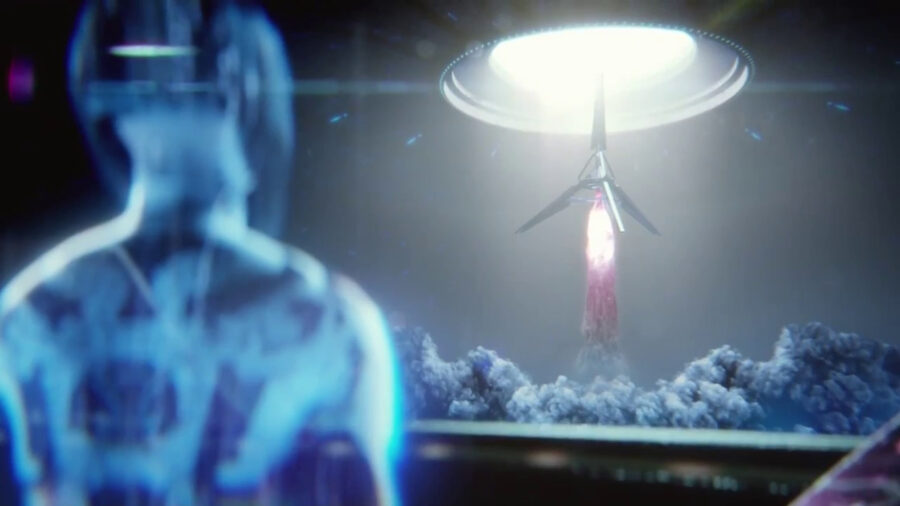
Alex Garland’s Halo movie script laid out a storyline that was basically the entire plot of the original Halo game. The Master Chief, assisted by an AI called Cortana, would fight the Covenant while attempting to save the human race from being pulverized. The story was a direct adaptation of exactly what happened in Halo: Combat Evolved.
In other words, his script was exactly what fans wanted. It was also pretty much the exact opposite of what we call got in the terrible Parmount+ TV show.

Several filmmakers wanted to be part of the Halo movie project. Peter Jackson, director of the Lord of the Rings movies, came on board as a producer in October 2005. Neill Blomkamp (who would later be known for the movie District 9) was to direct the film.
Before Neill, Guillermo del Toro had also been in negotiations. Del Toro passed on the Halo movie opportunity to work on Hellboy 2: The Golden Army. Neil got picked instead. Lord of the Rings special effects gurus WETA Workshop were chosen to handle the Halo movie’s effects.
Neill Blomkamp Tried To Make Halo Cyberpunk

When Neill Blomkamp got hired to direct the Halo movie, he wanted to do something different. Instead of what Microsoft wanted, he wanted a cyberpunk kind of film. He spent five months at WETA coming up with a rewrite for the screenplay. But, Fox did not like the idea and they also knew Microsoft would hate it.
Despite Fox and Microsoft’s objections, the developers of Halo, Bungie, loved the cyberpunk style Blomkamp planned for film. However, due to greed and disagreements with everyone else, Blomkamp’s vision died along with the rest of the project.
Will There Ever Be A Halo Movie?

In 2010, DreamWorks briefly wanted to take a stab at making the Halo movie. Just as Neill had a different vision for the film, DreamWorks also wanted to explore the Halo novels instead of the games. The idea was to sidestep Microsoft and its ties to the game entirely. Sadly, after a few months, they abandoned the idea.
At the moment, there are no plans to make a Halo movie. But, fans got a taste of live-action adaptation of Halo. A web series for Halo 4: Forward Unto Dawn was released followed by DVDs and Blu-ray.
Fans can also enjoy Halo: Nightfall via streaming devices and DVD copies. Although the failure to make the Halo movie was a disappointment to the fans, the game is still exciting. But, it would have been interesting to watch the Neil Blomkamp cyberpunk style movie.
The Halo TV Show Everyone Hates

Eventually, we got a Halo TV series produced by Steven Spielberg’s Amblin Television. If you’ve seen it, you hated it.
The series used almost nothing from the game and ignored the basic fundamentals of the Halo universe. For instance, not only did Master Chief take his helmet off, he almost never wore it. They even failed to get Cortana right. She ended up as a minor character who was never with Master Chief for more than a minute in the show’s entire run.
The Halo TV series seemed to go out of its way to avoid showing anything good. Characters often talked about cool things happening off camera, but aside from three or four minutes of actual style Halo combat (spread throughout the entire two seasons), nothing Halo-like ever happened.
Will There Ever Be A Halo Movie?

In 2010, DreamWorks briefly wanted to take a stab at making the Halo movie. Just as Neill had a different vision for the film, DreamWorks also wanted to explore the Halo novels instead of the games. The idea was to sidestep Microsoft and its ties to the game entirely. Sadly, after a few months, they abandoned the idea.
Now, with the failure of the Halo TV series, it’s unlikely anyone will want to invest time and money in a Halo movie. If you’ve seen the TV series, then you know they didn’t invest much money in that either.
The idea of a Halo movie, is dead, for now. Maybe in a far off future not yet seen, fans will finally get the Halo movie they’ve wanted and deserved.
Entertainment
Apples excellent AirPods Pro 3 are back on sale for just $200 — a $50 savings

SAVE $49.01: The Apple AirPods Pro 3 are 20% at Amazon and Walmart as of April 22. Snag a pair for just $199.99 (normally $249).

$199.99
at Amazon
$249
Save $49.01
Our very own Stan Schroeder is fresh off reviewing the new AirPods Max 2, Apple’s updated over-ear headphones. While he thought their noise cancellation has improved since the last generation, they still can’t block out sounds as well as the AirPods Pro 3: “Wearing them on a busy street makes the outside noise vanish in a spectacular fashion,” he writes of the earbuds.
So, if you’re an Apple user looking for best-in-class ANC, stick with the AirPods Pro 3. Right now, they happen to be on sale for just $199.99 at Amazon and Walmart — that’s a savings of nearly $50 and one of their best deals to date. They briefly hit $184 on Amazon back in February, but never since. (And they were $219.99 everywhere last Black Friday.)
For comparison’s sake, the AirPods Max 2 are up to $350 pricier depending on the color.
The AirPods Pro 3 actually have the same H2 chip as the AirPods Max 2, so they support the same suite of smart features like Adaptive Audio and Live Translation. On top of that, they come with a built-in heart rate monitor that “worked perfectly,” per Mashable contributor Adam Doud. (Read his full review.)
Mashable Deals
On their own, the AirPods Pro 3 will net you up to eight hours of battery life per charge with their ANC enabled. Their included charging case adds an extra 24 hours of use.
I can personally assure you that you won’t find the AirPods Pro 3 on sale for anywhere cheaper — even if you go for a used pair. In new condition, they’re $239.99 at B&H Photo and full price at Best Buy and Target. Then there’s Best Buy’s open-box AirPods Pro 3, which are are $204.99 in fair condition. Pass.
Entertainment
LA public schools pass screen time limits for students in a first
Los Angeles public school students may be returning to the age of college-ruled notebooks and Scantrons, following a Tuesday school board vote that will limit the use of computers, laptops, and tablets in classrooms.
Titled “Using Technology with Intention,” the new resolution mandates the creation of grade-level and subject-specific screen time limits across Los Angeles Unified School District (LAUSD) schools, including a complete ban on device usage for kindergarten and first grade. The use of one-to-one devices, like individual Chromebooks, will be discouraged for second through fifth grades, as well.
Revised guidelines will also address video-aided lesson plans, access to video streaming platforms like YouTube, and expanded restrictions on gaming and social media platforms.
District staff must present the revised tech use policy by June, which will go into effect for all LAUSD students beginning with the 2026-2027 school year. Guidelines will be reevaluated every year, and schools are tasked with tracking and sharing student screen time numbers with parents.
Mashable Light Speed
The resolution cites increasing concern about the effect of screen time on young minds and alleged screen addiction, including recent Center for Disease Control and Prevention (CDC) studies that show a correlation between high screen time and adverse health effects. The board was unanimously in favor of the tech restrictions, with one recusal.
“We know that tech is not going away and can be a powerful tool in the classroom. This is not about going backwards. This is about rethinking school time and screen time in schools to ensure we are doing what actually helps students learn best,” board member Nick Melvoin said during Tuesday’s meeting.
“This is not about going backwards. This is about rethinking school time…”
Advocates, parents, and even students have spent the last year lobbying for greater tech restrictions following the passing of a 2025 bell-to-bell cellphone ban restricting the use of personal devices during school hours. Schools Beyond Screens, a national classroom tech safety coalition founded by LAUSD parents and teachers, helped craft the resolution in collaboration with board members and co-sponsors Melvoin, Karla Griego, Tanya Ortiz Franklin, Jerry Yang, Kelly Gonez, and Rocío Rivas.
“Now is the time for a safe and science-backed approach to classroom technology, one that is not guided by Big Tech talking points like screen value over screen time,” the organization wrote in a press release following the decision.
“There is much work to be done, and this is only the beginning, but today, we are proud, grateful, and – for the first time in a long time – hopeful. Our kids may yet have the kind of public education that they deserve — one that is proven effective and free of undue digital distraction, harmful content, and corporate exploitation.”
Topics
Social Good
Family & Parenting
Entertainment
The Bang & Olufsen Beosound Explore Bluetooth speaker is at the lowest price weve seen all year
SAVE $75: The Bang & Olufsen Beosound Explore Bluetooth speaker is on sale for $224 at Amazon, down from the standard price of $299. That’s a 25% discount.
$224
at Amazon
$299
Save $75
Packing up for an adventure means figuring out how to bring along a soundtrack. A trip to the cabin or a lakeside campground all deserve to be experienced with a great playlist. If you could use an upgrade before summer to get a waterproof Bluetooth speaker, check out this deal at Amazon.
As of April 22, the Bang & Olufsen Beosound Explore Bluetooth speaker is on sale for $224 at Amazon, marked down from the normal price of $299. That’s a 25% discount that takes $75 off the price. It’s also the lowest price we’ve seen at Amazon so far this year.
A compact speaker with a scratch-resistant aluminum shell is exactly what we should be packing on adventures. With an attached carabiner, the B&O Explore speaker is designed to clip onto your backpack when you hit the trail. Or you can utilize the rubber base to set it on a rock or even in the sand. It’s both waterproof and dustproof, adding to the durability.
Bang & Olufsen notes this model gets up to 27 hours of playtime before it needs to recharge. It weighs under 1.5 pounds, so it won’t add much bulk to your gear. It takes about two hours to recharge the Beosound Explore.
Mashable Deals
Before summer kicks into high gear, add the Bang & Olufsen Beosound Explore speaker to your pack. It’s ready for any adventure you have planned.

Apples excellent AirPods Pro 3 are back on sale for just $200 — a $50 savings
Red Bulls' struggling defense clashes with woeful D.C. offense


